
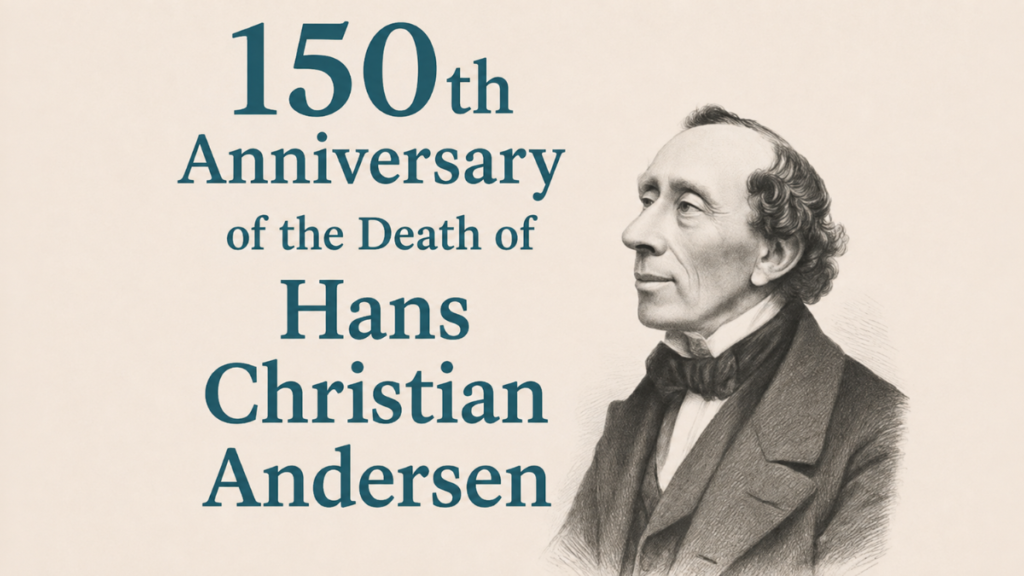
A life, his tales, and an immortal legacy
Marking 150 years since the death of Hans Christian Andersen (1805 to 1875), with a close, detailed look at his life, his historical context, his original tales, and his literary legacy.
A voice fell silent 150 years ago, and it still keeps us company
On August 4, 1875, Hans Christian Andersen died in Copenhagen, one of the most influential storytellers of all time. He may no longer be physically with us, yet his imagination lives on in the generations that keep rediscovering his wit, his tenderness, and his endings, often bitter but always with a luminous moral.
This anniversary is not for mourning, it is for celebrating a life that was itself a fairy tale and left behind a universal legacy.
Childhood and origins: magic from the very start
Hans Christian Andersen was born on April 2, 1805, in Odense, Denmark, the son of a shoemaker and a washerwoman. His childhood was not easy, yet it was there that his fascination with puppets, oral storytelling, and the tales he told his sister with cutouts and drawings first took hold.
Poor and of humble origin as he was, the support of a patron, Jonas Collin, gave Andersen access to an education and a chance to train. That sense of being an outsider, of not fitting into high society, became a recurring theme in his most famous tales, The Ugly Duckling above all.
A literary career: from novels to universal tales
Before he made his name as a teller of tales, he wrote novels and plays. He published his first significant work in 1829, Fodreise, followed by successful novels like The Improvisatore in 1835. That same year, though, he published his first tales for children, most of them entirely original, including Thumbelina, The Little Mermaid, and The Princess and the Pea, opening a new era in children’s literature.
His most emblematic works and their context
The standouts:
- The Little Mermaid (1837): inspired by a real romantic disappointment, with a tragic ending where the heroine turns to sea foam yet wins spiritual salvation.
- The Emperor’s New Clothes (1837): a satire on vanity and collective fear.
- The Ugly Duckling (1843): an autobiographical metaphor about pain and transformation.
- The Snow Queen (1844): the basis for Frozen, with romantic and mystical touches.
- The Steadfast Tin Soldier (1838): a tale of impossible love and courage in the face of an inevitable ending.
Taken together, his tales broke away from traditional folklore, standing out for their emotional and symbolic depth. Most were written in nineteenth century Denmark, in an era moving from absolutism toward modernity.
The historical and literary context
Living through the Danish Golden Age and influenced by German Romanticism, by Hoffmann and Tieck, Andersen worked in a world where the upper class set the terms. With his humble background, he navigated social prejudice by combining fantasy, humor, and drama in his stories. His style let him fold adult content into short tales that still worked for children.
Cultural legacy: the museum, the adaptations, and why he still matters
The Hans Christian Andersen Museum in Odense, designed by Kengo Kuma, offers an immersive experience. Beyond that, the author remains present thanks to:
- The Hans Christian Andersen Award, the international prize for children’s literature.
- Literary and film adaptations of his tales.
- His statue in Central Park, New York, and tributes all over the world.
Theories and myths surrounding his life
One unconfirmed theory holds that he was the illegitimate son of a Danish aristocrat and that his real origins were covered up by high society. There is no evidence for it, though the story feeds a reading of Andersen as an outsider reaching for a kind of literary nobility.
Why is he still relevant today?
- His stories speak universally about love, loss, transformation, and identity.
- They break with the moralizing tone of children’s writing, bringing in ambiguous endings, hope, and sacrifice, with no sugarcoating.
- His tales get adapted into gentler versions, yet many of us read the originals for their depth and symbolism.
A tribute to the great storyteller, 150 years on
Marking this anniversary means recognizing how a fragile, vulnerable, sincere voice redefined the tradition of the fairy tale. Andersen wrote from simplicity and emotion, and his legacy endures, moves people, and changes hearts.
Andersen beyond Denmark: the world’s storyteller
Few authors have crossed language borders the way Hans Christian Andersen has. His tales have been translated into more than 150 languages, and editions in German, French, English, and Italian were already circulating in the nineteenth century. His ability to connect with human experience, from the most intimate to the most universal, made him a global author without ever losing his Danish essence.
Writers like Astrid Lindgren, of Pippi Longstocking fame, and Tove Jansson, creator of the Moomins, cite him as a literary reference point. Even contemporary writers of adult fiction, Salman Rushdie and Margaret Atwood among them, have mentioned his influence on their use of allegory and their rereadings of classic tales.
In Japan his tales are required childhood reading, and he is deeply respected as a symbol of sensitivity and poetic ethics. In Latin America, authors like Gabriel García Márquez and Isabel Allende have acknowledged that the fairy tale was a vehicle for their imagination from an early age.
Was it all acceptance? The criticism Andersen faced
For all his success and his lasting legacy, Andersen was not spared criticism:
- Some contemporaries found him too sentimental, or too tragic, for children.
- Certain modern critics see a melancholy view of the world in his work that can feel harsh or less than uplifting.
- His constant traveling and his need for recognition also stirred envy and mockery in European literary circles, particularly French ones.
Even so, his detractors acknowledged his genius as a storyteller. His style, close to the spoken word, with simple sentences loaded with feeling, broke with the flowery language of the period.
How he saw childhood
Unlike many nineteenth century authors, Andersen did not idealize childhood. To him, children were small beings perfectly capable of understanding sadness, injustice, and beauty. That is why characters die in his tales, suffer for love, or fail to reach their dreams, always with a glimmer of hope or inner growth.
That approach, revolutionary in its day, has been championed by child psychologists, teachers, and modern writers. Rather than sweetening the world, Andersen believed in walking children through it with stories that named the hard things, with sensitivity and respect.
His final years: the solitude of the artist
In his last years, Andersen was received as a national hero in Denmark. He divided his time between summer stays, official receptions, and tributes, while feeling lonelier and lonelier. He never married, and his romantic relationships were frustrated or unrequited. That wound shows up symbolically in many of his tales.
He died at 70 in the home of friends, surrounded by the people who truly loved him. His funeral, on August 11, 1875, drew enormous crowds. Denmark and the world said goodbye to their most beloved storyteller.
Why Hans Christian Andersen is still on my shelf
When I think about Hans Christian Andersen, what comes to mind is not a “children’s” writer but a wise man who used tales as mirrors. Through his stories I have cried, I have thought hard, and I have gone back to childhood without ever stopping being an adult. He is an author who grows with you.
That is why, 150 years after his death, his shadow is still long, warm, and magical.
Thank you, Andersen. For teaching us to see past the obvious, and for reminding us that even the ugliest duckling can become a swan.
You can also watch the video on YouTube
Did this piece move you or inspire you?
Leave a comment with your favorite tale, or with a memory you have of Andersen’s books.
If you enjoyed it, share this tribute with someone who loves literature.
If you like “fairy tales” for grown ups, do not miss the stories of Mathias Malzieu.
See you on the next literary journey!