Reading The Diary of a Young Girl means getting close to a voice that is young, honest, and necessary. In this post I share how I experienced it, what it teaches, why it still matters, and how to approach it with respect, calm, and good sense.
Anne Frank wrote from a hiding place. She wrote with fear, with doubt, with anger, with excitement, with hope for the future, and with that very human need to say the things you sometimes cannot say out loud.
Reading her diary is not only about approaching a historical document. It also means listening to a girl who was growing up, who wanted to be understood, who felt watched by the adults around her, who argued with her family, who needed privacy, and who dreamed of a life that was taken from her.
That is why this book still lands so hard. It tells the story from the inside, from daily life, from the small frictions, from the forced silence, from the exhaustion of living locked in together, from the longing to look out a window and feel that the world is still out there.
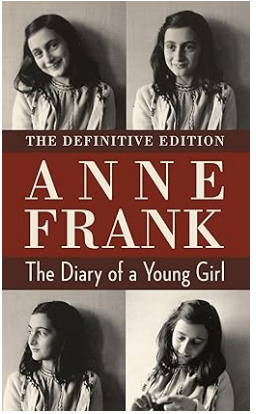
The Diary of a Young Girl collects the thoughts, experiences, and emotions of Anne, a Jewish teenager who stayed hidden with her family during the Nazi occupation of the Netherlands. In entries written between 1942 and 1944, Anne writes about fear, about living crowded together, about the loss of freedom, about her family conflicts, about her hopes, and about her wish to become a writer. It is a personal and historical testimony that helps us understand the Holocaust through a young, intimate, and deeply human voice.
This post contains affiliate links. Using them helps me out at no extra cost to you.
What The Diary of a Young Girl Is and Why It Still Matters
The Diary of a Young Girl is the personal record of Anne Frank, a German Jewish girl who lived in hiding in Amsterdam during the Nazi occupation of the Netherlands.
Anne received her diary for her thirteenth birthday, in June 1942. At first, like any teenager might, she used it to write about her days, her thoughts, her frustrations, her hopes, and the things that are sometimes hard to say to other people.
Her life changed in a terrible way, though. The persecution of Jewish people kept getting harsher, and her family had to go into hiding to try to survive.
Anne, her parents, her sister, and four other people spent more than two years in the back part of a building, in a hidden space we know as the secret annex.
Inside that space, Anne wrote. She wrote about living together in close quarters, about the fear of being discovered, about the arguments, about the food, about the news that reached them from outside, about her relationship with her mother, about the admiration she felt for her father, about her sister Margot, about Peter, about her body, about her own character, and about how badly she wanted to be a writer.
The important thing to remember is that this is not an invented novel. The Diary of a Young Girl is a real diary. Anne did not know what was going to happen. She was not writing toward the ending we already know. She was not building a story to move anybody. She was living through something brutal and found in writing a kind of support.
You don’t have to turn the diary into a heavy lesson to understand its value. It is enough to read it slowly and let that young voice remind us of something very basic: no person should be persecuted for their origin, their religion, or their identity. No girl should have to hide in order to live.

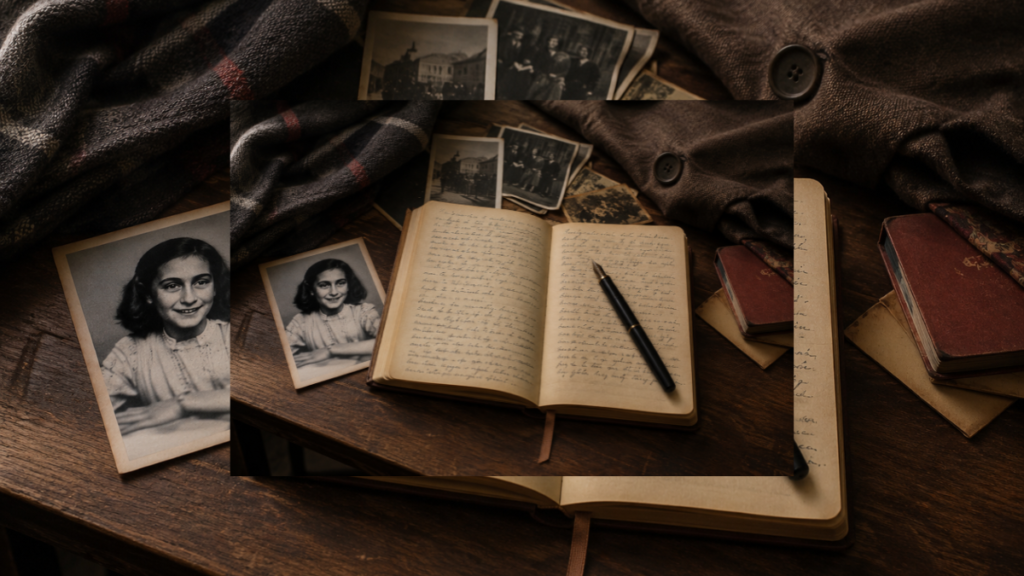
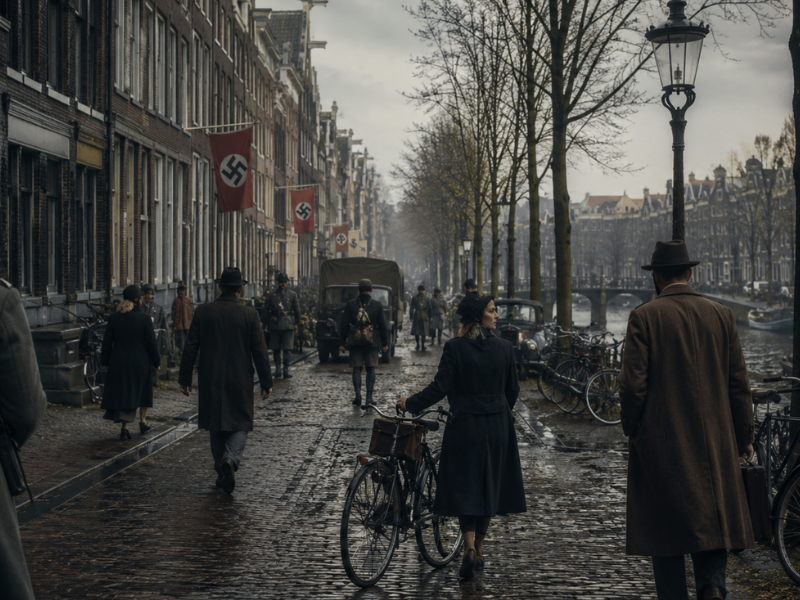
The images in this post were created with AI assistance for illustrative purposes
The Diary
The first time I read The Diary of a Young Girl, I don’t think I understood everything in front of me. I understood that it was a sad story, I understood that it was important, and I understood that it dealt with a terrible time.
Some books need time, though. Sometimes you read them young and they reach you one way, then you come back to them years later and find layers you had missed.
That is what happened to me with Anne Frank. Going back to parts of the diary, I paid less attention to the ending I already knew and more to Anne’s voice as she wrote.
I noticed how she tried to understand herself. How she needed a space of her own, how she wanted to be taken seriously, how writing was a kind of shelter for her.
That part feels very close. Not because we can compare our lives to hers, which would be unfair and absurd, but because there are emotions we do recognize.
Anne wanted privacy. She wanted to feel loved, to know who she was, to grow up without everyone having an opinion about her. She wanted to be allowed to get angry, to be wrong, to change her mind, and still be listened to.
That makes the diary more than a historical read. It is also a book about adolescence, identity, and the need for a voice of your own. Anne is at a complicated age even under normal circumstances.
She is no longer a child, but she is not an adult yet. She needs distance from her parents’ gaze, and she also needs affection. She wants independence, yet she lives shut in with seven other people, with no real room to breathe.
Reading that carefully helps you see her differently. Anne is not just “the girl with the diary,” the way people so often put it. She is a girl with a strong personality, with intelligence, with anger, with a sense of humor, and with plenty of contradictions.
Sometimes she can seem unfair to the people around her. Sometimes she picks apart her own flaws with a maturity that catches you off guard. Other times she simply complains, the way anyone would after being shut in for that long.
I am also struck by the way Anne turns the diary into a friend. She writes to Kitty as if she could tell her everything she cannot say out loud. The idea is simple, but it is very powerful.
Most of us have written something at some point to sort out what we were feeling, even if we never called it a diary. It might have been in a notebook, in a note on our phone, or in a message we never sent. Putting words to what goes on inside helps. Anne knew that very well.
Anne Frank Is Not Only a Victim, She Is a Voice
One of the things I care about most when talking about The Diary of a Young Girl is not reducing Anne to her ending. Her story is part of the Holocaust and cannot be separated from that context.
It would be disrespectful to talk about the diary as if it were only a story of personal triumph, or a pretty read about hope. It is not. Behind it there is persecution, antisemitism, fear, violence, and immense loss.
At the same time, it doesn’t seem fair to talk about Anne only as a victim. Anne was a person with a voice of her own. She had ideas, personality, a sense of humor, a drive to write, and a very particular way of looking at other people.
There are moments when Anne is ironic. Others when she gets angry and doesn’t filter much. There are also entries where she is more vulnerable, with a sadness you can feel even when she doesn’t name it directly.
In others she talks about her hopes, her changes, Peter, and what she wants to do when it is all over. That mix of registers makes her voice feel very much alive.
When we remember Anne only through the tragedy, we lose an important part of her. The tragedy is there, of course. Anne was also a girl who wanted to be a writer, though. A girl who looked at the adults around her and did not understand them. A girl who needed to feel special to somebody.
None of that takes away the pain of her story. If anything, it deepens it, because we understand better everything that was lost. What was lost was not a life in the abstract. It was a specific life, with a specific personality and specific possibilities.
A writer who was just starting to find her voice was lost. A future woman who never got to exist was lost.
That is why the diary is still so valuable. It lets us hear Anne beyond what others have said about her. It lets us meet her own words. Her pages are not only historical evidence, though they are that too. They are a conversation that opens again every time somebody reads her.
The Historical Context of The Diary of a Young Girl
You don’t need to know all of World War II by heart to read The Diary of a Young Girl. You don’t need to remember every date or every battle. It does help to have the basic context clear, though, because without it the reading stays incomplete.
Anne Frank was born in Frankfurt, Germany, in 1929. Her family was Jewish. When Hitler came to power and antisemitism became state policy, the Franks moved to the Netherlands looking for a safer place.
For a while they were able to rebuild their lives in Amsterdam. Anne went to school, made friends, and had a childhood that, though shaped by her family’s upheaval, still held on to a certain normality.
That normality broke when Germany invaded the Netherlands in 1940. From that point on, life for the Jewish population filled up with bans and threats.
Jewish people were pushed out of many areas of public life. Humiliating rules were imposed on them. Their freedom was restricted. They were singled out, registered, and turned into the target of an increasingly organized persecution.
This matters because we sometimes imagine history as if everything happened all at once. It did not. The exclusion was built step by step.
First a difference is treated as suspicious. Then one ban is allowed. Then another one arrives. Later it becomes normal for certain people to have fewer rights. Once a society gets used to looking the other way, the damage keeps moving forward.
The diary shows how that enormous history walks into a house, a family, and a girl’s life. Anne does not explain events the way a textbook would. She lives them. She describes how her world keeps shrinking.
She describes what it means to be unable to move freely, to have to hide, to stay silent for hours, and to depend on other people for food or news.
The Frank family hid in the back section of the building where Otto Frank, Anne’s father, worked. Eight people lived there: Anne, her father Otto, her mother Edith, her sister Margot, Hermann and Auguste van Pels, their son Peter, and Fritz Pfeffer.
Outside the hiding place, several people helped them by bringing food, books, news, and support. That help was dangerous. Anyone who cooperated could face severe consequences if they were caught.
This detail deserves attention too. The diary is not only about the fear of the people in hiding. It also reminds us that some people decided to help. In a time when looking the other way might have been safer, some chose to get involved. They could not always change the ending, but what they did mattered.
Understanding the context does not mean turning the reading into a cold lecture. It means giving Anne the frame she deserves. Her diary was not born in just any circumstances. It was born in the middle of a real persecution. Reading it without remembering that would leave us with only part of the picture.
Everyday Life Inside the Hiding Place
One of the parts of The Diary of a Young Girl that hits me hardest is the daily life inside the hiding place. We often picture the secret annex only as a place of fear, and of course it was.
Fear was always there. Any noise could turn into a threat. Any unexpected visitor to the building could make everyone hold their breath. Any mistake could have terrible consequences.
The hiding place was also somewhere they had to live every single day, though. They had to get up, eat, study, argue, clean, wait, share space, put up with other people’s quirks, and coexist with people they did not always like. That everyday layer makes the diary even more human.
Anne writes about tension over food, about the silence during working hours in the building, about the arguments among the adults, about each person’s temperament, about the small discomforts that in a normal situation might not matter much.
When you are shut in, any detail can grow enormous. A badly chosen sentence weighs more. A look bothers you more. Somebody else’s habit becomes unbearable, because there is no way to get away from it.
That makes you think about something very simple: freedom is also made of small things. Being able to go for a walk, to open a window. Being able to speak without lowering your voice. Being able to be alone, to argue and then leave the room. Being able to be bored somewhere other than home. We usually take these things for granted, yet in the diary they show up as impossible luxuries.
Anne is physically confined, but she tries to keep an inner world running. She studies, reads, writes, observes, and examines herself. Writing becomes her own room. In a place where almost everything is shared, the diary gives her a space nobody can fully invade.
It is also interesting to see how confinement affects relationships. People who might have treated each other politely for a few hours have to live together for years.
There is not enough distance to soften anyone’s flaws. Everyone is scared, tired, and under constant pressure. In that atmosphere, arguments are not simply arguments. They are the expression of accumulated tension.
Anne tells it from her own point of view, of course. She is not always objective. No diary is. That subjectivity is part of the text’s value, though. It lets us know how she experienced that shared life.
Anne’s Relationship With Her Family
Anne’s relationship with her family is one of the richest and most delicate parts of the diary. It does not come across as idealized. Anne is not writing to present a perfect family. She writes from daily friction, from adolescence, from the lack of space, and from a very strong need to feel understood.
With her father, Otto Frank, Anne is usually warmer. She calls him Pim and sees him as someone she can trust. She feels he understands her better than the others do, or at least that he treats her with more patience.
Her father is a kind of emotional anchor for her in a very difficult environment.
With her mother, Edith Frank, the relationship is much tenser. Anne often writes about the distance she feels from her. Sometimes she judges her harshly. She says she does not feel understood or loved the way she needs.
Those parts can be uncomfortable to read, especially because we know the situation they were all living through. They are also very revealing.
Anne was a teenager. She was trying to build her identity. She needed to separate emotionally from her mother, to question her place in the family, and to feel like her own person. That is fairly common at that stage of life, though in her case it happens inside an extreme situation.
She has no room to breathe, she cannot go out, she cannot look for support elsewhere in a normal way, and she cannot have a free social life. Everything any teenager would feel gets concentrated inside a few walls.
There is also her relationship with Margot, her sister. Anne sees her as more proper, calmer, and more accepted by the adults. That comparison weighs on her. She feels less valued, or more criticized.
Margot appears in the diary through Anne’s eyes, and that view is a mix of affection, jealousy, admiration, and distance.
These pages also help us understand that families do not stop having conflicts just because they are going through something terrible. We sometimes think that in an extreme situation everything ordinary disappears. It does not work that way.
People go on feeling jealousy, a need for attention, anger, guilt, tenderness, pride, and exhaustion. Emotional life does not stop because there is fear. Sometimes it even gets more intense.
Anne writes about her family because they are near her all the time. Too near. Her words can be unfair at moments, but they are sincere. That sincerity lets us watch her grow, make mistakes, reconsider, and change her mind at certain points.
Anne and Writing as a Shelter
Anne’s relationship with writing is one of the most moving parts of the diary. At first, her notebook is a birthday present. Something pretty, personal, almost new.
Little by little, though, it becomes much more. It becomes a friend, an outlet, a mirror, and a place where Anne can say what she doesn’t always dare to say outside those pages.
Anne calls her diary Kitty. That gesture gives the text a very intimate tone. She does not write like someone filling pages for the sake of it. She writes like someone talking to a person who listens.
Kitty is the imaginary friend who does not interrupt her, does not correct her, does not judge her, and does not tell her how she ought to feel. For Anne, that is worth an enormous amount.
In the hiding place, almost everything is dictated by circumstances. The schedule, the movements, the noise, the food, the conversations, the visits, the fear.
The diary is one of the few things that truly belongs to her. In its pages she can get angry, dream, analyze the others, talk about her body, her desires, her future, and her sadness. She can be freer there than she is off the page.
It is also important to remember that Anne wanted to write. She was not only a girl venting in a notebook, though she was that too. She had an increasingly clear sense of her wish to become a writer or a journalist.
She wanted to publish one day. She wanted her words to be good for something. In fact, she revised parts of her diary after hearing that testimonies of the occupation might be collected once the war ended.
That detail changes how you read the book. We see an Anne who is not only expressing herself, but starting to think like an author. She observes the others, organizes memories, corrects, describes scenes, analyzes personalities, and looks for a way to tell a story.
Her writing evolves as she grows. There is a voice taking shape right in front of us.
It hurts to think about everything that voice might have gone on to write. It is also striking to see what she left behind. Anne could not live the life she dreamed of, but her words survived. Writing did not save her physically, and that has to be said honestly. It did save her voice from being forgotten.
People say that writing helps you sort out your head, and with Anne you can really see it. She writes to understand what she feels. To talk to herself. To separate anger from fear. To keep from being reduced to her confinement.
That is one of the reasons the diary still reaches so many people. Not all of us have kept a journal, but almost all of us understand the need for a place where we can be honest. A place where you don’t always have to look strong, pleasant, or correct. Anne found that place in writing.
What You Learn From Reading The Diary of a Young Girl
Everyone takes something different from The Diary of a Young Girl. It depends on your age, on where you are in life, on what you know about the history, and on how you come to the book. Even so, there are lessons that come through clearly and that keep this reading so important.
Learning to See History Through One Specific Life
The diary reminds us that history is not made only of big events. We study World War II through maps, dates, names of leaders, treaties, and figures. All of that is necessary for understanding the context, but it can stay distant if we never connect it to real lives.
Anne does exactly that. She brings us close to one specific life. She shows us how a political decision, an unjust law, or a hate-filled speech ends up walking into a girl’s bedroom.
History stops being abstract and turns into a family in hiding, a teenager writing, a worried mother, a father trying to protect his own, and a group of people who depend on outside help to survive.
That perspective changes a lot. It doesn’t let us hide behind the numbers. It forces us to remember that every victim had a story, a personality, a voice, a routine, and a possible future.
Learning That Hatred Doesn’t Come Out of Nowhere
Another essential lesson is that hatred does not appear overnight. It gets prepared, it gets normalized. Prejudice comes first. Then cruel jokes, rumors, propaganda, discriminatory rules, and the idea that some people are worth less than others.
The Diary of a Young Girl shows us the consequences of that process from the inside. Anne does not have to explain the whole political system for us to understand what is happening. We see it in how her world shrinks. We see it in the need to hide, in the constant fear.
That invites us to pay attention. Not to draw easy comparisons with any current situation, but to recognize signs that are never worth ignoring.
When a group is dehumanized, when different rights are justified for different people, when contempt becomes normal, something dangerous is growing.
Learning That Adolescence Has Depth Too
Anne was a teenager, and you can tell on every page. You can tell in her mood swings, in her anger, in her need to be heard, in the way she experiences affection, and in her questions about herself. Being a teenager did not make her way of seeing things shallow, though.
Quite the opposite. Anne has moments of enormous clarity. She examines herself with real intensity. She thinks about who she is and who she wants to be. She asks questions about her character, her relationships, the world, and the future. She has a rich, complex inner life, and one that is sometimes very demanding of herself.
Reading her helps us remember that young people don’t feel less for being young. They feel a great deal and don’t always know how to express it. Anne expressed it by writing. That lets us listen to her without interrupting.

Learning the Value of the Written Word
The diary exists because Anne wrote. That sounds obvious, but it is a powerful idea. If Anne had not put words to her experience, we would know far less about her today. We might know facts about her family, but we would not hear her voice this way.
Writing has that power. It does not always change the facts, but it can keep an experience from disappearing entirely. It can preserve a way of seeing. It can keep a voice alive when there is no physical presence left.
Anne wrote for herself, for Kitty, and in a way for a future she hoped to reach. Her words traveled much further than she could have imagined. That doesn’t erase the tragedy, but it does show us how much it matters to tell, to preserve, and to read testimonies.
Learning Not to Look the Other Way
The diary also speaks, indirectly, about the responsibility of the people standing nearby. The Frank family and the others in hiding depended on those who helped them from outside.
Those people took risks. They brought food, news, books, and support. They kept the secret for a long time.
That makes us think about individual decisions. In hard times, not everyone acts the same way. There are those who persecute, those who obey, those who keep quiet, those who protect themselves, and those who help.
The diary invites us to ask ourselves what it means to act with humanity when doing so is not comfortable.
Why The Diary of a Young Girl Still Connects With Readers Today
It might seem like a diary written in the 1940s sits very far from our lives now. In many ways, thankfully, it does. Emotionally it still connects, though, because Anne talks about very human things.
She talks about feeling misunderstood, about having a place of your own, about arguing with your family, about not fully understanding yourself. She talks about needing a friend, even when that friend is a diary.
Those emotions are still recognizable. Anne’s context is extreme and should not be compared lightly to our lives. Even so, the way she expresses what she feels creates closeness. We don’t feel close to her because our lives resemble hers, but because her voice is so human.
It also connects because we live in a time when everything moves fast. Fast opinions, fast videos, fast messages, fast outrage. The Diary of a Young Girl asks for a different speed. It asks to be read slowly.
The diary also has something we value a lot today and can find hard to come by: sincerity. Anne is not trying to show a perfect version of herself.
She does not write to seem good, kind, or strong at all times. She writes from what she feels, even when it doesn’t put her in the best light. That honesty keeps the text breathing.
It reminds us of the importance of privacy too. Anne did not have a public window where she could measure instant reactions. She had a notebook. She wrote for an imaginary friend and for herself.
That is why it is still read by young people and adults alike. Every age finds something different. A young reader may connect with the need to be heard.
An adult reader may pay more attention to the parents, to the shared living, to the danger, or to everything that was lost. The book shifts a little depending on who is reading it.
What Moves Me Most About Anne Frank
It is not only the fear that runs through her story. The fear is there, of course. It is in the confinement, in the noises, in the news, in the constant possibility of being discovered. What reaches me most, though, is the mix of fear and future.
Anne is afraid, yet she keeps imagining. She wants to study, to write, to be somebody in her own right. She wants to go out into the world and be recognized for what she thinks and what she writes. She wants a life after the hiding place.
That hope hurts because we know it could not come true. It also says a great deal about her. Anne was not just a girl waiting. She was a person with desires, with plans, and with an idea of herself under construction. She had an inner life that confinement never managed to put out.
Her clear-sightedness moves me too. Anne analyzes herself a lot. Sometimes she looks at herself harshly, asks why she acts a certain way, why she feels split between what she shows and what she keeps hidden, why other people don’t see her the way she believes she is.
There is something very adult in that way of observing herself, even though she is still a teenager.
Another thing that stays with me is her longing for nature and freedom. In the diary, the outside world appears almost out of reach. The sky, the trees, the air, the street. Simple things that those of us on the outside treat as ordinary.
For Anne, looking at nature from the hiding place carries enormous weight. That contrast between the open world and the closed space of the annex is painful.
Thinking about the writer who was being born also moves me. Anne had talent, an eye for observation, and a real drive to tell stories. We don’t know what she would have written later, but the diary shows a clear promise. That interrupted possibility weighs heavily.
A Book for Young Readers and Adults
The Diary of a Young Girl is usually read in adolescence, especially in school. That makes sense, because Anne was a teenager too and many young readers can connect with the way she feels. Treating it as a book only for young people would sell it short, though.
It is a book for young readers and adults, even if each age reads it differently. A young reader may focus more on the family relationships, on the need for privacy, on first romantic feelings, on the sense of not being understood, or on the wish for a voice of one’s own.
An adult reader may focus more on the historical context, on the parents’ responsibility, on the constant fear, on the close quarters, or on how fragile everything we take for granted really is.
Rereading it also changes the experience a lot. What looked like one more complaint when you were a teenager can read, as an adult, like a desperate attempt to hold on to a space of one’s own.
What once seemed like only a sad story can later look like a testimony about identity, writing, and memory.
I find it an especially valuable read because it doesn’t treat young people as if they were incapable of thinking about deep subjects. Anne thought, observed, and wrote with intensity. Her emotions were not less important for coming from someone who was thirteen, fourteen, or fifteen. That is worth remembering.
For adults, the diary can also be a wake-up call. We sometimes listen to teenagers very little. They get corrected a lot, advised a lot, interpreted a lot. Anne reminds us that a young person can have an enormous inner world and a very serious need to be taken into account.
The Value of Memory
Talking about The Diary of a Young Girl means talking about memory. Not decorative memory, but the kind that demands attention. Remembering is not just repeating that something happened. It means asking ourselves what we do with what we know.
The diary helps us keep one specific voice alive. Anne Frank is not only a name attached to the Holocaust. She is a girl who wrote. A girl who left behind pages full of life, fear, doubt, humor, and hope for the future. Reading her is a way of refusing to let her voice vanish into statistics.
Memory also forces us to look antisemitism and persecution straight in the face. It is not enough to say it was a terrible time. We have to understand how it was possible. How the hatred was built, how unjust laws were passed, how many people kept quiet, how others cooperated.
There is a responsibility in how we tell these stories too. Somebody else’s pain should not be turned into a quick read or into empty content. Anne Frank deserves to be read with respect. The victims of the Holocaust deserve memory, not simplification.
The diary reached us through a chain of events and decisions. Anne wrote. Her papers were saved. Otto Frank, her father, survived and decided to publish the diary.
Since then, millions of people have read her words. That chain makes us responsible too. Every reader decides whether to skim or to really listen.
Memory does not change the past. I wish it could. It can change how we look at the present, though. It can help us recognize hate speech and remind us that indifference has consequences too.
The Diary of a Young Girl and the Importance of Listening to Young People
One of the reflections The Diary of a Young Girl leaves behind is how much it matters to listen to young people. Anne wanted to be taken seriously. She did not want her thoughts treated as unimportant kid stuff.
She needed somebody to understand that there was far more inside her than the adults seemed to see.
In the diary, Anne does not always communicate in a comfortable way. Sometimes she protests, judges, and closes herself inside her own point of view. Underneath all of that, though, there is a clear need to be heard.
She wants somebody to read her properly, so to speak. She wants people not to stop at the surface.
Reading her diary can help us look at today’s teenagers differently. Not to compare them with Anne, but to remember that young emotions are serious too.
It can also help young readers feel less alone. Anne does not talk down to them. She talks from a similar age, with doubts, anger, excitement, and hope for the future. That closeness is worth a lot.
Frequently Asked Questions About The Diary of a Young Girl
Is The Diary of a Young Girl a novel?
No, The Diary of a Young Girl is not a novel. It is a real diary written by Anne Frank during the time she spent in hiding with her family and several other people in Amsterdam, under the Nazi occupation of the Netherlands. It reads with great immediacy and has very narrative moments, but it is not an invented story. It is a personal testimony.
Who was Anne Frank?
Anne Frank was a Jewish girl born in Frankfurt, Germany, in 1929. Her family moved to Amsterdam to escape Nazi antisemitism. During the German occupation of the Netherlands, Anne had to hide with her family in a secret annex. There she wrote the diary that would later become one of the best known testimonies of the Holocaust.
What age is right for reading The Diary of a Young Girl?
It depends on each reader’s maturity and on whether an adult is reading along with them. It is usually recommended from early adolescence on, especially in middle and high school. Even so, it helps to explain the historical context well and to leave room for questions. It is not a light read, but it can be very valuable when it is handled with care.
Why is The Diary of a Young Girl so important?
It matters because it brings us close to the Holocaust through a personal, young, and honest voice. Anne lets us see how a historical persecution affected one specific life. It also has literary and human value, because it shows the growth of a girl who thought, wrote, dreamed, and wanted a future.
What does The Diary of a Young Girl teach?
It teaches the value of memory, the danger of hatred, the importance of freedom, and the power of writing. It also teaches that adolescence can hold real depth and that behind every historical statistic there were real people with inner lives, desires, conflicts, and dreams.
For me, The Diary of a Young Girl is a book that deserves to be read slowly. It is not a book to read just because it shows up on so many lists, or to mention without having truly listened to it.
It is a diary that asks for attention. It asks us to let Anne speak without constantly turning her into a symbol, a famous quote, or a tidy lesson.
What I value most is her voice. Anne writes with a mix of honesty, intelligence, anger, tenderness, and hope for the future. Sometimes she is bright, sometimes harsh, sometimes impatient, sometimes vulnerable. That range makes her real. We don’t need a perfect Anne. We need to read the Anne who wrote those pages.
Reading The Diary of a Young Girl is not comfortable, but not every book has to be. Some books are there to make us think. To remind us of things we should not forget.
I don’t close this book thinking only about sadness, though the sadness is there. I close it thinking about Anne as a girl who wanted to live, write, grow, and be heard. I close it feeling that I have been in the presence of a voice that keeps speaking, because somebody decided to preserve her words and because we keep reading them.
Reading Anne Frank Today
Reading The Diary of a Young Girl today still makes sense, because memory needs readers. It is not enough for the book to sit on a shelf, or for the title to ring a bell, or for us to vaguely know who Anne was. You have to open it, read it calmly, and let her voice reach you.
Anne wrote under circumstances that should never have existed. She wrote in hiding, persecuted for being Jewish, cut off from a normal life and surrounded by fear. She also wrote from her intelligence, her humor, her appetite for life, her need for affection, and her wish to become a writer.
That mix is what keeps the diary so necessary. It is not only a testimony of horror. It is also the testimony of an inner life that held out as long as it could. Anne could not choose many things, but she did leave words behind.
Reading her helps us remember better. It helps us look at history through one specific person, and it helps us listen to young people more closely.
If you have read The Diary of a Young Girl, I would love to know how you experienced it. Maybe you read it in school, maybe you discovered it as an adult, or maybe you are thinking about reading it now.
If you haven’t read it yet, or you feel like revisiting it, here is the link online or at La Casa del Libro.
Which part stayed with you the most? What image did you have of Anne before reading her? Did it make you think differently about memory, freedom, or adolescence?
I’ll read you in the comments, because this is one of those books that make more sense when they are shared.