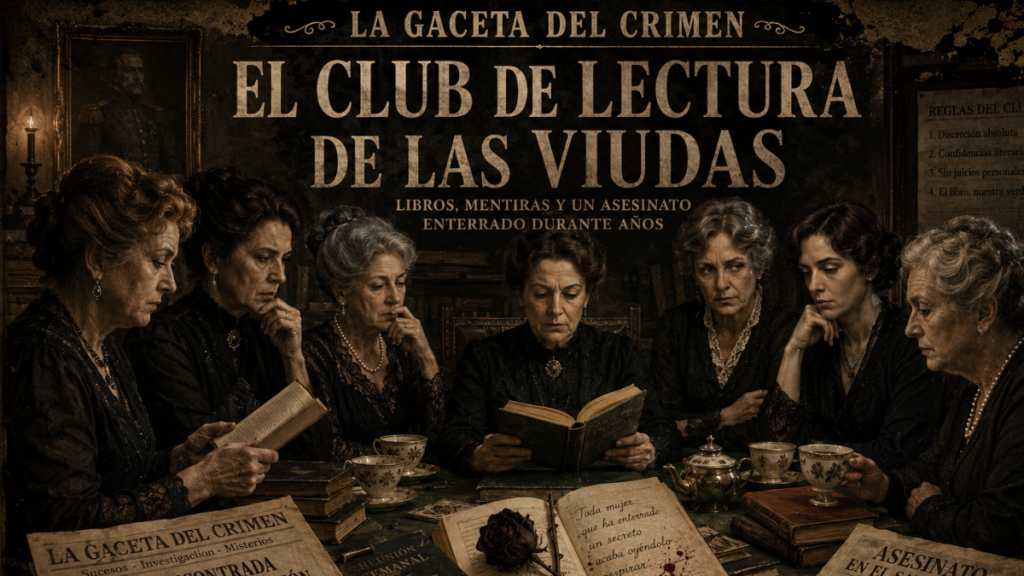
Discover the unsettling mystery of the Widows’ Book Club, a story of secrets, marked books, hidden confessions, and a murder that stayed buried for years, in The Crime Gazette.
The Crime Gazette
Weekly Edition | Mysteries and Unexplained Events
The Widows’ Book Club
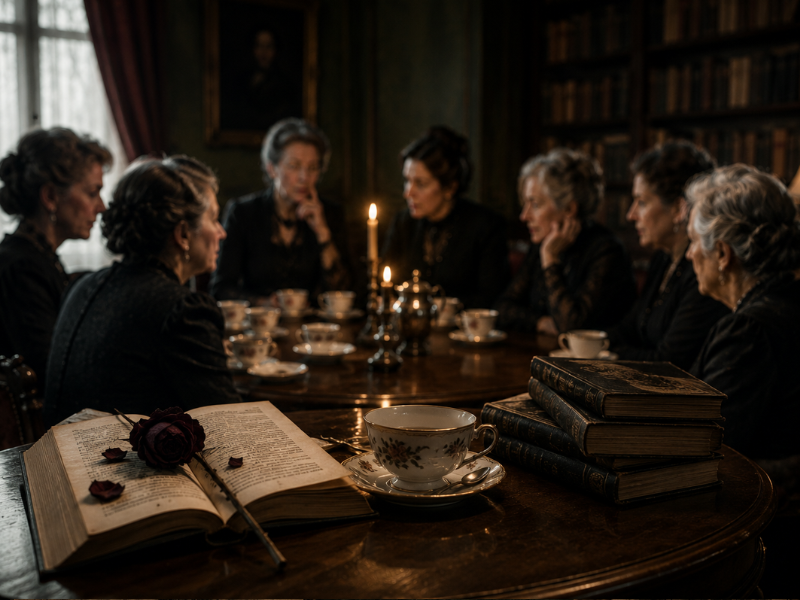
In the city of Santa Aurelia there are societies that advertise themselves on posters, others that require a recommendation, and a few that go on existing for years without anyone noticing them until some misfortune finally gives them a name. The Widows’ Book Club belonged to that last group. It met every Thursday at six in the evening in the green parlor of the Old Casino, beside a fireplace that had not been lit in decades, under a portrait of an admiral who seemed to disapprove of leisure in any form.
There were seven women. All widows. All respectable. All of them with the kind of life story that small towns tell in a low voice, not out of scandal, but out of habit. They read English novels, French memoirs, serialized potboilers, and once in a while some moral treatise that none of them ever quite finished. They drank their tea unsweetened, copied sentences into small notebooks, and argued about endings with a severity that would have made more than one dead novelist tremble.
Nothing about those meetings looked criminal. Then the first marked book showed up. Then the second. Then the third. Every copy chosen for the weekly session held, somewhere in its pages, a clue connected to the death of one of the members’ husbands. Not a direct accusation. Not a confession. A clue. A detail. An underlined word. An initial in the margin. A date. A name that had no business being there.
The whole thing would have stayed a literary oddity if, after the fifth meeting, one of the widows had not turned up dead in her house, sitting in the armchair where she usually read. The book lay open on her knees, one sentence marked in blue pencil: “Every woman who has buried a secret ends up hearing it breathe.”
The Seven Ladies of the Green Parlor
The club was presided over by Doña Berta Almadén, widow of a notary, a tall, dry woman with a voice so measured that even her silences sounded like they had been drafted in front of witnesses. She had founded the circle after her husband’s death, so she said, so that reading might offer company where marriage had left only routine.
To her right sat Doña Celia Pardo, widow of a pharmacist, small, nervous, always in gloves even in warm weather. She read fast and remembered tiny details, as if books were rooms where somebody had moved a vase an inch to the left.
Doña Ramona Vilches, widow of a military man, wore hats far too solemn for such domestic afternoons. She claimed to hate sentimental novels, though she always picked passages about thwarted love to read out loud.
Doña Inés Robledo, widow of a local banker, was the richest and the most distracted. She seemed not to be listening, yet at the end of every discussion she would deliver one sentence that rearranged the whole room.
Doña Amalia Cifuentes, widow of a doctor, carried a cane with a silver handle and had a laugh that never quite reached her eyes. She used to say that death did not frighten her, only its paperwork annoyed her.
Doña Teresa Montalvo, widow of a merchant, was the youngest. Barely forty-six. Her husband died falling down the warehouse stairs. In Santa Aurelia people said it was an accident. In Santa Aurelia people say a lot of things so they don’t have to look at other ones.
The last was Doña Elisa Baroja, widow of a judge. She was the one found dead in the armchair. She was also, according to the first suspicions, the one who had started leaving clues in the books.
The First Marked Book
The first oddity turned up in a worn edition of The Woman in White. Doña Celia opened the copy to read her assigned chapter and found a word underlined three times: “arsenic.” None of that would have meant anything if the late Mr. Pardo, pharmacist and Celia’s husband, had not died years earlier from what was called food poisoning.
The room went still. Celia shut the book a little too fast. Berta asked whether something was wrong. Celia said no. The others had seen it, though. One word doesn’t kill anyone, but it can raise the dead with admirable efficiency.
The following week, in a volume of ghost stories, a date appeared in the margin: November 17. That was the day Ramona Vilches’s husband fell from his horse during a hunt. The horse, according to the stable hands, never reared. That day it did.
At the third session, inside a novel about inheritances, someone had slipped in a dried flower. An oleander. Inés Robledo’s husband had died of heart failure while summering in a house ringed with oleanders. Inés looked at it and said only, “How tasteless.” She put the flower in her purse anyway.
The club began to change. Nobody came just to read anymore. They came to watch which book they were handed, which page had been folded over, which word was breathing harder than the rest. Literature, once a refuge, had turned into a courtroom.
A Death With Too Much Composure
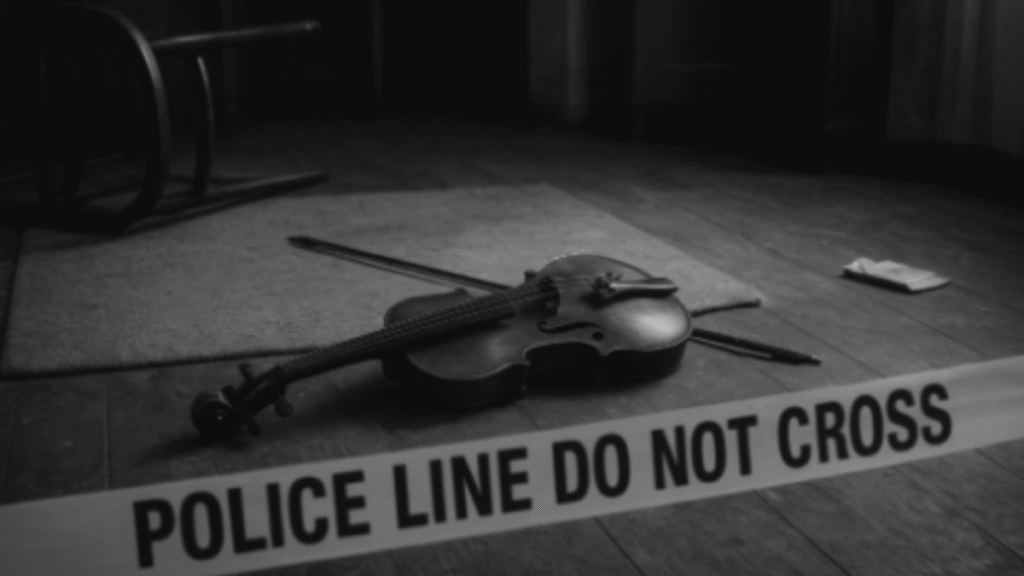
Elisa Baroja died on a Thursday night, barely three hours after the meeting. Her maid found her in the parlor of her house, seated beside the lamp, feet together, hands resting on an open book. There were no signs of violence. No broken glasses. No furniture out of place.
The doctor spoke at first of heart failure. Elisa was old enough to die without explaining herself. The open book on her knees changed the nature of the scene, though. It was a copy of Rebecca, borrowed from the club. On the marked page, one sentence was underlined in blue pencil. In the margin, an initial: B.
Inspector Salgado, who took the case, was not a man of literary enthusiasms. He looked at the book, looked at the room, looked at the maid, and said, “Somebody here wanted us to read.” That line, which this Gazette obtained from an officer who was present, deserves to appear in print. From that moment on, the case stopped being a private death and became a text.
On the side table sat an untouched cup of linden tea. In the fireplace, fresh ashes. In the wastebasket, several half-burned papers. One still held a legible line: “If I don’t say it, the books will.”
The Investigation Enters the Club
Inspector Salgado questioned the six remaining widows in the green parlor of the Old Casino. It was a smart decision. Some places force people back into their roles. Sitting in their usual chairs, the ladies looked less like suspects and more like characters. Characters, when they know they are being watched, tend to overact.
Berta Almadén stated that Elisa had been worried for weeks. “She was reading badly,” she said. “Elisa never read badly.” Celia added that the dead woman had started taking notes on everything. Ramona called that a vulgar habit. Inés asked whether they might serve tea, which the inspector correctly judged to be an elegant way of buying time.
Amalia Cifuentes was the first to name the possibility everyone else was chewing on. “Elisa believed our husbands hadn’t died the way people said.” Nobody contradicted her. Teresa Montalvo looked at the floor. Berta pressed her lips together. Celia dropped a glove.
The inspector asked to see the books from the last few sessions. Six copies appeared, all of them marked. Underlined words, folded corners, dried flowers, tiny notes. Nothing conclusive on its own. Together, though, they made a very ugly melody.
The Dead Husbands
Mr. Pardo, the pharmacist, died of indigestion after a cold supper. His wife Celia inherited the drugstore and sold it the following month. She always said she couldn’t stand the smell of medicine.
Colonel Vilches fell from his horse during a hunt. His widow Ramona kept the saddle for years, though she had the animal put down the day after the accident.
Robledo the banker died of a heart attack during a scorching summer. Inés, his widow, closed up the country house and never set foot in it again.
Doctor Cifuentes died of an infection after cutting himself on surgical instruments. Amalia, his wife, burned part of his medical library, she said, so she wouldn’t have to live among reminders.
Montalvo the merchant fell down the stairs of his warehouse. Teresa, the young widow, sold the business and moved to a smaller house, though a much brighter one.
Judge Baroja, Elisa’s husband, died years before she did, of a stroke. His death was clean, public, and free of rumor. Maybe that is why Elisa felt entitled to investigate everyone else’s.
Almadén the notary, Berta’s husband, died during a trip to Madrid. Officially, of pneumonia. Unofficially, nobody quite knew where he had spent his last night.
Elisa’s Notebook
The key turned up in an ordinary place: behind a cushion. Elisa’s maid found a small notebook with green covers while tidying the parlor after the inspection. On the first page was a list of names. Not the widows’ names, but their husbands’. Next to each one, a single word: poison, horse, oleander, scalpel, stairs, journey.
Elisa had been investigating for months. Newspaper clippings, dates, statements from old servants, drugstore receipts, anonymous letters. She accused no one outright, but she was chasing a terrible hypothesis: every widow in the club had had something to do with the death of her husband. Not all in the same way. Not all with the same intent. All of them, though, had apparently survived marriages the city considered respectable and the notebook described as cages.
On the last pages, Elisa had written a line that unsettled even the inspector: “We didn’t found a book club. We founded a sentimental alibi.”
Further down she added: “If one of us killed, maybe we all protected her without knowing it, because deep down we all wanted death to be passed around the table like a tray of pastries.”
The Secret Meeting
The day before she died, Elisa summoned Berta in secret. So said a coachman who drove her to the dead woman’s house at eight in the evening. Berta denied the visit. Then, faced with the evidence, she corrected herself. She said she went to talk about books. Nobody talks about books in secret unless they are afraid literature is about to start pointing fingers.
According to Berta, Elisa was agitated. She wanted to dissolve the club and hand her notebook over to the police. Berta begged her to be careful. “You can’t dig up old deaths without destroying present lives,” she told her. Elisa answered, “Present lives are built on graves that were never properly closed.”
Berta insisted she left before nine. The maid confirmed hearing the door. She also stated that later, around ten, she heard voices in the parlor. One of them was Elisa’s. The other, she said, “could have been any of the ladies, because when they get angry they all sound equally polite.”
The Twist in the Books
For days everyone believed Elisa had marked the books to expose the others. Then one discovery changed how the case read. In the green parlor, inside the cabinet where the club’s copies were kept, someone found a box of blue pencils identical to the one used in Rebecca. The box did not belong to Elisa. It belonged to the club.
The inspector compared the marks. Some were Elisa’s, yes. Others were not. There were different pressures, different slants, different ways of folding down a corner. That meant several widows had taken part in the game of clues. Or that somebody had wanted it to look that way.
The question was no longer who was marking the books. The question became who decided that Elisa would die with one on her knees.
A look at the lending records turned up one more detail: that copy of Rebecca should not have been in Elisa’s house at all. It was checked out to Berta. Elisa took a different book home that Thursday. Somebody swapped the copies after the meeting.
Berta Almadén, President and Keeper
Berta became the natural suspect. The initial B beside the marked sentence seemed a little too clear. Maybe that is exactly what made it suspicious. Experienced killers rarely sign with the first letter of their own name, unless they want to look like characters in a cheap serial.
Questioned again, Berta kept her composure until the inspector mentioned the trip to Madrid where her husband died. Something shifted in her face then. Not fear. Exhaustion. Berta admitted that her husband had not died in Madrid, but in a disreputable inn on the way home. She paid to move the body and change the recorded place of death. She did not kill him. She hid him to preserve a dignity he had destroyed many times over while he was alive.
“My crime,” she said, “was tidying up the scene.”
That explained her fear of the notebook, but not Elisa’s death. Berta had a motive to silence her. She also had more than enough intelligence not to leave a B beside the body.
Teresa’s Confession
The youngest widow was the one who held out the least. Teresa Montalvo asked to give her statement alone. She said her husband did not fall down the stairs. Or rather, he fell because she had taken the lamp off the landing. He went down to the warehouse drunk every night and came back up angrier every night. Teresa did not push him. She never touched him. She let the darkness do what she didn’t dare to do herself.
“When I heard him fall, I didn’t go down,” she said. “I waited. I prayed. Then I went down.”
The inspector asked whether Elisa knew. Teresa said yes. Elisa had visited her days earlier. Not with a threat, but with compassion. “She told me she understood some deaths, but that understanding wasn’t the same as absolving.”
Teresa cried without making a sound. Her confession shook the investigation, though it still did not solve Elisa’s death. Teresa had nowhere near the coldness required to stage the scene with the book. Or maybe that was simply what everyone wanted to believe.
The Widow Who Had Not Killed
The real turn came from Inés Robledo. All through the case she had seemed distant, almost bored. She was the one, though, who handed the inspector a letter from Elisa. It had arrived the morning after the death, as if the dead woman had seen her own ending coming.
The letter read: “Dear Inés, if anything happens to me, don’t look for the woman who killed her husband. Look for the one who couldn’t.”
The line opened a new crack. Until then everyone had assumed Elisa was investigating deaths. In fact she was investigating an exception. One of the widows had not caused her husband’s death. Her husband had been murdered by someone else.
Inés’s husband, Robledo the banker, did not die of a natural heart attack. The oleander found in the book was not pointing at Inés as the guilty party. It was pointing at the country house, where some of the banker’s financial associates used to gather. Almadén the notary was among them. So was Judge Baroja, Elisa’s husband.
Elisa had discovered that her own husband, Judge Baroja, covered up a banking fraud that Robledo had threatened to expose, which would have taken down several men of standing. Robledo died shortly afterward. The supposed heart condition was convenient. Far too convenient.
The Real Crime
The real crime was not Elisa’s death, even though that death is what opened the case. The real crime was the death of Robledo the banker, years earlier. Elisa had learned too late that her husband the judge not only covered up that death, but kept documents proving the poison was administered during a dinner at the country house.
Who did it? Not Inés. Inés loved her husband very little, but she did not kill him. The culprit was Amalia Cifuentes, the doctor’s widow. Her husband supplied the compound, and years later he died after cutting himself on contaminated instruments. An accident? Perhaps not. Amalia had learned a great deal from her husband.
Robledo was about to ruin several families. The doctor prepared a small dose. Amalia, who was at the dinner, poured it. Her husband, frightened, wanted to confess years later. He died before he could. Amalia always called it a surgical infection. Elisa’s notebook suggested another possibility: Amalia contaminated the instruments to keep him from talking.
Elisa uncovered the whole chain. Robledo. Cifuentes. Baroja. Without knowing it, the book club was a room where every surviving member of that web of silences sat down together every Thursday.
Amalia killed Elisa because Elisa was no longer investigating only the widows. She was investigating the dead men they had protected. After all those years, Amalia could not stand the idea that a shared reading would be the thing that put her in the dock.
The Club’s Last Meeting
The police arrested Amalia on a rainy afternoon, shortly before the weekly meeting. She asked to finish the chapter she was reading. The inspector refused. “You’ve had years to read,” he said.
On her way out, Amalia looked at the other widows and said something that should not be prettied up: “Every one of you wanted somebody to do it.” Nobody answered. That sentence held one part that was false and one part that was unbearably true.
The club never met the same way again. Berta tried to keep it going for two more weeks, but nobody could open a book without hunting for accusations in the margins. Celia moved in with a niece. Ramona gave away her novels. Inés reopened the country house, had the oleanders pulled out, and planted rosemary. Teresa took a job in a bookstore. Berta kept the cabinet in the green parlor locked.
The last entry in the club’s register, written in an unknown hand, read: “Book chosen for the next session: none. Topic of discussion: what we did with our lives after we survived.”
A Note From This Newsroom
The Widows’ Book Club leaves us with an uncomfortable lesson. Reading does not always console. Sometimes it sharpens. Sometimes a novel doesn’t distract you from guilt, it holds a lamp over it. Those women were not monsters out of a cheap serial. They were widows, readers, neighbors, survivors of marriages and arrangements the city preferred to call respectable. Some were guilty. Some were accomplices. Some simply kept quiet when speaking up would have cost too much.
Crime, like a good book, rarely ends on the last page. It goes on living in whoever reads it, in whoever hides it, in whoever underlines a word believing nobody will know how to read it. In Santa Aurelia, ever since, book clubs check the margins before they begin. Not out of fear of literature. Out of respect.
Do you think the widows were guilty, or victims of the secrets they inherited? Leave your theory in the comments. At The Crime Gazette, every reader is an investigator too.
Don’t miss anything new in our Gazette!