Discover the unsettling story of the painting that changed expression, in The Crime Gazette. A dark chronicle that grips you from the first word.
Weekly Edition, Mysteries and Unexplained Events
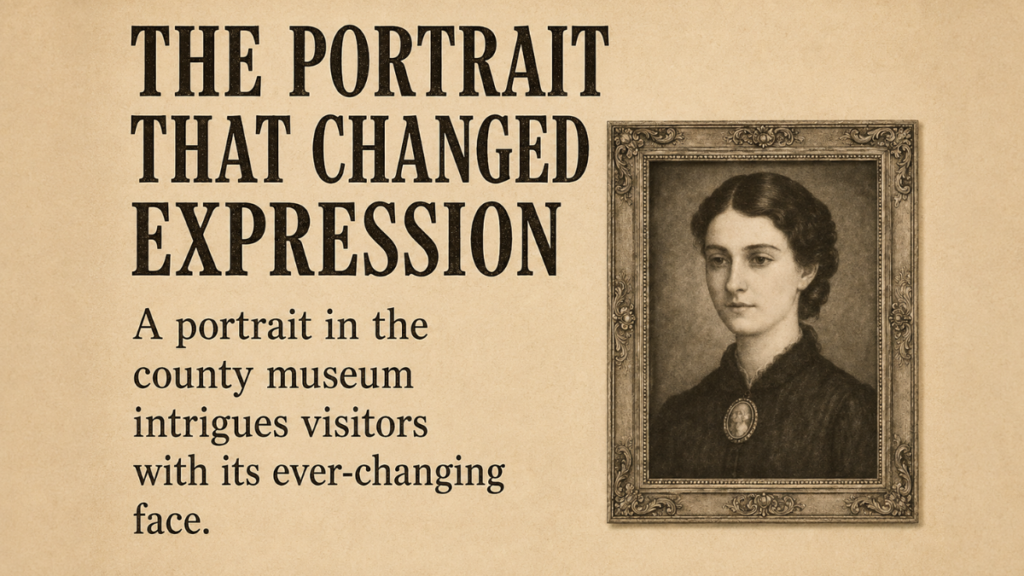
The painting that changed expression
There are objects that ought not to move when nobody is looking and that nonetheless rearrange themselves inside a town’s conscience until it turns into a vigil. This chronicle concerns one of those objects: an oil portrait, dated to roughly the end of the nineteenth century, that many people swear transforms night after night. The sitter, a lady with pale lips and a sidelong gaze, smiles, weeps, frowns, or fixes you with a warning stare depending, they say, on whoever stops in front of her frame. It is tempting to write it off as superstition. The list of accounts, though, is long, meticulous, and at times unbearably consistent.
The painting hangs in the main hall of the old Customs House, now the County Museum. It is not the most valuable piece in the collection, yet it has earned center stage through sheer murmuring. The gallery attendants, accustomed to discreet yawns, have learned to watch that painted face as though it might suddenly push through the aged varnish and deliver a verdict. The first documented report dates from a rainy afternoon: a retired schoolteacher swore the lady in the portrait began to weep. Hours later, a small fire broke out in the teacher’s kitchen. Whatever the correlation may be worth, the superstition was born.
Since then, the piece has picked up nicknames that appear in no catalog: the Lady, the Watcher, the Restless One. In keeping with this Gazette’s sobriety, we will call it by its record: Portrait of a Lady with Cameo, artist unknown, oil on canvas, 92 by 64 centimeters, roughly 36 by 25 inches, circa 1898. It is worth remembering how ordinary people name things, though. Only a town knows, with the aim of pure instinct, exactly where a secret hurts.
The first expressions: from rumor to record
It was the museum guide, Doña Matilde Ordóñez, who gathered the first dozen accounts. “I assumed visitors were talking themselves into it,” she admits. “Then I started to notice a pattern. The lady would frown when couples came in mid argument. She would smile faintly when a child walked in holding a grandmother’s hand. And one night she looked with unbelievable hardness at a man who got too close to a display case. I called the guard. The man turned out to have a small chisel in his pocket.”
Another account, from a conservator who prefers to remain anonymous, describes how the shine in the eyes varies under stable lamplight with no convincing technical explanation. “It is not that the pigment changes,” he clarifies, “it is the direction of the gaze. A slight shift, as though she were taking note of you.” Lighting tests were run: lamps at 45 degrees, filters, diffusers, photometry. The results always left a residue that could not be explained, a margin of unease that the technical side quietly stepped around.
The rumor jumped from case to case, from hallway to hallway, until it spilled out into the city. Shopkeepers closed earlier once night fell, teenagers, who are of course invincible, organized clandestine visits, and the museum, pushed along by the fever, opened Friday night viewings. Nobody came out indifferent. Some laughed it off. Others, like people leaving a stranger’s wake, crossed themselves on the way out the door.
The attendant in Room 2
Don Fermín, a gallery attendant, is the accidental chronicler of this case. He keeps duty notebooks in clear handwriting, with times, light conditions, and diagrams of visitor footprints on the waxed floor. “There is no science in what I say, only the habit of looking at the same thing for many hours,” he smiles. His observations are precise: when the sky clouds over and the barometric pressure drops, the lady presses her lips together. When the school bell rings in the distance, her jaw seems to loosen, as though she were listening to recess. And on windy nights her shadow, yes, her shadow, stretches toward the window, against all logic of an interior light source.
Fermín claims to have seen an expression that appears in no nineteenth century painting: a rapid blink, no longer than a third of a second, when he heard the surname “Navarro” spoken by a visitor on the phone. “I thought nothing of it. Until two days later, when I learned they had arrested a Navarro for stealing cars two streets from the museum.” Readers may make of the coincidence what they will. This Gazette hands down no sentence, it merely gathers clues like breadcrumbs in a wood with too many paths.
Provenance: how the painting got here
Portrait of a Lady with Cameo entered the museum in 1973, donated by the Larráinz family after the sale of an ancestral house. The inventory of the time, onion skin paper and purple stamps, offers little more than measurements and a cursory description of the gilded frame with its foliage motif. One name slips through the paperwork, though: “B.”, followed by an illegible abbreviation, possibly the painter’s surname. One expert consulted believes he sees the late Madrid school, another sees links to workshops in the south. The lady’s cameo shows a tiny Roman profile carved in carnelian, which could hold clues about the family portrayed.
One hypothesis marks a turn in the investigation: the painting may have been a commemorative commission after a tragic event. Two date marks with different days have been found on the reverse, September and November of the same year. Two sittings? A repainting? Under raking light, a conservator detected a faint pentimento at the left corner of the mouth: the smile used to be broader. Who asked for the joy to be dimmed? Who decided the lady should keep a secret under a coat of varnish?
A night of testing
Rather than feed the myth without method, the museum authorized a controlled session with three high resolution cameras, a colorimeter, and measurements of humidity, temperature, and pressure. Present were two technicians, the guide Matilde, the attendant Fermín, and this correspondent. Twelve exposures were taken at five minute intervals. During the middle hour, the gaze appeared to shift a few degrees to the left when viewed directly, while the photographs showed minimal variation in the reflectance of the varnish. The conclusions were cautious: the human eye deceives itself. One of the technicians, reviewing the material, called for silence all the same: in the sixth exposure, the shine in the right tear duct looked brighter than in the fifth and dimmer than in the seventh. Condensation? An artifact? Or does the painting breathe?
The test ended without any proclamations, though with an unofficial warning: “Whatever it is, it affects the people who look at it. Maybe the painting does not change, maybe the viewer does,” said the youngest technician, before putting his camera away with a look of relief that had no place in the protocol.
A timeline of attributed expressions
Monday, 7:10 p.m. A married couple argues quietly. The lady frowns, according to three unconnected witnesses. The guide confirms the ambient light had not changed.
Wednesday, 12:35 p.m. A school visit. Two children insist “the lady smiled” while they were singing. The photograph from that moment reveals no change, though a semicircular reflection in the varnish suggests a point of light that was not there in the previous shot.
Friday, 9:02 p.m. During the night viewing, a young man gets too close. Fermín warns him off. The visitor says “she gave me a dirty look.” A minute later a siren is heard in the distance. It was an ambulance.
Sunday, 5:41 p.m. A woman in mourning leaves a flower beneath the painting without a word. Nobody hears a thing, yet two people report a “tremor” along the painted line of the neck, as though she had taken a deep breath.
Competing theories
The optical hypothesis holds that microvariations in the varnish layer, combined with the viewer’s angle, can create the illusion of movement. The psychological one points to emotional pareidolia: we read faces where there are only brushstrokes. The metaphysical one speaks of paintings “charged” by events of grief. The folkloric one recalls that in the Larráinz house, a young woman who had been painted died of fever before her wedding. And the most prosaic, though no less unsettling, argues that the painting works as a social mirror: it gives back what we carry inside, as any good portrait does, only with an emphasis that stings.
One detail feeds all four: the cameo. Some visitors insist that the small Roman profile changes mood as well, as though the lady’s echo spilled into that miniature. Absurd, according to the experts. Disturbing, according to those who swear they have seen it. This Gazette takes no side, though it does note one thing: attention to the cameo grew after news of the fire at the schoolteacher’s house. More eyes since then, more expressions, more stories.
The effect on the city: devotion and suspicion
The gift shop sold out of postcards of the Lady in two weeks. Tiny replicas of the cameo, carved in resin, are also on sale, and some people wear them around the neck as a charm. The conservators object: “This is not a relic.” The poets, on the other hand, have found a muse. Evening readings are held in the square with verses that try to soothe the lady: “If I look at you, do not judge me; if you look at me, I will not judge myself.”
There are people who say they feel better after quietly telling the portrait their sorrows, as though the painting could absolve them. Others avoid Room 2 altogether, especially anyone dragging a secret that the Lady, they say, detects in the stiffness of a jaw or the shuffle of a pair of feet. This is not the first time a museum has been a confessional, nor the first time it has been a silent tribunal.
A discovery on the back of the canvas
During a routine inspection, technicians spotted two barely visible pencil lines on the stretcher that looked like letters and numbers: “A. C., 11/XI”. A signature? A retouching date? The find was photographed and the decision was made not to lift any layers without a formal conservation project. The guide Matilde, with that mixture of common sense and respect for the sacredness of a craft, asked for time: “Let’s not tear the skin off the Lady because the press is in a hurry. Let her breathe.”
That caution has been a balm in this case. The city, which lives at speed, is grateful for the pace of drying lacquer. Meanwhile the painting stays where it hangs, its foliage frame holding up silences, its lady who sometimes smiles and sometimes does not, its cameo that may or may not change. Mystery, like good music, needs repetition and rests.
A final visit, alone
This correspondent asked permission to spend five minutes alone with the portrait before closing. The room was clean and smelled of wax and sweet dust. I stood three meters away, then two, then at one careful step. I said my name, out of politeness. Whether the lady changed or not, I cannot say. What I do know is that the varnish gave back a shine that felt like recognition. I thought about the young woman who perhaps sat one November afternoon, about the hand that adjusted her cameo, about the instruction “less smile, please,” about the painter who obeyed and, in obeying, left behind without knowing it a trace of joy hidden under the final coat.
I left with a provisional conclusion: sometimes what we call mystery is an excess of humanity trapped on a surface. Other times the mystery calls us by name and asks, without a voice, whether we are ready to hold its gaze. Perhaps that is what the Lady does: she looks at us until we look at ourselves. And in that exercise, more than one conscience gets straightened, like a frame returning to true.
Advice for visitors
Keep a respectful distance. The painting is not an altar, though it is not a fitting room mirror either.
Avoid flash photography. Mystery has no need of violent light.
If you think you notice a change, write it down: time, weather, where you were standing. Memory is a laboratory when used properly.
Remember: the Lady does not judge you, though you might. Adjust your expectations before you walk in.
Are the Lady’s expressions a trick of the light, a shared illusion, or the remains of a story we have not finished reading? Leave your accounts and theories in the comments: at The Crime Gazette, every reader is an investigator too.
Do not miss the mysteries of The Crime Gazette. Do you dare to solve them?