Learn how to balance reading for pleasure with reading to learn. It would be wonderful to enjoy your books more without feeling guilty for thinking you should be studying or reading something more “productive.” Let’s look at how to reconnect with the joy of reading without giving up on growing.
Do you read because you want to or because you feel you should?
There is a question I ask myself a lot, and maybe you have asked it too: why do we read? For pleasure, or to learn?
For a long time I thought those were the same thing. I read because I loved it, and also because I wanted to understand the world, sharpen the way I think, grow as a person. Over time I found out there is a subtle difference between reading for pleasure and reading to learn, and that learning to balance the two can completely change your relationship with books.
That is what I want to talk about today. I am going to tell you how I learned to enjoy both kinds of reading without stressing out, without comparing myself to anyone, and without feeling like I have to justify what I read. Because reading, above everything else, should be a refuge. Don’t you think?
The pleasure of reading: when words become a refuge
For me, reading for pleasure means letting go. It means opening a book because you feel like it, with no goals and no lists. It means getting lost in a story, falling for a character, staying up until three in the morning just for one more chapter.
Reading for pleasure puts you back in touch with yourself. You are not doing it to improve anything, you are doing it because it is good for you. That sounds obvious, and we still forget it sometimes.
We get pulled along by whatever everyone is recommending, by the “books you have to read before you die” lists, by the feeling that a good reader has to read a lot and read fast. The pleasure of reading is not measured in quantity, though. It is measured in feeling. What matters is not how many books you finish, it is how the ones you pick make you feel.
Reading to learn: the other side of the trip
The other kind of reading is the kind that changes us. Reading to learn means picking a book on purpose, with a goal in mind. It could be an essay collection, a biography, a history book, or even a novel that teaches you something about yourself or the world between the lines.
I go through stretches like that, times when I need books that challenge me, that make me think, that force me to see things a different way. On those days I read with a pencil in hand. I underline sentences, take notes, look for connections between the page and my own life.
I have also learned that if everything I read is for learning, something important goes missing: lightness. Reading only to learn can turn a pleasure into an obligation, and once that happens, the habit stops feeding your soul.
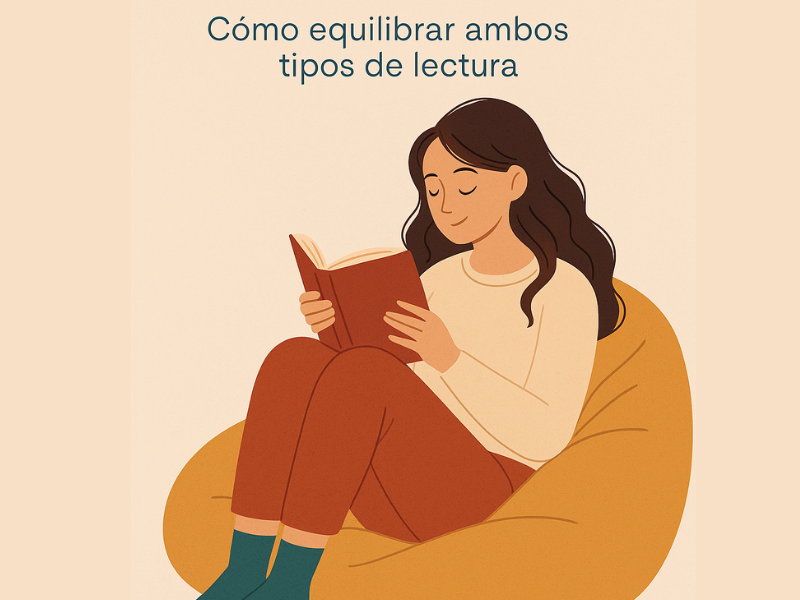
How to find the balance between the two
You do not have to choose one or the other. There is room for both. The balance comes from learning when you need each kind of reading.
Listen to where you are in life
Some days I want a light story that lets me switch off. Other days I need a book that helps me understand my emotions or the way I see the world. Neither option is better than the other. They are two different ways of growing alongside books.
If you are tired or overloaded, do not push yourself into something dense. If you feel curious or motivated, go ahead and take on that essay collection. Listen to what your body is asking for and let your reading adapt to you, not the other way around.
Pair books to your headspace
One strategy that works well for me is keeping two books going at once: one to enjoy and one to learn from. I read a novel before bed and a personal growth book in the morning or on my coffee break. That way each book serves a different purpose instead of competing with the other.
Do not feel guilty about what you read
There are no better or worse books, only books that make you feel something and books that do not. If a light story makes you happy, it has already done its job. If a more complex book overwhelms you, save it for another time. Reading is not a competition. It is a private conversation between you and the words.
Reading as a way of knowing yourself
Over time I have come to see that reading, in any form, is a way of getting to know yourself. Every book you choose says something about you.
The books you read for pleasure reflect your emotions, your needs, your appetite for dreaming or escaping. The books you read to learn reveal what is nagging at you, what you are aiming for, what you are trying to understand. Balancing the two is not a question of organization. It is a question of being honest with yourself.
Always ask yourself: what do I need today? Maybe answers, maybe calm. Both are valid.
How to get the joy of reading back once you have lost it
Sometimes reading stops being a pleasure and turns into an obligation, and it should not be that way. Maybe you have not picked up a book in a while, or you feel like you cannot concentrate. It has happened to me, and what I found is that the answer is not forcing yourself. It is reconnecting bit by bit with the reading you actually like.
I set aside the books I “should” read and went back to the ones that made me smile: short stories, novels I already knew, comics even. I reminded myself that reading does not have to be productive. It only has to be enjoyable.
Tips for finding your way back to reading
- Reread your favorites. Going back to a story that shaped you is like visiting an old friend.
- Read with no goals and no challenges. Let curiosity lead.
- Switch formats. If focusing is hard right now, try audiobooks or shorter pieces.
- Read a little, but be present for it. One page read with attention beats a hundred skimmed.
I have written more about how to reconnect with reading, in case you want to take a look.
Learning goes well beyond “serious” books
We tend to assume that learning only happens with essays or technical books, and that is not how it works. A love story can teach you about empathy. A fantasy novel can get you thinking about your own fears. Learning does not always mean taking notes. Sometimes it is enough to let a character move you.
Deep learning happens when something from the book stays with you, when a sentence follows you around for days, when a passage makes you look at the world differently. That counts as learning too, just the kind that comes through the heart.
How to organize your reading without the stress
You do not need a perfect system to read in a balanced way, though a little structure helps, at least until it turns into routine.
Keep a flexible list
Skip the endless to-be-read lists. Jot down a few titles you actually feel like reading right now, and update the list whenever your interests shift.
Try the 80/20 rule
Spend 80% of your reading time on books you fully enjoy and the other 20% on books that challenge you or teach you something you care about. That keeps your motivation up without wearing you out.
Accept that not every book is for you
You are under no obligation to finish a book that is not grabbing you. Forcing yourself through it usually just pushes you further away from the habit. Put it down without guilt and find one that inspires you or that you like better.
Frequently asked questions about reading for pleasure or to learn
Is reading for pleasure a waste of time?
Of course not. Reading for pleasure is good for your emotional wellbeing, your empathy, and your creativity.
What if I only want to read novels?
Perfect. Fiction teaches too, just not in the way we are used to calling teaching. Stories help us understand emotions, relationships, and lives that look nothing like our own.
How can I read more without the pressure?
Start with a few minutes a day. The amount is not the point, consistency is. A small habit you enjoy always grows over time.
What if a book bores me?
Nothing. Not every book connects with every reader. Put it down and find one that gets you going. Reading should be something you enjoy, not something you owe.
I went through a phase myself where I felt I should only read books that would make me “better.” Essay collections, productivity titles, classics everyone else seemed to have read. Over time I understood that reading for pleasure teaches me too, just in a gentler way.
I have learned things from romance novels, from fantasy, from poetry. Sometimes what a book gives me is not knowledge, it is comfort. That has value too. Every book serves a purpose at the moment it shows up in your life.
The balance is not in what you read. It is in how your reading lets you feel more like yourself.
Reading to feel and reading to grow
There is no correct way to read. Reading for pleasure and reading to learn are not opposites, they are two paths that work together. Some books you enjoy and they teach you without your noticing. Others make you think even though you do not fully enjoy them.
Sometimes you will learn while you are moved, and sometimes you will enjoy yourself while you learn. Reading does not really have to choose between heart and mind. It can be both.
So next time you pick up a book, ask yourself what you need that day. Maybe to switch off, maybe some inspiration. Either one is a good answer.
What about you, do you read more for pleasure or to learn? I would love to know. Tell me in the comments and let’s swap experiences, books, and thoughts.
If you enjoyed this post, share it with someone who loves reading too, and subscribe to the blog so we can keep talking about books, feelings, and everything that moves us.