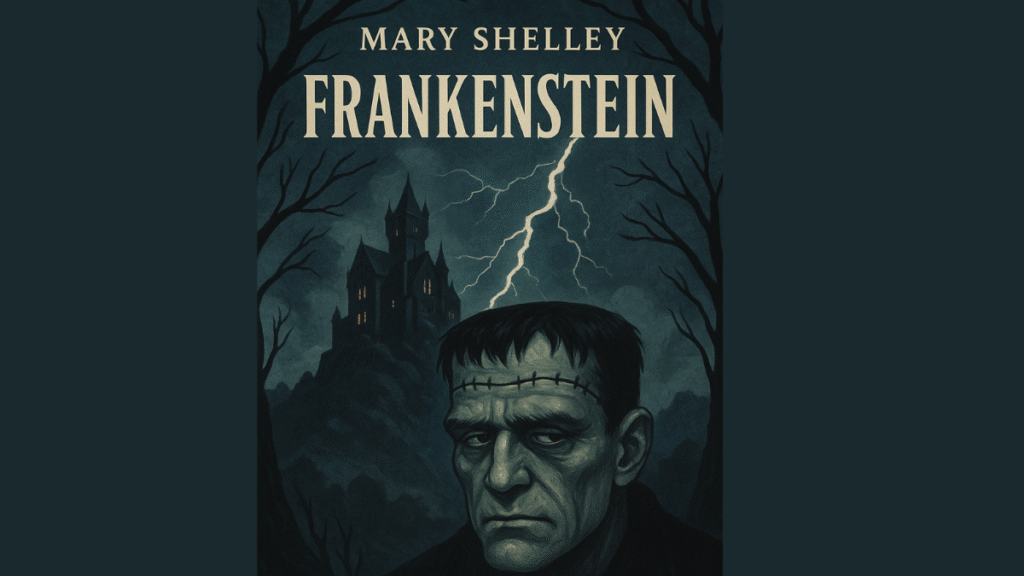
Halloween is coming up and I have been rereading some classics. Last week it was Dracula, and today it is Frankenstein, the story that upended literature and human thought and is still picking up new readers today.
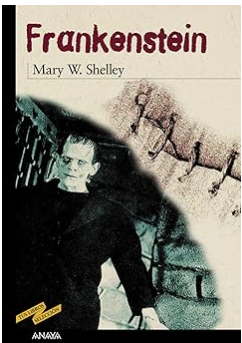
Frankenstein; or, The Modern Prometheus is one of the great works of world literature, written by Mary Shelley. The novel tells the story of Victor Frankenstein, a young scientist so obsessed with the boundary between life and death that he gives life to a creature who quickly becomes his greatest torment.
The first time I read this book was in the fall, well before Halloween became the whole production it is now. Like a lot of people, I had the standard mental image: a green monster, stitches across the forehead, a thunderstorm. What I found when I opened Mary Shelley’s book was something else entirely.
Frankenstein is not simply a horror story. It is a book about loneliness, ambition, guilt, and the wish to be loved. It is about the power and the danger of knowledge, about what it means to create, and about what happens when you refuse to take responsibility for what you bring into the world.
This post contains affiliate links
Mary Shelley, the brilliant mind behind the myth
Mary Wollstonecraft Shelley was born in London in 1797. Her parents were two extraordinary figures: the feminist philosopher Mary Wollstonecraft and the writer and thinker William Godwin. She grew up surrounded by books, ideas, and intellectual argument. She had no formal schooling, but her house was a constant churn of thought.
Mary was ahead of her time. She lived in a society where women were rarely taken seriously as authors, and she still wrote one of the most influential books ever published when she was barely eighteen.
The idea for Frankenstein came during an unusually cold summer in Switzerland in 1816, while she was staying with her husband, the poet Percy Bysshe Shelley, and their friend Lord Byron. That year became known as “the year without a summer,” because the eruption of Mount Tambora in Indonesia the previous year had cooled the global climate. Stuck indoors in a house on Lake Geneva, the young writers decided to entertain themselves by inventing ghost stories.
One night, after a conversation about whether electricity could reanimate a body, Mary had a nightmare. She dreamed of a scientist bringing to life a creature built out of corpses. When she woke up, she started writing what would become Frankenstein; or, The Modern Prometheus.
The world Frankenstein was written in
The book was first published in 1818, at the height of Romanticism. It was an age of scientific discovery and medical advances, and also of fear of the unknown. Europe had just come through revolutions, wars, and deep social change.
Romanticism celebrated emotion, freedom, and nature, and it also questioned the limits of reason and of human power. Frankenstein fits that moment perfectly. It is a story that combines science with poetry, horror with philosophy.
Mary Shelley knew how to capture the anxiety of her time. In a society both fascinated and terrified by scientific progress, she dared to ask: how far can a human being go without destroying himself?
The plot: the tragedy of creating without loving
Victor Frankenstein, a young Swiss man in love with science, decides to push past natural limits. Driven by ambition and curiosity, he becomes obsessed with creating life out of death. In his laboratory, surrounded by instruments and corpses, he pulls off the impossible: he reanimates a body, and we will not call it human.
The result horrifies him. The creature that comes to life is not the perfect being he imagined, it is deformed and terrifying, so Victor panics and abandons it.
The creature, aware of how different she is and of how the world rejects her, learns to speak, to read, and to think for herself, though all she wants is to be accepted, to be loved, to be seen as something more than a monster. Rejected over and over, her pain curdles into hatred and she sets out to take revenge on her creator.
What follows is a tragic, wrenching story about loneliness, guilt, and loss. Victor and his creature end up locked in a spiral of mutual destruction that climaxes in the Arctic, in a final pursuit where both of them understand that their fate is sealed.
More than a monster: the creature and her humanity
One of pop culture’s great mistakes is thinking Frankenstein is the monster. He is not. Frankenstein is the creator, and the creature, who never gets a name, may be the most human character in the whole book.
She starts out intelligent, sensitive, and compassionate. She learns language by watching a family, discovers how beautiful the world is, and dreams of belonging somewhere. Constant rejection is what changes her. What turns her into a monster is not where she came from, it is the cruelty of the people who despise her.
Mary Shelley forces us to look past the surface and makes us ask: who is the real monster? The one born different, or the one who rejects what he does not understand?
The novel’s central themes
Ambition and knowledge
Victor Frankenstein embodies the obsession with total knowledge. His wish to “create life” is an act of arrogance, a way of playing God. The book reminds us that knowledge without responsibility can destroy.
Loneliness
Victor and the creature both live in isolation. He because of his obsession, she because of how she looks. Both long for love and understanding, and both end up trapped in their own emptiness. Shelley shows that isolation does not only destroy, it strips away your humanity.
Rejection and identity
The creature looks for her place in the world, and constant rejection pushes her into a crisis of identity: who is she, if nobody accepts her? What is her existence for, if all it does is frighten people? Those questions are as current now as they were when the book was written.
Guilt and responsibility
Victor tries to run from what he made, and he cannot outrun the guilt. The novel lays out a universal ethical lesson: creating something is not enough, you have to take responsibility for it.
The style: a story inside a story
Shelley uses an epistolary structure. The book opens with letters from an explorer, Robert Walton, who finds Victor in the Arctic. Through those letters we get Frankenstein’s story, and inside that, the creature’s.
This layering of voices creates closeness and distance at the same time, like listening to a confession. Shelley combines the emotional with the rational, the Gothic with the philosophical, and that is what makes Frankenstein so remarkable.
Frankenstein’s impact on literature
Frankenstein is considered the first modern science fiction novel. It opened a new path by mixing science with morality and philosophy, and its influence reaches all the way to now. Movies, shows, comics, and retellings keep going back to this story. From Blade Runner to Black Mirror, plenty of contemporary work chews on the same ethical questions Mary Shelley raised more than two centuries ago.
It has also pushed thinkers, artists, and scientists to question the power of human creation. The idea of a “modern Frankenstein” has become shorthand for a warning about knowledge without empathy.
Mary Shelley and women in literature
Mary Shelley was a pioneer. At a time when women had few chances to publish anything, she wrote a book that changed history, and she did it without chasing glory or recognition. The first edition of Frankenstein came out anonymously, because nobody would have taken a horror novel by a young woman seriously.
Over the years her authorship became known and her reputation grew. Today she is recognized as one of the most powerful voices in world literature. Shelley wrote about monsters and science, and she also wrote about human feeling, loneliness, and responsibility. Her eye was deeply empathetic, which was rare in the writing of her era.
What the author was living through
You cannot understand Frankenstein without knowing Mary Shelley’s pain. Before she wrote it, she had lost her first baby and was living inside a turbulent relationship with Percy Shelley. Death, loss, and loneliness were part of her daily life.
Many scholars believe Frankenstein was her way of processing that grief. A creature born out of death, looking for love and finding rejection, can be read as a reflection of her own sense of not belonging anywhere. That emotional connection is what gives the book so much of its force.
Frequently asked questions about Frankenstein
Is Frankenstein horror or science fiction?
Both. It has the Gothic horror of the nineteenth century, and it is also a meditation on the limits of science and morality, which is what makes it the first work of modern science fiction.
What is the book’s main message?
It is about a creator’s responsibility toward what he creates, about the danger of unchecked ambition, and about the human need for love and acceptance.
What does the subtitle “The Modern Prometheus” mean?
In Greek mythology, Prometheus stole fire from the gods to give it to humankind and was punished for it. By creating life, Victor Frankenstein does something similar: he steals the power of creation and pays for it.
Why is it considered a feminist work?
Because it was written by a woman who broke the rules of her time, and because the message underneath it questions the male role in creation and in the control of knowledge.
Reading Frankenstein is like looking into a dark mirror. It gets you thinking about the limits of knowledge, and about empathy and rejection too. I felt compassion for the creature and anger toward Victor.
Every chapter pushes you to think about the power of our decisions, about how we sometimes create things, relationships, or situations without considering what comes next. It struck me that all of us, at some point, can be Frankenstein or his creature: creators who run away, or beings looking for love.
The heart behind the monster
More than two hundred years later, Frankenstein is still current. It speaks to power, to fear, to loneliness, to the wish to be seen. Mary Shelley did not only write a horror story, she wrote a warning about humanity.
Her message still holds up. What turns us into monsters is not our appearance, it is the absence of empathy. What makes us human is the capacity to love, including to love what we do not understand.
If you have never read Frankenstein, I would encourage you to go in with no expectations. Do not expect a scary story, expect a deep trip into the human soul. It is a book that shakes you and holds you at the same time.
If you have already read it, tell me: who do you think the real monster is?
You can find it online at Amazon and, almost certainly, at any brick and mortar bookstore.