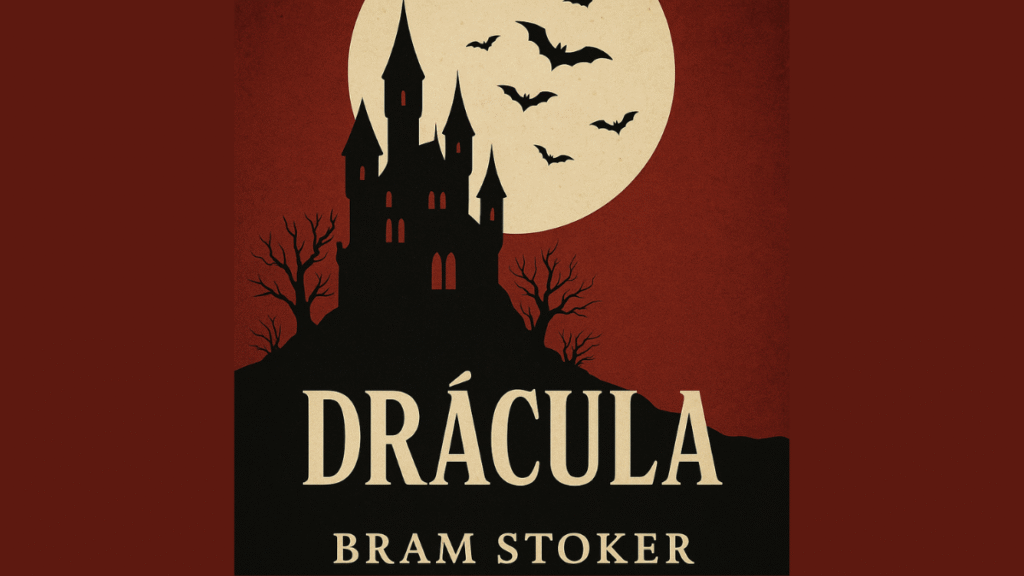
Discover Dracula by Bram Stoker in this full, warm, and passionate review: analysis, historical background, characters, narrative style, and trivia about the immortal novel that shaped the modern vampire myth.
Dracula, published in 1897 by Bram Stoker, is the Gothic novel that shaped the modern vampire myth. Told through diaries and letters, it follows Count Dracula’s arrival in England from Transylvania and the fight a small group of characters puts up to stop him. The book is full of mystery, dark atmosphere, and the tension between science, superstition, and the fears of its era.
This post contains affiliate links
Why Dracula still fascinates me
I have to admit it: very few books have stirred up as many conflicting feelings in me as Dracula by Bram Stoker. I read it for the first time as a teenager, partly out of curiosity and partly because of the pull that anything Gothic has always had on me. The truth is that even though I already knew who the Count was from movies and pop culture, reading the actual book was a completely different experience.
It is darker, slower, and more atmospheric than I expected. It is not just a vampire story. It is a portrait of collective fear, of the tensions inside a society changing at breakneck speed, and above all a brilliant piece of storytelling.
Today I want to share a very special post with you so we can dig into everything this book is hiding: the historical background, the characters you never forget, and the way Stoker built a myth that is still alive more than 125 years later.
Bram Stoker, the man behind the myth
A life marked by shadows
Abraham “Bram” Stoker was born in 1847 in Clontarf, a Dublin neighborhood. He was very sick as a child and spent long stretches confined to bed, which fed his imagination. Once he recovered, he studied mathematics and worked as a civil servant, though the pull of art and literature never left him.
His life took a turn when he met the actor Henry Irving, with whom he built a close professional and personal relationship. Stoker became his manager and ran the Lyceum Theatre in London, a job that put him in contact with the artistic and literary bohemia of his day.
How Dracula came together
Stoker spent about seven years researching European folklore, vampire myths, and the legends of Transylvania. He drew on historical figures like Vlad the Impaler, but also on rural superstitions still circulating in the nineteenth century. The result was a book that fed on the fantastic and on the very real fears of its time.
The era behind the book: Victorian fear
Reading Dracula means sinking into the end of the nineteenth century, deep in the late Victorian period. This was a society in transition, with huge technological leaps (the railway, the telegraph, electricity) and with deep anxieties underneath:
- Fear of the foreigner: Count Dracula is the invader from the East who comes to corrupt British society.
- Fear of female sexuality: Mina and Lucy stand for two different ideals of womanhood. Lucy’s transformation into a vampire reflects the Victorian dread of women’s independence and of desire that cannot be controlled.
- Science against superstition: the characters reach for crucifixes and blood transfusions alike. The book is one long conversation between the modern and the ancient.
The plot of Dracula
The novel is told through diaries, letters, newspaper clippings, and assorted documents, which gives it a realistic, fragmented feel.
Jonathan Harker, a young lawyer, travels to Transylvania to close a deal with Count Dracula. He soon realizes he is a prisoner in a castle full of secrets.
Dracula sails to England, where he becomes a threat to Lucy, Mina Murray’s friend.
After Lucy dies and is transformed, her friends, among them Dr. Seward and Professor Van Helsing, decide to fight back against the Count.
Mina, now Jonathan’s wife, becomes Dracula’s next target, which raises the stakes in the fight between the group and the vampire.
In the end, the characters chase the Count all the way back to Transylvania on an epic journey that builds to their final confrontation.
The characters: light and shadow
Dracula
The ultimate antagonist. Seductive, cruel, powerful. He is also decadent, a symbol of an aristocracy in decline that stays alive only by draining the energy of others.
Jonathan Harker
He stands for reason, duty, and the naivety we all bring to evil at first. His stay at the castle is one of the most terrifying stretches of the novel.
Mina Murray
Smart, brave, and organized, she is the Victorian heroine who proves that strength is not always physical.
Lucy Westenra
She embodies purity and female vulnerability. Her transformation is one of the most chilling and most symbolic scenes in the book.
Van Helsing
The wise man who brings together science and tradition, medicine and superstition. He is the moral and practical leader of the fight against the Count.
The novel’s central themes
Modernity versus superstition
The novel captures a moment when society wanted to believe in science but could not shake off its old fears.
The power of sexuality
Dracula and his brides represent desire crossing the line. Lucy’s transformation and the hints around Mina broke with Victorian rigidity.
The outsider and the fear of invasion
Dracula feeds on blood, and he also stands for the British fear of the “other” who threatens to contaminate what is ours.
Good against evil
Symbolism aside, Dracula is also the classic story of a group of people who band together to defeat a common enemy.
Narrative style: a novel of many voices
Building the book out of diaries and letters turns Dracula into a choral story. The epistolary structure makes the reading far more immersive, because you feel like you are snooping through private papers. It also lets you see several points of view at once and ramps up the tension, since the characters often have no idea what the reader has already learned somewhere else.
Adaptations and legacy
Few novels have been adapted as often as Dracula. There is the silent era with Nosferatu (1922), the iconic Bela Lugosi performance (1931), the Gothic Christopher Lee version at Hammer Films, and Francis Ford Coppola’s take (1992).
On top of that, the character has inspired countless comics, shows, video games, and spin off novels. Dracula is not just a character. He is a cultural archetype.
Frequently asked questions about Dracula
Is Dracula horror or Gothic romance?
It is both. It is a Gothic novel that mixes romance, adventure, and psychological horror.
Is it hard to read today?
It can feel slower than a contemporary novel, but the epistolary structure keeps it very readable.
When is the best time to read it?
Fall and winter are ideal. Long, cold nights match the mood of the novel perfectly.
Is it based on Vlad the Impaler?
Stoker took inspiration from the historical Vlad, but the character is more a blend of legends and Victorian fears.
My experience
What gripped me most about Dracula was not the scares, it was the atmosphere. I felt the cold in the castle corridors, the London fog, Mina’s dread, Van Helsing’s desperation. It is a book that does not age, because it speaks to fears we all share: losing control, forbidden desire, the unknown pushing its way in.
If you are interested, you can find it on Amazon.
Why you should read Dracula
If you have never read it, I hope you will. Beyond the myth, Dracula is a book that combines feeling, tension, reflection, and beautiful writing. It is a classic that still feels alive, still starts conversations, and still reminds us that monsters are not as far from us as we would like.
If you would rather read something less frightening, try Stephen King and his novel Firestarter.
Now tell me, have you ever read Dracula? Which version got you more, the book or one of the adaptations? I would love to hear from you in the comments. If you enjoyed this post, share it with your reader friends and subscribe to the blog so you never miss a review like this one.