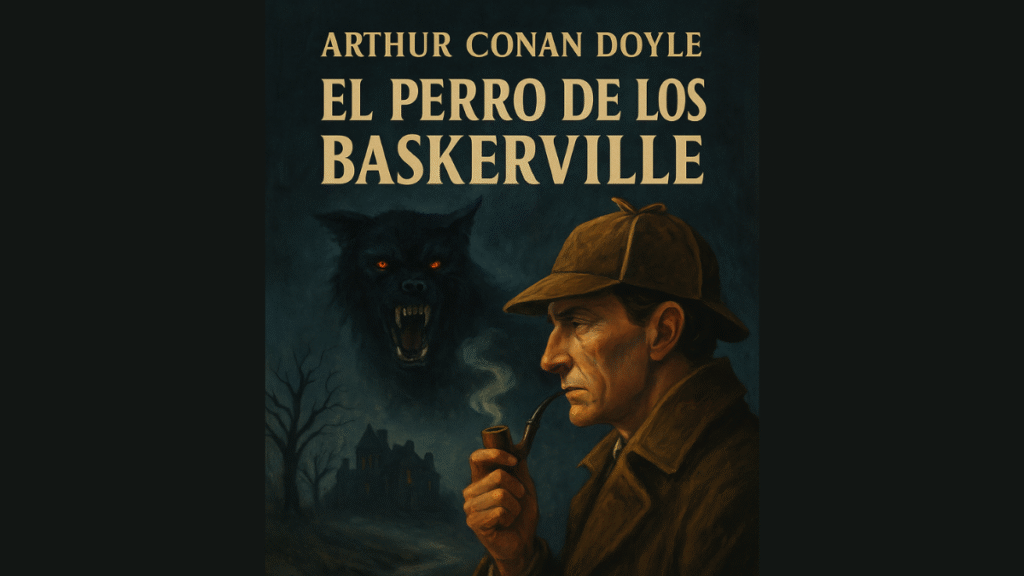
Dive into The Hound of the Baskervilles, one of Arthur Conan Doyle’s most iconic novels. Discover the mystery, the historical background, the author’s own secrets, and why this book still captivates readers in every era.
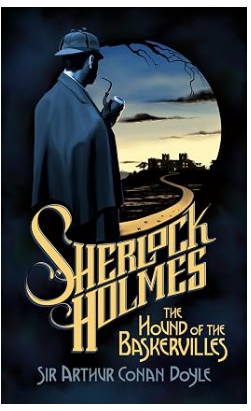
A cursed legend, a hellhound, and a detective willing to face the unknown. In The Hound of the Baskervilles, Sherlock Holmes and Dr. Watson investigate the mysterious death of an English nobleman on the Dartmoor moors, where superstition and fear tangle with logic and reason. It is one of Conan Doyle’s darkest and most fascinating stories, a timeless classic where fear, intelligence, and Gothic atmosphere fuse together.
This post contains affiliate links. If you buy through them, you support my work at no extra cost to you.
The Hound of the Baskervilles is a mystery novel by Arthur Conan Doyle, published in 1902. It is one of the most famous cases of detective Sherlock Holmes and his inseparable companion, John Watson.
The story blends reason with superstition, science with fear, reality with legend. On the surface it is a detective investigation, and yet the atmosphere has something dark, unsettling, almost supernatural about it, perfect for the Halloween season coming up, right alongside other classics like Frankenstein or Dracula.
The most fascinating part is how Doyle keeps you doubting the whole way through. Is there really a demonic hound out on the moors, or does everything have a rational explanation? That tension between the reasonable and the mysterious is what makes this novel a permanent classic.
Historical background: when reason lived alongside the occult
To understand the power of this story, it helps to look at the moment it was written. We are at the start of the twentieth century, in the late Victorian world.
British society was living an interesting contradiction. On one hand it took pride in its scientific, medical, and technological progress. On the other, it was drawn to the supernatural, to spiritualism, to the mysteries of the mind and the soul. Logic and mysticism sat side by side, and Conan Doyle, with that brilliant mind of his, captured the split perfectly in this novel.
He was a doctor himself, a man of science, and he also had a deep interest in spiritualism. That inner contradiction shows up in The Hound of the Baskervilles: the struggle between believing and proving, between ancient fear and human reason.
Arthur Conan Doyle, the man behind the myth
The lives of authors who build worlds so powerful the worlds end up outgrowing them have always intrigued me. Arthur Conan Doyle is one of those cases.
He was born in Scotland in 1859 and studied medicine, which shaped the methodical, almost surgical way his most famous character operates: Sherlock Holmes.
In many ways Holmes represents the scientific mind Doyle admired. The author himself, though, was an emotional and contradictory man. While he was writing about the most logical, rational detective in the world, he was looking for comfort in the spiritual after losing people he loved. That split between faith and science, between fear and evidence, pulses through every page of The Hound of the Baskervilles. Sometimes it feels like the author is arguing with himself through his characters.
The return of Sherlock Holmes: a literary resurrection
Here is a detail plenty of people forget: when Doyle wrote The Hound of the Baskervilles, Sherlock Holmes was already dead. Or at least that is what the world believed.
Years earlier, Doyle had “killed” him in the story “The Final Problem,” worn out by the way the character overshadowed the rest of his work. The public never forgave him. There were protests, furious letters, enormous social pressure. Holmes was so beloved that Doyle eventually brought him back.
The Hound of the Baskervilles was the book that marked his triumphant return. The story is set before Holmes’s death, and even so it was a reunion between the author, his creation, and his readers.
That is why this book carries a special energy, as if Doyle were writing with a mix of reconciliation and renewed excitement.
The cursed legend and the skeptical detective
The story opens with the mysterious death of Sir Charles Baskerville. Out on the moors around his manor in Devonshire, they say an enormous hellhound prowls, tormenting the family for generations. The legend claims the animal is punishment for an old sin committed by an ancestor.
When the new heir, Sir Henry Baskerville, arrives from Canada to take over the manor, the fear spreads all over again. That is when Sherlock Holmes and Dr. Watson step in to solve the case.
Doyle plays the reader masterfully. He makes us doubt: what if the legend is real? What if not even Holmes’s logic can explain everything?
The atmosphere he builds is so thick you can almost feel the damp of the moor, the fog, the distant howl of the hound.
The moors as another character
In this novel the setting is not just a backdrop. Dartmoor becomes a character with a life of its own. The bogs, the thick fog, the silence create a constant sense of danger and isolation. It stands for the unknown, the wild, everything outside human control.
Conan Doyle does not only narrate a story, he draws it with words. Every description is so visual you can practically smell the wet earth or hear footsteps lost in the dark.
The landscape becomes an emotional force that wraps around the characters and the reader alike.
Watson, the heart of the story
I have always thought that without Watson, Holmes would be unbearable. His intelligence and his coldness would be hard to swallow without someone there to make him a little more human.
Watson is the reader’s eyes inside the story. In The Hound of the Baskervilles his role matters even more, because Holmes is absent for a large chunk of the book.
That gives the narration a warmer, more human voice. We watch Watson get scared, second guess himself, make mistakes, and push on anyway with a mix of courage and curiosity. He is the one who connects us emotionally to the story, the one who lets us live the mystery from the inside.
The power of fear you cannot see
One of this novel’s greatest strengths is how it handles fear. Conan Doyle never reaches for the cheap jump scare. He knows that what you do not see frightens you more than what you are shown.
The fear lives in the sounds, in the mist, in a shadow moving without a clear shape. It is an elegant, psychological fear that gets under your skin before you notice. That kind of fear never goes out of style, because all of us are afraid of the unknown. Years go by and the howl of that hound still raises the hair on your arms.
Between the Gothic and the scientific
Look at the novel closely and you can see a perfect blend of two worlds: the Gothic and the detective story.
The first brings the dark atmosphere, the isolated manor, the family curse, the supernatural edge. The second brings method, deduction, rational observation. Doyle gets them to complement each other, and the magic of the book comes out of that union. It is as if he were saying: you can trust logic, just never forget that the dark is out there too.
The ending, between the fog and the truth
I am not going to give away the ending, but I can say it is a lesson in balance. Doyle closes the mystery brilliantly, with no loose threads, while keeping a faint chill that lingers after you shut the book. The resolution holds together, and it does not cost the supernatural mood a single ounce of its charm. It is the kind of ending that satisfies you and leaves you thinking at the same time.
Because beyond the crime and the deduction, what really stays with you is the experience of having traveled through a place where reason and fear walk side by side.
Why it still feels current
Sometimes I wonder why a book from more than a century ago still grabs so many readers, and I think the answer is simple: because it is about something that never changes.
We all have our own inner moors, those places full of shadows and doubt, and at some point we all need a voice that helps us bring light where everything looks confusing. The Hound of the Baskervilles reminds us that even the most rational minds feel fear, and that courage is not the absence of fear. It is going after the truth in spite of it.
Frequently asked questions about The Hound of the Baskervilles
Who wrote The Hound of the Baskervilles?
Arthur Conan Doyle, the Scottish doctor and writer who created Sherlock Holmes.
When was it published?
It came out as a book in 1902, after being serialized in The Strand Magazine starting in 1901.
Why does this novel matter so much?
Because it marked the return of Sherlock Holmes, and because it is considered a masterpiece of both detective fiction and Gothic mystery.
Is it based on real events or on legends?
On legends. Doyle drew on a local Devon story about a phantom hound and on conversations with his friend Fletcher Robinson, who told him about the Dartmoor moors.
What is the book’s main message?
That reason can light up even the darkest mysteries, and that fear is an unavoidable part of being human.
Would I recommend reading it today?
Without a doubt. It still grabs you, moves you, unsettles you, and leaves a mark.
Adaptations and legacy
It would be impossible to talk about The Hound of the Baskervilles without mentioning its many adaptations. It has been brought to film, the stage, radio, and television. One of the most notable is the BBC version with Benedict Cumberbatch, which moves the story into the twenty first century without losing what makes it work. Every era has made its own version, and that alone proves this story has something that does not age.
Things you might not know
- Doyle is said to have found much of his inspiration in the landscapes of southern England while working on the story.
- Sir Henry has often been described as a composite of several figures from British high society.
- In some stage adaptations, the hound used on stage was reportedly convincing enough to make audiences cry out.
- In the original run in The Strand Magazine, Sidney Paget’s illustrations did a lot to reinforce the story’s eerie tone.
The author and his era
Arthur Conan Doyle lived through a period of deep change. He watched the world go from candlelight to electricity, from myth to the microscope, from superstition to science. He was a man caught between two worlds, and maybe that is why his stories last, because they are about the eternal fight between the visible and the invisible, between doubt and certainty.
The howl that never fades
Every time I reread The Hound of the Baskervilles, I feel a door opening onto mystery, onto wonder, onto the part of things that cannot quite be explained. In a world that seems to have everything worked out already, that is a luxury.
We still need stories that remind us there are shadows left, that there are still things that make us look into the fog with curiosity. Maybe that is why, years later, we can still hear the echo of that hound out on the moors. When we do, some part of us smiles, grateful to still feel the thing only great stories know how to produce.
You can find it on Amazon.
If your eyes need a break, you can listen to it instead:
If you have not read The Hound of the Baskervilles yet, I hope you will. Pick a quiet night, make something warm to drink, and let the story wrap around you.
If you have already read it, I would love to know how it made you feel. Did it scare you? Did the ending surprise you? Did the atmosphere get to you as much as it got to me? Leave it in the comments. This blog is not only for talking about books, it is for living them together.