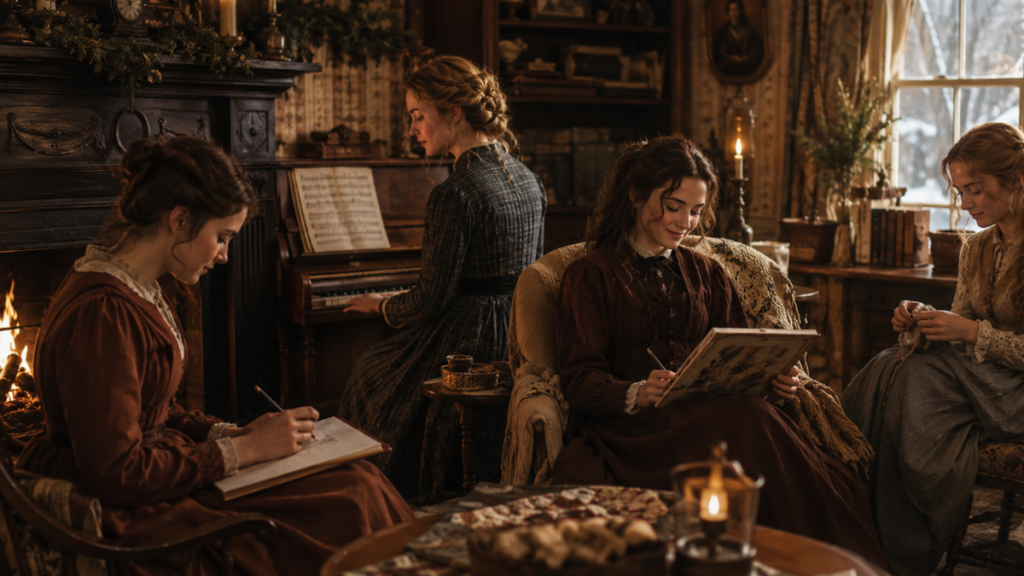
Discover why Little Women still moves us. We reflect on the March sisters, female independence, their life lessons, and the warmth of home.
It turns out that Little Women is not just a story about girls in period dresses living in a country house while their father is at war.
It’s an emotional map of growing up, dealing with other people’s expectations, and finding your own way without losing the affection of the people who matter to you.
If you’re looking for a comforting read, stick with me for a while. Let’s have a relaxed chat, digging into all the details about why the March sisters still have so much to tell us today.
Illustrative image generated with AI assistance
This post contains affiliate links, using them helps me out at no extra cost to you.
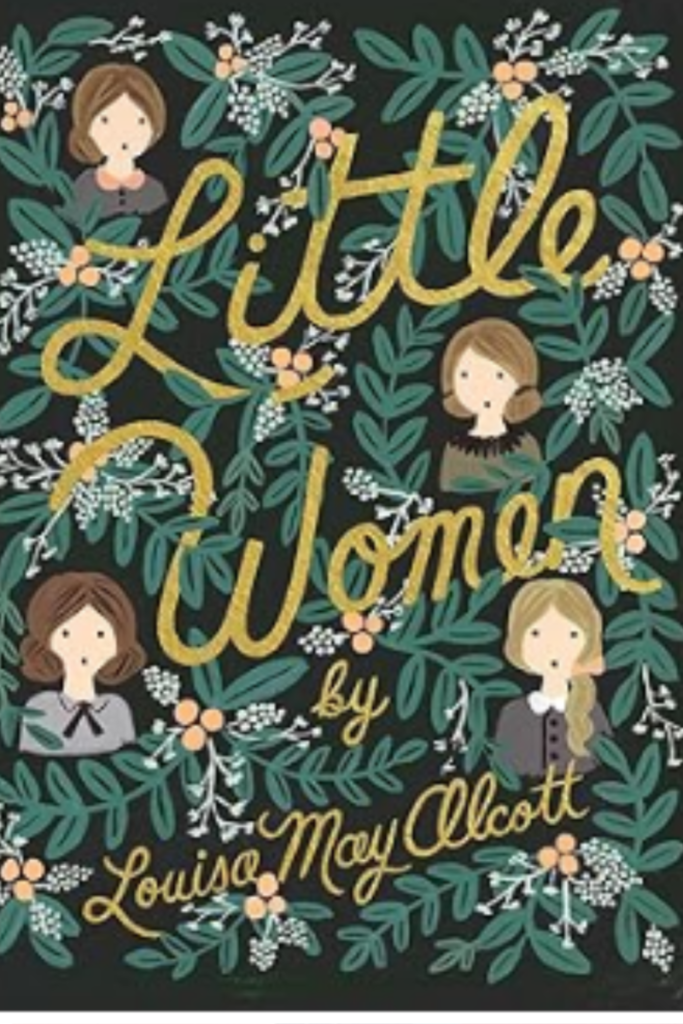
Little Women tells the story of Meg, Jo, Beth, and Amy March, four sisters growing up during the American Civil War. Through their dreams, financial struggles, family relationships, and personal choices, the novel explores growing up, independence, love, loss, and finding your own path.
The origin of a story that almost didn’t exist
To really understand why this novel works, you need to take a second look at its author, Louisa May Alcott. She wasn’t particularly eager to write a novel for young girls when her publisher asked her to.
In fact, she found it to be a pretty boring and uninspiring assignment. She was used to writing more mysterious, much darker stories under a pseudonym to help pay her family’s bills.
However, since her family’s financial situation was difficult, she decided to take on the challenge. But instead of inventing ideal characters or perfect princesses, she did something revolutionary for her time: she looked at her own childhood and drew direct inspiration from her sisters.
The result was unusually fresh. Alcott didn’t try to create a sweetened handbook of good manners, but instead depicted everyday life with its anger, innocent envy, financial troubles, and the desire to take on the world when you’re fourteen or fifteen.
The Alcott Family and the Marches: Where Reality Meets Fiction
The correspondence between the author’s real life and the book’s plot is simply fascinating. Louisa was Jo: impulsive, independent, with a wild passion for writing and very little patience for the stiff rules of the society of her time.
Her older sister, Anna, was the inspiration for Meg, always seeking harmony, composure, and wanting a quiet, comfortable life. Elizabeth, sweet, quiet, and a lover of music, was the direct inspiration for Beth. The youngest, May, a talented artist with a flair for grandeur and a strong desire to stand out, became Amy.
Writing from real experience made the dialogue sound authentic from the first page. The March sisters don’t talk like marble statues, they argue over a dress, get mad because one of them read another’s diary without permission, laugh together until their stomachs hurt, and really suffer when things go wrong at home.
Four faces of the same search for identity
The wonderful thing about this group of sisters is that they represent different ways of being in the world. None is better than the others, although each reader usually ends up getting attached to a particular one.
We’re often given the impression that the rebellious girl is the only valid kind of heroine, but if you read carefully, you realize that the book respects each one’s freedom to choose her own path, even if that path is staying at home taking care of the household.
Meg: the desire to fit in and the maturity of simple love
Meg is the eldest sister. She has a very clear sense of duty and loves beautiful things. She feels hurt by the family’s financial hardships because she remembers when the family was better off, and sometimes, she feels tempted by the lavish lifestyle of her wealthier friends.
However, Meg’s journey is very human. She learns that material luxury doesn’t guarantee peace of mind or genuine affection. Her choice to marry a humble man for love and build a modest home takes a lot of courage.
It isn’t an act of surrender, but a conscious decision to prioritize what truly fills her heart.
Jo: the tireless struggle to be yourself
Jo is, without a doubt, the soul of the book. She’s the character that almost all of us have identified with at some point, when we’ve felt that the mold society tried to fit us into felt too restrictive.
Jo doesn’t want to submit to the traditional expectations of her time. She hates the constraints of women’s clothing, prefers to run through the fields, devours books, and dreams of making a living from her writing to lift her family out of poverty.
Her growth is beautiful because she never loses her essence. Throughout the story, she matures, learns to manage her fiery temper, and discovers that independence doesn’t mean isolating yourself from the world or giving up meaningful relationships, but learning to love others freely.
Beth: the quiet strength of everyday empathy
Beth is usually the sister who is hardest to understand at first glance. She’s shy, extremely introverted, and finds her world within the four walls of home and at the keys of an old piano.
In a world that often rewards the loudest people, or those who take up the most space, Beth reminds us of the priceless value of calm presence.
She is the glue that keeps the family together when things get tough outside. Her compassion seeks no applause or recognition. She takes care of sick neighbors or handles household chores simply because she wants to.
Her physical fragility contrasts with enormous moral strength, making her the refuge all the sisters turn to when they need a bit of peace.
Amy: Unapologetic Ambition and Personal Growth
I have to admit that when I was little, I didn’t like Amy very much. She’s the youngest in the house, a bit spoiled, vain, and obsessed with manners. But rereading the story as an adult, my perspective changed a bit.
Amy is incredibly honest about her aspirations. She wants to be an artist, she wants to stand out, and she’s not ashamed to admit that she wants a comfortable and elegant life.
She’s not silly. She sees the world with unsparing realism. As she grows up and travels through Europe, she recognizes her own artistic limits with a lot of maturity and turns her youthful frivolity into impressive social intelligence.
Amy doesn’t give up on her goals, but she learns to pursue them with integrity.
The figure of Marmee: the guide who teaches how to think
You can’t talk about the girls without mentioning their mother, Mrs. March, whom they affectionately call Marmee. Instead of being the typical authority figure, Marmee acts as an empathetic guide who prefers her daughters to learn from their own mistakes.
There’s a precious moment in the book where she confesses to Jo that she also has a fiery temper, but she has spent years learning to control it.
That moment of vulnerability between mother and daughter is a breath of fresh air. Marmee gives them room to make mistakes, supports their hobbies without judging them, and teaches them that true wealth isn’t in the bank account, but in peace of mind and self-respect.
Friendship with Laurie and the warmth of home
Laurie’s character adds a fantastic layer of sweetness to the whole story. He’s the rich, orphaned, somewhat lonely boy who lives in the big mansion next door under his grandfather’s care.
The relationship between Laurie and the March house is a tribute to the welcoming power of a close-knit family. Laurie doesn’t envy the Marches’ money because they don’t have any. He envies the laughter, the warmth, the impromptu plays in the attic, and the freedom to express what they feel without fear.
The bond between Jo and Laurie is one of the most delightful parts of the story. They understand each other with just a look, share private jokes, and become a mutual refuge.
However, as often happens in real life, dynamics change as friends grow up and have to face what they truly want for their future.
Universal themes that are still relevant today
If Little Women continues to be sold in bookstores all over the world, it’s not just because of pure nostalgia for past times. It’s because it touches on issues that still concern all of us.
Economic independence and the dignity of work
One of the novel’s strongest recurring themes is money. Or, rather, the lack of it. The sisters constantly experience the frustration of wanting to do things and being limited by the family’s resources.
The author approaches women’s work without romanticizing it. Jo writes stories nonstop to earn a few dollars; Meg teaches children from wealthy families, enduring subtle disdain; Amy helps where she can and takes care of her demanding great-aunt.
Working isn’t an elegant hobby for them, it’s a necessity that helps the family maintain its dignity, and that effort makes them stronger and more independent.
Grief and the inevitable passing of time
Growing up involves leaving things behind, and the book portrays that with a delicacy that tugs at the heartstrings. The transition from childhood to adulthood is not a bed of roses. There are moments of loss, uncertainty about where we’re going, and inevitable pain.
Beth’s illness and passing represent that breaking point where childhood ends definitively for the March sisters. The way the family faces the loss, leaning on each other without falling into empty drama, shows tremendous emotional maturity and leaves you with a beautiful sense of comfort.
Why the ending keeps sparking debate among readers
I can’t honestly revisit this novel without addressing Jo’s ending. It’s one of the points that continues to spark debate in book clubs, and honestly, I totally get why.
For generations, many people have felt disappointed because Jo didn’t end up marrying Laurie, or because she chose to marry Professor Bhaer and start a school instead of staying completely single and devoted solely to her books.
But to really understand this part, you need to know the context of the author herself. Alcott admitted in her private letters that she didn’t want Jo to get married.
Alcott wanted Jo to remain a literary spinster, just as she herself did in real life. However, readers of the time demanded a traditional romantic ending for the heroine, and the publisher put considerable pressure on her to please the audience.
Alcott responded in her own way with a small act of rebellion. Instead of giving people the predictable, fairy-tale romance with the young and handsome Laurie, she decided to pair Jo with an older, poor intellectual of modest background.
Bhaer is someone who values Jo for her intelligence, offers constructive criticism when he knows she is capable of better work, and respects her as an equal.
Looking at it from a broader perspective, Jo’s marriage isn’t a surrender to social norms, but a choice to build a partnership based on mutual respect, intellect, and a shared life project at Plumfield.
Movie adaptations: different takes on the same classic
The story of the March sisters has been brought to the screen many times. Every generation has had its own movie version, and they all add interesting nuances to the conversation.
The classic version from the nineties
For many of us, the 1994 movie directed by Gillian Armstrong and starring Winona Ryder is a beloved reference. It has a cozy atmosphere, beautiful music, and a cast that perfectly matched how many readers imagined the characters.
Winona Ryder beautifully captures that mix of overflowing energy and sensitivity that defines Jo.
The modern and dynamic look of 2019
The adaptation directed by Greta Gerwig offered a very fresh approach. Instead of telling the story in a linear way, Gerwig plays with the timeline, alternating between the warmth of the sisters’ childhood and the more subdued tone of their adulthood.
The best thing about this version is how it treats Amy’s character with greater sympathy, explaining the reasons for her decisions with striking pragmatism. Also, the film pays a beautiful tribute to Louisa May Alcott herself, as a creator and entrepreneur fighting for the rights to her own work.
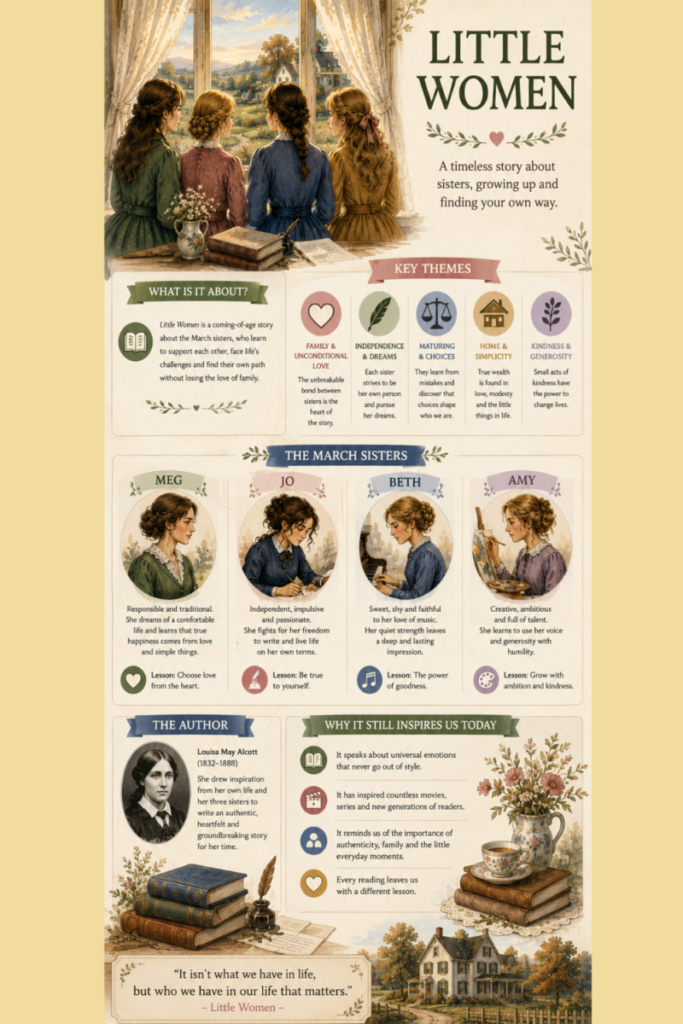
Illustrative Infographic Little Women
Frequently Asked Questions About Little Women
Is the book only for women or children?
Not at all. Although for decades it has been wrongly labeled as literature exclusively for girls or children, it is a universal work. It talks about the human condition, family life, art, death, and personal aspirations. Anyone who enjoys a well-told story with lilifelike characters will know how to appreciate it.
In what order is it best to read the parts or sequels?
The book we now know as Little Women often includes the two parts originally published separately: adolescence and adulthood. There are later sequels focusing on Jo’s school students, like Little Men and Jo’s Boys, but the main story of the four sisters is contained in Little Women itself.
Is it difficult or slow-going for modern readers?
Surprisingly, no. Unlike other classics of its time that can feel heavy because of endless descriptions or flowery language, Alcott’s style is very lively, straightforward, and full of natural dialogue. It’s a surprisingly easy read
You can find the book on Amazon and at Casa del Libro.
Now that we’ve reached the end, I would love to hear your opinion.
If you’ve already read the novel, I’d like you to tell me in the comments which of the four sisters you identify with most and whether your perception of them has changed over the years.
Were you more like Jo when you were younger, but now understand Meg or Amy better? What did you think of where the characters ultimately end up?
If you haven’t read it yet but you’re curious, tell me what attracts you most about this story.
Little Women
Discover why Little Women still moves us. We reflect on the March sisters, female independence, their life lessons, and the warmth of home.
URL: https://lecturaysensibilidad.com/en/little-women/
Author: Lectura y sensiblilidad
4.8