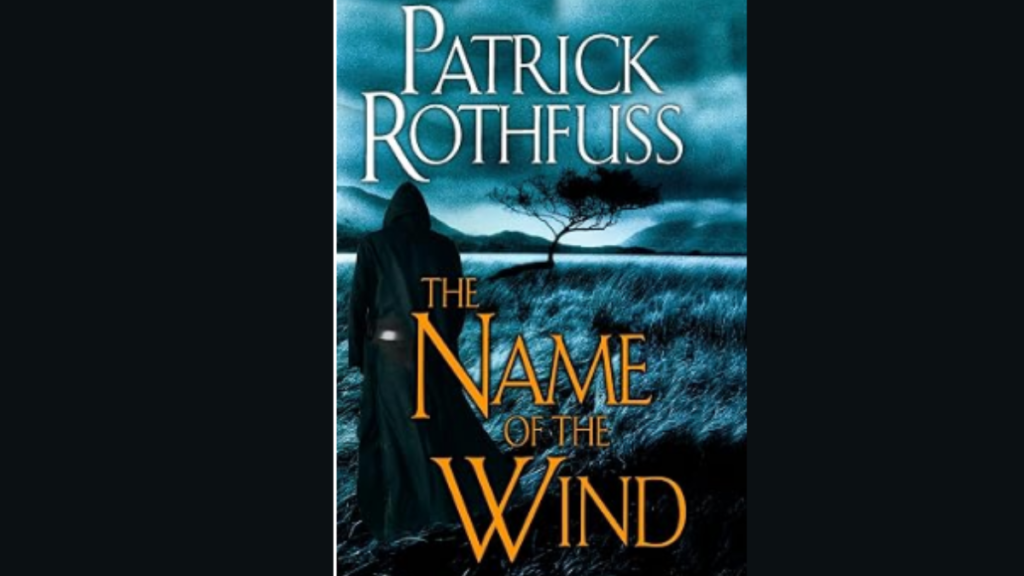
“The Name of the Wind” is the first novel in Patrick Rothfuss’s trilogy “The Kingkiller Chronicle”. Published in 2007, this work of epic fantasy has earned an enormous readership thanks to its lyrical style, its intricate world, and its charismatic main character: Kvothe.
The Name of the Wind is the first installment of Patrick Rothfuss’s Kingkiller Chronicle trilogy. The story is narrated in the first person by Kvothe, a legendary magician, musician, and fighter living in hiding under a false identity as an innkeeper. Over the course of three days, Kvothe tells the true story of his life, a life that has already become myth: from his childhood with a troupe of traveling performers, through his time as an orphaned boy in the city, to his admission to the University, where he studies magic and chases hidden knowledge about the Chandrian, mysterious beings tied to the tragedy that marked his childhood.
The novel combines magic, learning, music, love, and tragedy in a rich, detailed fantasy world. Kvothe is a complex character: brilliant, arrogant, sensitive, and shaped by a constant inner struggle. The Name of the Wind stands out for its lyrical style, its introspective approach, and the depth of its characters and its universe.
“I have stolen princesses back from sleeping barrow kings. I burned down the town of Trebon. I have spent the night with Felurian…”
That is how it begins, and that is how it gets you.
The story opens in a humble inn called the Waystone, in a world where magic, myth, and science coexist. The innkeeper, an apparently ordinary man called Kote, is really Kvothe, a living legend hiding behind a false identity. When Chronicler, a famous scribe, tracks him down, he persuades Kvothe to tell his real story. That sets off a first person narration in which Kvothe recounts his life from childhood on. The structure of the novel alternates between the present at the inn and the memories of his past.
Kvothe was born into a troupe of traveling performers called the Edema Ruh, known for their musical and theatrical talent. From early childhood he proved brilliant, curious, and charismatic. His life changes completely when his family is murdered by a mythical force: the Chandrian, dark beings wrapped in legend. That event kicks off his obsession with uncovering the truth behind those beings and the stories that surround them.
Orphaned and alone, Kvothe survives on the streets of the city of Tarbean, where he faces hunger, violence, and abandonment. Those years forge his character, sharpening his wits, his adaptability, and his determination. Eventually he decides to enroll at the University, an institution where students study both scientific and magical disciplines, including naming, a special kind of magic based on knowing the true name of things.
At the University, Kvothe quickly stands out for his intelligence, his talent with the lute, and his insatiable hunger to learn. He also makes enemies, though, especially Ambrose, an arrogant student from a noble family. Kvothe runs into obstacle after obstacle: extreme poverty, punishments, academic rivalries, and the difficulty of finding any information about the Chandrian, which seems to have been systematically hidden or destroyed.
One of the central threads of the novel is Kvothe’s relationship with Denna, a mysterious and gifted young woman who moves in and out of his life. Their connection runs deep, yet the relationship is unstable, shaped by Denna’s independence and by the emotional immaturity of them both. Through her, Kvothe also explores the line between idealized love and the real thing.
During his time at the University, Kvothe learns about sympathy, a rational form of magic, and about true names, a more powerful and mysterious way of exerting control over the world. In one of the key moments of the novel, Kvothe manages to call the name of the wind, the feat that gives the book its title and confirms him as someone exceptional even by the magical standards of his world.
Much of the book takes place at the University, though the story also expands into other regions and conflicts, including a confrontation with a beast known as a draccus, which Kvothe defeats using knowledge and cunning. That mixture of learning, discovery, and adventure forms the narrative core of the novel.
The book ends without resolving many of the mysteries it raises, such as the true nature of the Chandrian, the reason information about them has been buried, and how Kvothe becomes the weary, disillusioned man of the present. The brilliant young Kvothe is clearly a long way from the melancholy innkeeper telling the story, which leaves the reader anticipating the next books in the trilogy.
“The Name of the Wind” is a deeply introspective, lyrical novel that mixes fantasy, tragedy, and adventure. More than a simple tale of heroes and magic, it is a study of the power of stories, of identity, and of the price of knowledge. Patrick Rothfuss creates a rich, believable world where language and music are every bit as powerful as magic.
Some books arrive in your life like a storm, others like a soft melody. The Name of the Wind arrived as both for me: a story that roars and whispers, that dazzles and comforts.
It took me a while to decide to read it, because by the time I came across it we were already in 2013 and everyone was reading Game of Thrones.
I had heard so much about this book, though, that I finally gave it a shot, and thank goodness I did, because I loved it. From the very first sentence I knew I was about to experience something special.
Patrick Rothfuss is an American author born in 1973. He spent more than ten years writing The Name of the Wind, which was published in 2007 and became an immediate success.
Rothfuss is a meticulous, passionate writer. His style steps away from conventional fantasy: there is no “chosen one” with a magic sword, no simplistic battle between good and evil. His books are about growing up, about searching, about understanding the world through music, knowledge, and words. You will not find another book quite like it, that much is certain.
Ever since publication, fans have been waiting impatiently for the close of the trilogy (The Doors of Stone), which still has no firm release date. Even with only two books out, The Kingkiller Chronicle has left a deep mark on contemporary literature.
What would I highlight about this book?
What won me over was the way it is written. For me, it is how the magic and the fantasy are introduced as though they were an ordinary part of people’s lives, with no flowing cloaks, no wands, no towering castles. Specifically:
- The prose: delicate, poetic, almost musical. Reading Rothfuss is like listening to a well composed song.
- Kvothe: a complex, charismatic character full of nuance. He is not perfect, which is exactly what makes him feel so real.
- The setting: the University, the myths, sympathy as a logical form of magic… all of it built with an incredible level of detail.
- The music: it is not an add on. It is an essential part of Kvothe’s soul and of the book itself.
My personal take
The Name of the Wind is not just a fantasy story. It is a story about the power of words, about how legends get built, about the desire to understand the world through music, love, and knowledge.
It is a novel that makes you read slowly, that invites you to savor every sentence. It has no interest in racing toward the ending, it enjoys the journey.
In a world full of hurry, that is a gift.
Do I recommend The Name of the Wind?
Without hesitation.
If you want a book that grabs you with a deep story, unforgettable characters, and exquisite writing, this one is for you.
If you have already read it, maybe it is time to go back, to meet Kvothe again, and Denna, and Bast, and that world that feels as real as our own. Of course, do not miss the next book in the trilogy.
If you prefer, listen to this post as a video
What about you?
Have you read The Name of the Wind? What did you think of Kvothe? Do you have a theory about how the trilogy ends?
I would love to read your thoughts in the comments. Share this post if you also feel that some stories deserve to be remembered again and again.
You can find it on Amazon.