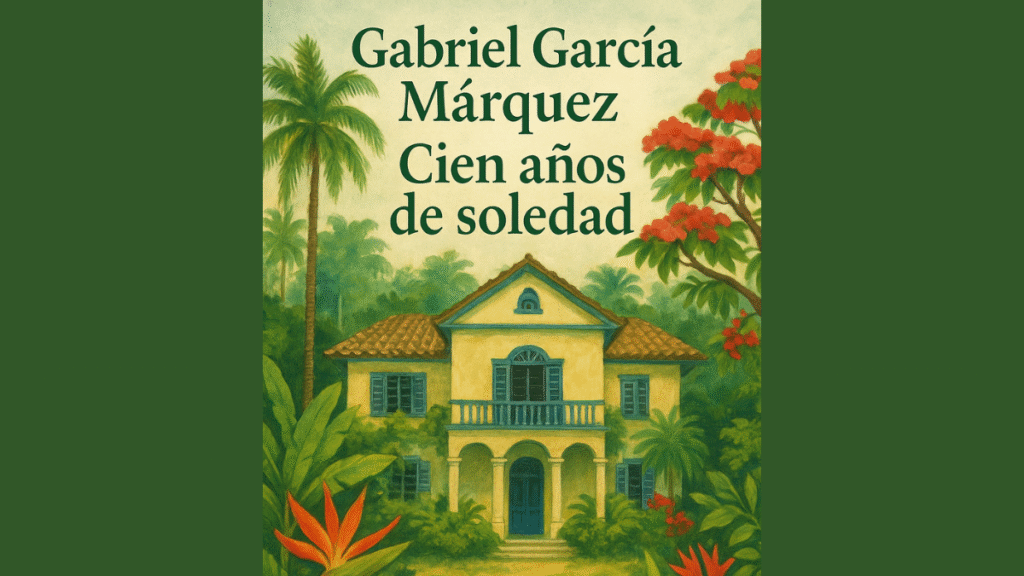
Come with me into the magical world of One Hundred Years of Solitude, the Gabriel García Márquez classic that changed literature forever. My personal take, some trivia, and why you should read it.
One Hundred Years of Solitude is Gabriel García Márquez’s masterpiece, a vibrant chronicle following the Buendía family across seven generations in the mythical town of Macondo. It is a novel steeped in magical realism, where the everyday and the extraordinary intertwine to explore love, power, solitude, and destiny.
Honestly, I have rarely felt what I felt while reading One Hundred Years of Solitude. This book floored me, had me underlining lines nonstop, and above all made me look at the world through different eyes.
The story of the Buendía family in the mythical town of Macondo is not just a family chronicle. It is a genuine hymn to life, to time repeating itself, and to the magic that sometimes slips by unnoticed in ordinary days.
You know the best part? It is a book that grows with you. Every time you go back to it, you find new shades, details, and reflections that passed you by before.
What is this book about?
You could sum it up as the chronicle of seven generations of Buendías, though the truth is that One Hundred Years of Solitude is far more than that. It is a choral story where passion, love, incest, politics, progress, forgetting, and death all share the same narrative space.
Macondo, that town lost in the Colombian jungle, comes into being almost by accident thanks to José Arcadio Buendía and Úrsula Iguarán. There we watch civil wars, banana companies, insomnia epidemics, endless rains, ascensions into heaven, and plagues of yellow butterflies go by. All of it narrated with the calm of someone telling you how they made their coffee this morning.
The author
I cannot talk about this book without pausing on its author, Gabriel García Márquez, or Gabo, as he is affectionately known. He was born in 1927 in Aracataca, Colombia, and he was a journalist before he was a novelist. Maybe that is why his way of narrating the unreal in a reporter’s tone feels so believable.
García Márquez published One Hundred Years of Solitude in 1967 and the novel was an immediate hit. It has been translated into more than 40 languages, sold millions of copies, and opened the door to the Nobel Prize in Literature, which he received in 1982. Beyond the awards, though, what fascinates me is how he captured the soul of Latin America, with its tragedies, its humor, and its contradictions.
What makes this novel so special?
Magical realism in its purest form
This book is probably the most famous example of magical realism there is. The extraordinary happens without anyone getting too worked up about it: Remedios the Beauty rises into the sky on an ordinary day while hanging out the sheets, or an insomnia plague makes the whole town forget who they are. In Macondo, that kind of thing is perfectly normal. Nobody bats an eye.
A mirror of Latin American history
Behind all that fantasy and all those extraordinary events, at least to us readers, lies a deep social and political critique. The civil wars, the banana plantation exploitation, the arrival of progress that is later forgotten: all of it speaks to the turbulent history of the continent.
Rich, poetic language
There are pages I have reread purely for pleasure, for the beauty of the writing. García Márquez had that magical ability to describe the most ordinary things with words that seemed to glow.
My experience with this book
I remember the first time I read it perfectly. I was afraid of getting lost with so many characters sharing the same name, a classic problem with this book, but in the end I let myself be carried along by the hypnotic rhythm of the narration.
I found myself laughing at the antics of certain Buendías, moved by Úrsula’s tenderness, angry at the injustices Macondo lives through, and finally feeling like part of that place where the impossible becomes possible.
It is not an easy book, I will not pretend otherwise. There are moments when you may feel a bit lost among so many José Arcadios and Aurelianos, yet sinking into this novel is absolutely worth it. You end up understanding that the confusion is part of the spell.
Trivia I love
- The original manuscript was nearly lost thanks to the rush and the debts the author was in when he sent the novel off to Buenos Aires.
- In his Nobel speech he acknowledged that One Hundred Years of Solitude grew out of the oral stories he heard from his grandmother in Aracataca, full of ghosts and superstitions.
- Many people believe Macondo was directly inspired by his hometown, though for him it represented the whole of Latin America.
Why do I recommend this book?
Because this is a book you do not simply read, you live it. It makes you question time, memory, and the cycles we repeat as a species and as families. It is a text so full of life, of pain, of humor, of beauty, that it leaves a mark on you.
It is also one of those classics that practically force you to rethink how stories get told. After reading it, no other book feels quite the same.
Unforgettable lines
So you get a sense of the novel’s poetic, powerful tone, here are a few quotes I am in love with:
- “The secret of a good old age is simply an honorable pact with solitude.”
- “The world was so recent that many things lacked names, and in order to indicate them it was necessary to point.”
- “Races condemned to one hundred years of solitude did not have a second opportunity on earth.”
If you want to know a little more about magical realism, here I tell you all about this wonderful literary movement.
To wrap up
Have you read One Hundred Years of Solitude? Did it grab you the way it grabbed me, or is it still on your list? I would love for you to tell me in the comments. If you know someone who loves literature, or who is looking for a book that will change their life, share this post with them. That way we keep building this little corner of passionate readers. Thank you for being here and for letting me share my love of books with you!
If this post was useful to you and you feel like saying thanks, you can buy me a virtual coffee here.