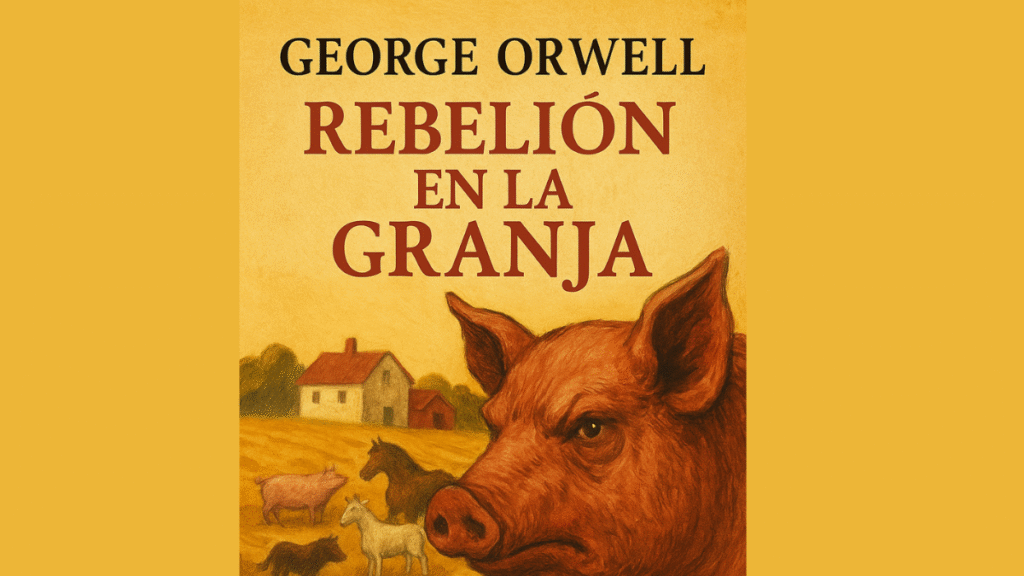
On August 17, 2025, Animal Farm turned 80, George Orwell’s unforgettable political satire. Discover the author’s life, the context the book was born into, its adaptations, and the powerful lessons it still leaves us today.
Animal Farm is a political fable written by George Orwell that uses animals rebelling against humans to attack the abuse of power and the corruption of revolutionary ideals.
When the animals tell us the truth
Some stories never expire. They adapt, travel from one generation to the next, and even as the names and settings change, they keep talking about the same things: power, ambition, hope, and how all of it can go wrong. Animal Farm, published on August 17, 1945, is one of those stories.
George Orwell created a fable that on the surface could read like a children’s story, while in reality it is a merciless X-ray of human nature and of the dangers lying in wait for any revolution.
Eighty years later, the farm is still there, its animals are still talking, and its warnings are still necessary.
George Orwell, the life of a nonconformist
George Orwell, born Eric Arthur Blair in 1903, grew up in a world defined by empires and inequality. He lived in British India, went to English boarding schools, worked as an imperial policeman in Burma, and then plunged into voluntary poverty to see the lives of the disadvantaged up close.
His time in the Spanish Civil War was decisive. He fought against fascism, and he also watched at close range how infighting within the Republican side turned into purges and authoritarianism. That experience made one thing clear to him: oppression does not always come from an outside enemy, sometimes it grows from inside the revolution itself.
All of that lived experience is the bedrock of Animal Farm, written with the clarity of someone who has seen power from the inside and knows exactly what he is talking about.
The historical context: a fable with real names behind it
The novel is a satire of the Russian Revolution of 1917 and of the Stalinist regime that consolidated afterward. Orwell wrote the book in the middle of World War II, when criticizing the Soviet Union was not welcome in certain British circles because of the alliance against Hitler.
That is why Animal Farm was turned down by several publishers before it saw the light of day. Once it finally came out, though, the impact was enormous. In very few pages, Orwell showed how revolutionary ideals could be twisted, and how leaders, once in power, could turn into the very tyrants they had promised to overthrow.
Plot summary
At Manor Farm, the animals, fed up with mistreatment by the farmer, Mr. Jones, decide to rebel and drive him out. Inspired by the ideals of Old Major the pig, they establish Animalism, a system in which everyone is equal and works for the common good.
At first, life improves. Before long, though, Napoleon and Snowball, the two leading pigs, come into conflict. Napoleon drives Snowball out with the help of a pack of trained dogs and keeps all the power for himself.
Little by little, the rules of Animalism get rewritten to benefit the pigs. The other animals work harder than ever, live worse than ever, and accept it all, convinced it is for the good of the farm. Until, at the end, they can no longer tell the pigs from the humans.
Do not tell me that plot cannot be applied to what is happening right now.
The characters and what they symbolize
- Napoleon: stands for Stalin, a leader who concentrates power and uses force to hold on to it.
- Snowball: inspired by Trotsky, the idealist who is expelled and turned into a scapegoat.
- Boxer: the strong, noble horse, a symbol of the worker who trusts authority blindly.
- The sheep: the crowd that repeats slogans without questioning anything.
- The dogs: the repressive force that secures the leader’s power.
- Old Major: the visionary figure, the equivalent of Lenin or Marx, whose ideals are distorted after his death.
Orwell’s style: clarity that stings
Orwell argued that good writing should be like a clean pane of glass. In Animal Farm, that clarity pairs with the structure of a fable, so the message lands directly, without any need for sermons.
The tone is plain, yet every detail carries weight. That is one of the reasons the book remains so accessible and so deep at the same time.
Adaptations of Animal Farm
The book has been brought to all sorts of formats:
- The 1954 animated film: one of the earliest adaptations, produced at the height of the Cold War.
- The 1999 television version: live action with special effects, giving the story a darker tone.
- Stage versions and operas: the story has been performed in theaters around the world.
- Comics and graphic novels: bringing the message to younger readers.
Every adaptation reads the story through its own moment, though they all keep the core intact: a warning against absolute power.
The morals and lessons it leaves us
- Power corrupts: even the people fighting for a better world can turn into oppressors.
- Memory is essential: when history gets manipulated, so does truth.
- Critical thinking is a defense: accepting slogans without questioning them opens the door to manipulation.
- Equality is not automatic: it has to be tended and protected constantly.
These lessons reach far beyond their original context and still apply to the world we live in.
Still relevant today: a mirror of the present
Eighty years on, Animal Farm remains uncomfortable, because it remains true. The manipulation of information, leaders who present themselves as saviors and end up perpetuating injustice, crowds that swallow half truths: all of it is as alive now as it was in 1945.
Reading it today is not only a literary exercise, it is a tool for understanding the present and questioning it.
Conclusion: an eternal fable
Animal Farm is short, yet its echo is endless. George Orwell managed to turn a story about animals into a universal warning against corruption and tyranny.
Marking its eightieth anniversary also means remembering that freedom and justice are never guaranteed, that they have to be defended every single day, and that sometimes the hardest truths are best told through a fable.
What do you think about Animal Farm? Do you believe its message is as powerful today as it was 80 years ago? I would love to read your point of view in the comments and open up a conversation about the lessons it leaves us. If you enjoy this kind of content and want to keep exploring great works of literature together, subscribe so you do not miss the next posts, and share this article with other book lovers.
Before we say goodbye, let me recommend a couple of other books with real substance behind them: The Vegetarian by Han Kang, and one of the great classics, To Kill a Mockingbird. I think you will love them both!