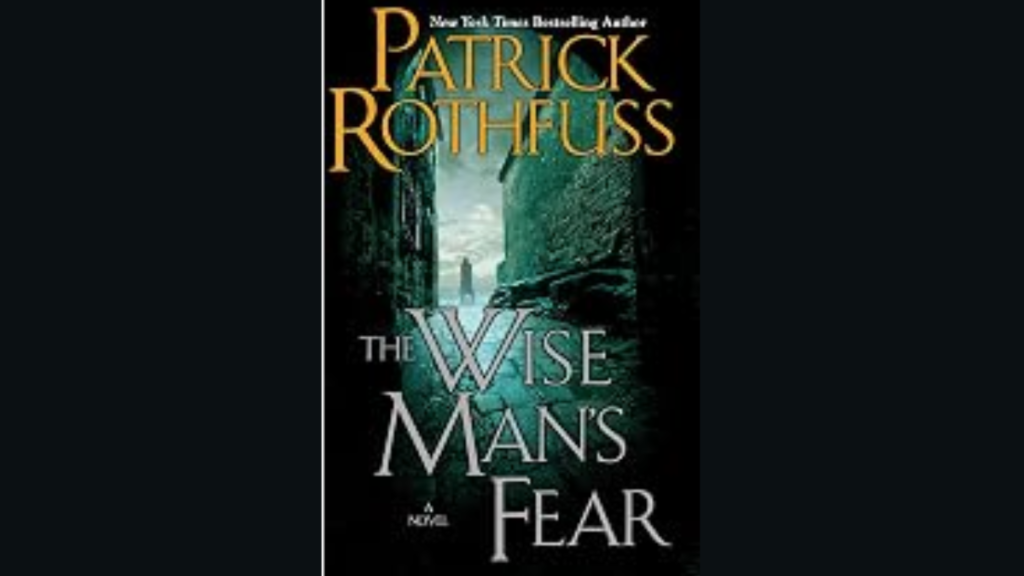
The Wise Man’s Fear: a full analysis of the second installment of The Kingkiller Chronicle. Characters, themes, how it connects to The Name of the Wind, Patrick Rothfuss’s style, and why this series keeps fascinating readers.
The Wise Man’s Fear, the second installment of Patrick Rothfuss’s acclaimed Kingkiller Chronicle trilogy, plunges us into Kvothe’s gripping journey. In this volume, the young hero leaves the University to set out on a road full of magic, mystery, love, and danger, where every step brings him closer to becoming the legend everyone talks about.
“Words are pale shadows of forgotten names. They are names fallen into silence.”
Kvothe
“Sometimes the truth does not need to be spoken out loud to exist. You carry it on your skin, in your eyes.”
Denna
“Naming is not describing, or classifying, or explaining. Naming is knowing.”
Elodin
I read The Wise Man’s Fear with the sense of leaning over the edge of a universe that grows with every chapter: vaster, more complex, more alive. If The Name of the Wind was the invitation, The Wise Man’s Fear is the journey that confirms Patrick Rothfuss wanted to write something bigger than a world of magic and swords. He wanted to describe the way stories turn into legend.
If you have not read it yet, relax: I will avoid the big spoilers. If you have already devoured it, you will find analysis and details here that might tempt you into a reread.
First things first: Rothfuss does not write to fill pages, every scene has texture. As I read, I kept being struck by how the descriptions, sometimes slow and sometimes cut short by the action, made the world feel tangible: smells, rhythms, silences. Kvothe stops being merely a protagonist and becomes both narrator and centerpiece of a meditation on identity, reputation, and the price of legend.
The novel is also ambitious. It is not just chasing adventure: it explores ethics, politics, music, martial philosophy (the Lethani of the Adem people), magic with real rules (sympathy and naming), and the nature of truth. That makes the reading satisfying on many levels, and for me it is the book where Rothfuss reaches a really notable narrative maturity.
Patrick Rothfuss and the origins of the trilogy
Who is Patrick Rothfuss
Patrick Rothfuss was born in Madison, Wisconsin, in 1973. He studied at Washington State University and spent years carving out his work until, after a long road, he managed to publish The Name of the Wind in 2007. With a careful style that is lyrical and direct at once, Rothfuss introduced Kvothe and the world of Temerant. His narrative voice, mixing the epic with sensitivity and private reflection, connected with an enormous readership that is still waiting for the trilogy to close.
The original structure: a trilogy built on a frame story
The Kingkiller Chronicle is set up as a framed narrative: Kvothe, now retired under the identity of Kote, tells his life to Chronicler over three days. Each day corresponds to one book of the trilogy. The first covers his childhood and early years, the second digs into his youth and bigger adventures, and the third, we hope, will close the circle. That setup creates a double reading: the story as it is lived, and the story as it is told and transformed into legend.
Where this book sits in the trilogy: its relationship with The Name of the Wind
The Name of the Wind, the origin
The Name of the Wind gave us Kvothe’s childhood, his time in destitution and at the University, his thirst for knowledge, and his early personality. It was a novel of discovery, curiosity, and wonder, where music and learning set the rhythm. Plenty of readers fell in love there with Kvothe’s voice and the way he tells a story, myself included.
The Wise Man’s Fear, the expansion
The Wise Man’s Fear picks up that voice and makes it more complex. If the first book set the context, the second widens the horizon: journeys, courts, new peoples, training, and relationships that transform the main character. Here we see Kvothe in situations that force him up against politics, honor, loss, and ambition. The essence of the trilogy, how myth is born out of a man, becomes far more visible. This second volume in particular explores how individual decisions, some small and some enormous, weave the reputation the world ends up remembering.
What The Wise Man’s Fear is about, with no major spoilers
If you asked me for the plot in one line, I would say this is the book of the trials that forge the legend. Let me unpack that a little more calmly, though.
Travel and learning
A large part of the book consists of the journeys Kvothe undertakes away from the University, taking him into wildly different cultural settings: palace courts, warrior lands, complicated political climates, and specialized teachings, such as how the Adem train and understand combat. It is a novel where learning is not only academic, it is physical, moral, and social. Kvothe learns languages, songs, ways of being, and with every lesson his view of the world shifts.
Encounters that transform him
There are encounters, romantic, dangerous, and enigmatic, that define this book. On the emotional side, the relationship with Denna remains one of the central threads: complex, ambiguous, full of comings and goings. On the fantastical side, the novel expands what we know about magic: sympathy, an almost scientific magic based on affinity and energy, and the search for what it means to “name” something, which in this universe is a profound understanding of the essence of things.
Moral and political conflicts
Unlike the first book, here Rothfuss brings in the intrigues of power far more openly: courts, lords, and plots where reputation, lineage, and diplomacy weigh as much as the sword. Kvothe moves through those spaces with cunning, and at the same time with internal wounds that shape his decisions.
A closer look at the big themes
1. The weight of legend and the truth of the person
One of the book’s philosophical questions is plain enough: what is left of the man behind the myth? Kvothe asserts his version of events to a chronicler, while Rothfuss keeps insisting on the gap between what is told and what happened. That opens up debates about memory, subjectivity, and how history gets built.
2. Music as a form of knowledge
Kvothe is a musician. Music is not simple entertainment here, it is a method of understanding, an emotional bridge, and on occasion a tool. The songs, poems, and fragments scattered through the novel help build its atmosphere and deepen the characters. If you are drawn to literature where art carries narrative weight, you will find it here.
3. The magic: sympathy and naming
Magic in Temerant is not arbitrary. Sympathy works like a science, with laws and costs. The art of naming, saying the true name of something in order to control it, is another kind of magic, subtler and more dangerous. Rothfuss blends science and mystery, and he does it coherently and originally.
4. Love, loss, and obsession
The relationship with Denna is a study in the impossibility of possessing someone and the beauty of wanting them. Kvothe does not only love, he also comes up against jealousy, mistakes, and misunderstanding. That is what makes the novel open real wounds in the reader: the frustration of watching a great soul trip over its own complexity.
5. The ethics of combat and the Lethani
During his time among the Adem, Kvothe is confronted with another way of seeing life: a martial philosophy that puts harmony, intention, and a code first, the Lethani. The novel uses that experience to ask questions about justified violence, honor, and discipline.
Key characters: more than banners, people who feel
Kvothe
He is the protagonist and the narrator. Intelligent, proud, impulsive, and tremendously gifted, Kvothe is the axis of the trilogy. His character forges the story. In this book we see him evolving: wiser, and also more aware of his own failings.
Denna
Enigmatic, free, elusive. Her ambiguity is her strength. Her relationship with Kvothe is one of the most discussed in the whole series. Is Denna a refuge, a wound, or both? Rothfuss draws her as a complex being who slips out of any easy definition.
Chronicler (Devan Lochees)
The scribe writing down Kvothe’s story. His presence reminds us that we are dealing with a deliberate narration: someone is choosing what to tell.
Bast
The figure who keeps company with the present day Kvothe, the Kote of the frame story. Bast brings light, unease, and a certain complicity with the legend.
Supporting characters: the Maer, the Adem, Felurian
The novel brings in courtiers, warriors, beings from the Fae, and characters who enrich the plot. Each one has a voice of their own and a narrative function that goes beyond mere paperwork: every one of them leaves a mark.
Style and language: poetry that never gives up on action
Rothfuss sometimes reminds me of a singer songwriter who decides to write a symphony. His prose is musical, packed with sentences you want to underline, with calculated pauses and images that stay with you. Be careful, though: that musicality never gets in the way of the tension. The rhythm alternates intense chapters with meditative ones. The reading asks for your commitment, and the payoff is big. If you are after lines that follow you around for days, this book has plenty.
Critical reception and the fandom
Since publication, The Wise Man’s Fear has cemented Rothfuss as a major voice in modern fantasy. The reader community is intense: forums, theories, analysis, and enormous anticipation for The Doors of Stone, the book that is supposed to close the trilogy.
At the same time, the book has drawn its share of criticism. Some readers feel the pacing is uneven, or that the prose spreads out into digressions. Personally, I think those digressions are part of the charm. They let you breathe, think, and better understand what drives the characters.
Adaptations and the future of the series
There have been attempts and proposals to adapt the Chronicle into other formats, series and screen projects among them, and industry interest is high. The definitive adaptation has yet to materialize in any stable form, though. In the meantime, the community keeps producing fan art, soundtracks, and discussions that keep Kvothe’s universe alive.
A thought on waiting for The Doors of Stone
If there is one recurring topic among readers, it is the wait for the third book. I understand the impatience: when a series grabs you, you want to complete the circle. I also think the wait has turned this trilogy into something more than literature, into a cultural phenomenon where the conversation between readers is part of the experience.
My personal advice: enjoy what has been published, reread passages, and join the debates. That makes the journey richer.
Frequently asked questions about The Wise Man’s Fear
How many pages does The Wise Man’s Fear have?
It depends on the edition and the format. English editions usually run somewhere between 1,000 and 1,200 pages, and translations and layouts vary.
Do I have to read The Name of the Wind first?
For me, yes. The second book picks up directly from the first and builds on a lot of its plot threads. Starting with the second one is likely to leave you confused and to cost you a lot of nuance.
Is it a good fit for readers new to fantasy?
Yes, though bear in mind that Rothfuss mixes fantasy with reflective prose and digressions. If you like epic stories with psychological depth, he is your author. If you prefer nonstop action with no pauses, you might want to try something else first.
Are there spoilers in this post?
I have avoided major spoilers about events that meaningfully change the plot.
What should you read after The Wise Man’s Fear?
It depends on what you loved. If it was the prose, look for authors like Guy Gavriel Kay. If it was the worldbuilding, carry on with the rest of the series, and try N. K. Jemisin or Neil Gaiman for different tones. If it was the music and the lyricism, Susanna Clarke’s work might be for you.
Why does Kvothe still matter?
For me, Kvothe matters because he embodies human contradiction: greatness and clumsiness, genius and error, love and self destruction. Rothfuss reminds us that legends are built out of scraps of truth and the imagination of whoever tells them. Reading The Wise Man’s Fear means accepting that ambiguity and letting yourself be moved by a story that is not afraid to look straight at the emotional complexity of its characters.
If you made it this far, thank you for reading. I would love to know: what do you think of this book? Which scene or character stayed with you? Write it in the comments, and I promise to read and reply. If you are hungry for more, do not miss the review of The Name of the Wind, the first book in the trilogy.
You can find the book on Amazon.