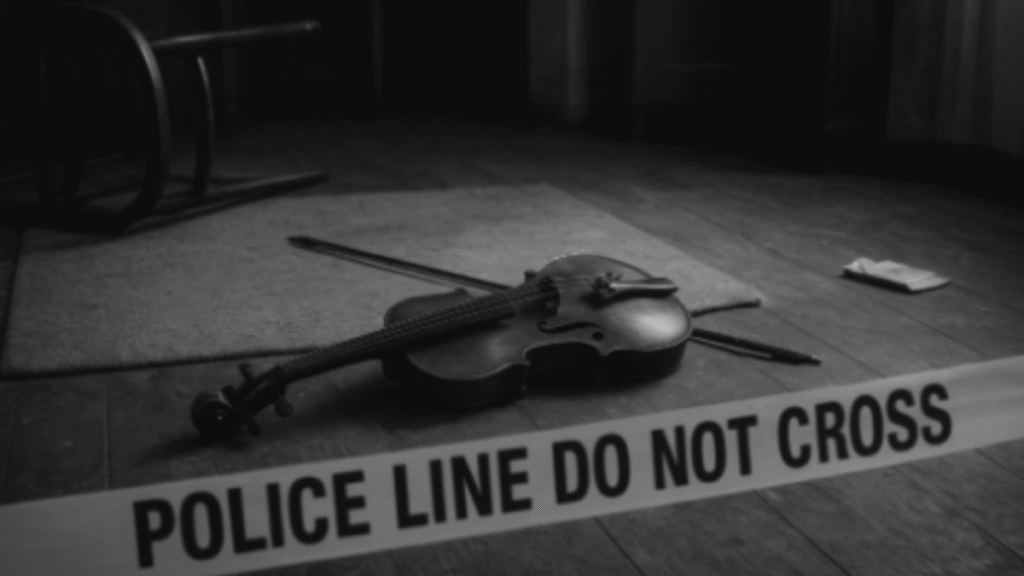
Discover the story of the clock with no hands in The Crime Gazette. A dark chronicle that pushes back against time and keeps some unsettling secrets.
The Crime Gazette
Weekly Edition, Mysteries and Unexplained Events
The clock with no hands
For months now, this town has learned to listen to time instead of checking it. The culprit, or the guardian, depending on who is telling the story, is an antique clock sold by a dealer on Herradores Street. It has no hands, which ought to leave it mute, and yet the people who have hung it in their homes talk about a metallic heartbeat, a breathing made of bronze, a rhythm that measures endings rather than minutes. They call it the Clock With No Hands. This chronicle follows its trail from the first sale to the last silence it left behind.
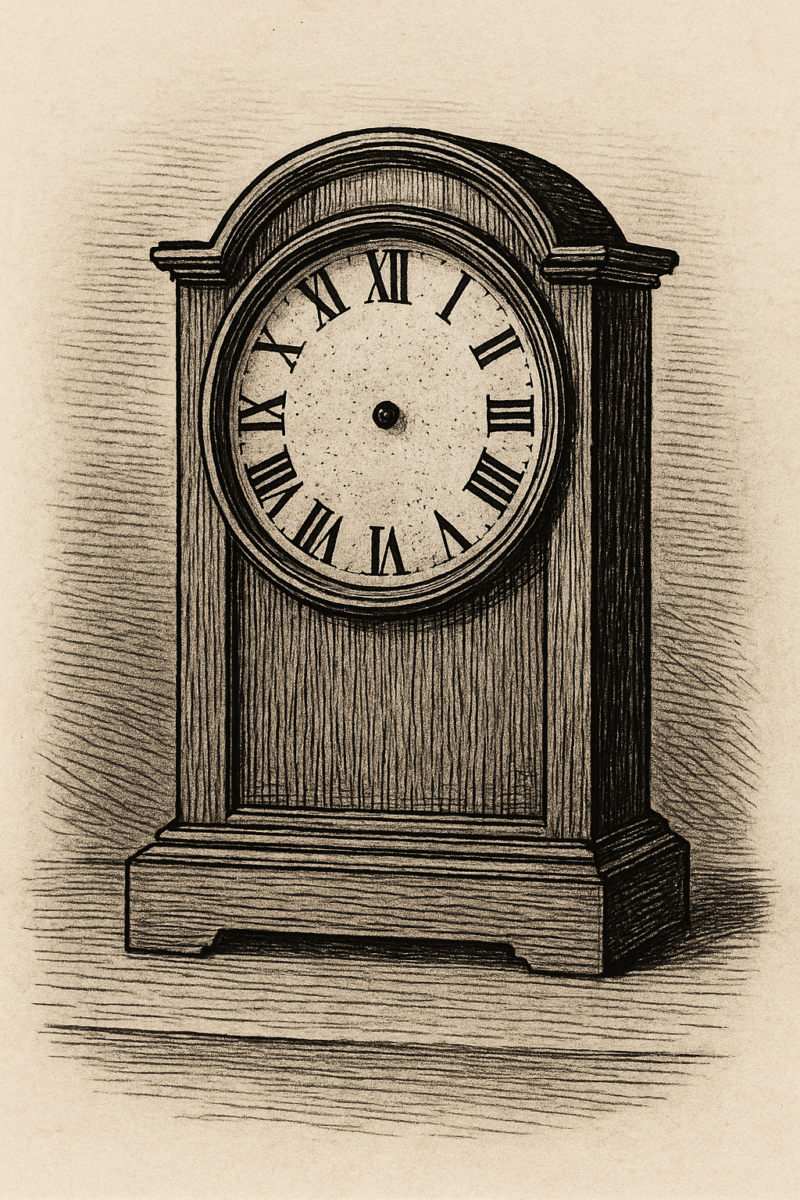
There is nothing to wind and no battery to replace. The case, dark wood, shows mother of pearl flowers and a small moon engraved on the plate. Where the hands should be, there is a pane of glass as clear as an animal’s eye, and behind it a white face gone faintly yellow with age. The pendulum, gilded, swings sometimes. Other times it sleeps. No rules. No warning. No permission asked. Put your ear close and you catch a faint sound, not a tick and not a hum, closer to the metal ring of a coin dropping into a well, though sustained and almost sweet. Even so, everything around the clock smells like a warning.
For this Gazette, the case starts on the afternoon of March 3, when a young woman, Mariana R., walks into Don Basilio’s antique shop looking for a gift for her father and walks out with the clock under her arm, wrapped in butcher paper. She hangs it in her hallway that same night, and the next morning her father collapses. He does not die, but he stays in the hospital for several days with a vague diagnosis. The family, superstitious like so many, carries the clock down to the storage room. The heartbeat, according to Mariana, could be heard from the landing, as though the whole building had it in its chest.
The dealer on Herradores and the first rumor
Don Basilio, the antique dealer, denies that the clock is cursed. “It is a curious piece, sure, even a rare one. It came in a lot with two lamps and a sewing box. I like things that tell stories. That is what sells. This one told too much, maybe.” His shop is a catalog of friendly dust: pocket watches that no longer beat, cages without birds, portraits of gentlemen in solemn suspenders. On a high shelf sits the gap the handless clock left behind. “I kept it at home for a while, to test it,” he admits. “It did nothing. Or I did not know how to listen.”
Once the story of Mariana’s father spread through the neighborhood, other buyers showed up. Some had seen the clock at a friend’s house. A widow hung it above her dresser and was visited by a dream so vivid, a train station with no platforms, that she woke up certain of one thing: somebody was leaving. Two days later her brother in law died, a man she barely knew. “I am not saying this out of superstition,” she tells me. “I am saying it so you understand that the clock does not announce an immediate death. It only warns you that news is coming. Like a telegram the bronze brings you from somewhere time does not wear out the way it does here.”
The rumor, moving with the quiet step of a cat, got louder: the clock does not tell the hour, it marks the end. Not every household that hung it suffered a loss, which is only fair to say. Every one of them, though, without exception, reported something: appliances that stopped at 12:11 a.m., light bulbs that went out together even when they were different brands, dogs that quit barking and stared at the pendulum with the inexplicable obedience you show to someone who gives orders without speaking.
Witnesses to the metallic heartbeat
Ana Beltran, a nurse, went to her mother’s house after getting a call from her in tears. “She did not tell me why. Just ‘come.’ When I walked in, I heard the heartbeat: metallic, yes, but also like someone breathing inside a box. I cannot explain it in clinical terms. My mother took me into the hallway, stopped in front of the clock, and said: ‘Listen. It is like it is saying goodbye.’ I did not want to believe her. That afternoon my aunt was admitted to the hospital, and she died at dawn, of something sudden.”
Mateo, a retired watchmaker, wanted to open the case to look at the works. “The lock had no key, so I jimmied it. The moment the screwdriver went in, the pendulum, which had been still for an hour, started to swing. Not fast, but steady. The wood was warm, like someone had been blowing on it from the inside. I shut it again. It gave me pause, not out of fear, more out of something like manners. You do not open a heart while it is beating.”
The Mendoza family returned the clock to Don Basilio after a week. “We were not sleeping. It was not that it made noise, it was not noise, it was its presence. I would walk into the kitchen in the middle of the night and know, without looking, that the pendulum was still. Or know that it was going. How? I have no idea, the way you know someone is watching you without seeing them. The kids stopped using the hallway. They were embarrassed to say they were scared of a thing with no hands.”
Provenance: the trail before Herradores
The paperwork for the lot the clock traveled in is thin: an initial (“C.”), the address of an inherited house on the outskirts of town, two signatures nobody can read. The house had been empty for years. Neighbors remember an older woman who lived alone and kept a spotless schedule: eight o’clock Mass, sheets on the line every Thursday, a lamp in the window on Sunday afternoons. Nobody went inside after the body was taken away. The clock must have stayed there, marking nothing, for years.
A note in pencil on the back of the clock, found by the dealer while he was cleaning the piece, reads: “So I do not forget.” Nothing else. Remember what? Remember whom? The line, plain enough to hurt, is worth several short stories and one chronicle: this one. Some people suggest the clock was hung in memory of someone who died, and that its heartbeat announces no death at all, only the stubbornness of remembering. Others answer that if this were true, why do the same things happen in every house? Can one person’s memory brush up against everyone else’s endings?
A carpenter who worked on the house outside town says the clock hung in the hallway, between the kitchen and the bedroom. “The missing hands caught my eye, obviously. I went to move it so I could varnish the wall, and it weighed more than it should have, like there was a lead box inside. It was hot, too. Hot in the winter, hotter in the summer, but not from the sun. That heat came from inside.”
Experiments, loosely scientific
To get out from under the rumors, we gathered three volunteers, an engineer, a musician, and a physics student, in a big room with whitewashed walls. We hung the handless clock and set up a high sensitivity recorder, a laser thermometer, a sound meter, and a vibration meter around it. The clock sat still for twenty minutes, completely silent. At minute twenty one, the pendulum moved half an inch and began to swing, calmly. The recorder picked up a low frequency sound close to infrasound, the thermometer registered a rise of 3.2 °F (1.8 °C) directly above the case, and the vibration meter flagged a micro oscillation we could not pin on traffic or on the building itself.
The musician suggested holding a sustained note on a tuning fork. At 440 Hz, nothing. At 432 Hz, the pendulum seemed to fall into step, which could have been our imagination, we admit that. The student dimmed the lights and the sound stayed. Nine minutes in, the heartbeat vanished, as if someone had pulled a cloth off it. We turned the lights back on, the pendulum swung twice more, then stopped for good. “The machine does not want to be measured,” the engineer said, half smiling. “Or it runs on some other logic.”
The most unsettling part came with no instruments at all. At 12:11 a.m., yes, that hour again, the clock, motionless, seemed to pull the air tight. There is no better word for it. In that same second the recorder shut off, the floor lamp flickered, and the student put a hand on her chest. “I just thought about my grandfather,” she said, without sounding sad. After that, the room was the same room it had always been, and the night was one more night with its ration of honest superstition and modestly useless measurements.
A timeline of houses and findings
- Mariana R.’s house (March): her father collapses. Clock goes to the storage room. Heartbeat audible from the landing. Three nights of brief blackouts at 12:11 a.m.
- The widow P.’s apartment (April): vivid dream of a station with no platforms, her brother in law dies two days later. Clock returned to the dealer.
- The Mendoza family (May): the children avoid the hallway, a sense of “presence” with no sound. Appliances read 12:11 a.m. when switched on. Returned immediately.
- A high school teacher (June): note in his journal reads, “The clock beats hard when I read out loud.” His sister falls seriously ill that same week. He decides to keep the clock “so I do not lie to time.” He still has it.
- A country house at kilometer 7 (July): family reunion. A guest puts a hand on the wood and says he feels “a voice with no sound.” Nobody dies, though there is a fight and a reconciliation. The clock has hung there ever since, and a heartbeat is heard now and then.
Competing theories: instrument, oracle, or mirror
The instrumental theory holds that the clock contains some thermal or acoustic resonance mechanism which, as the materials age, gets triggered by shifts in humidity and temperature, producing sounds and small movements of the pendulum. It would be a strange coincidence that the “endings” of people close to the owners keep landing inside those windows, which reinforces the illusion of cause and effect.
The oracular theory argues that the clock, stripped of its hands, stopped measuring time in order to announce it, as if it had been let go from the job of counting seconds so it could point at thresholds instead. It neither kills nor saves. It warns. Sometimes with plenty of notice, sometimes down to the minute before.
The mirror theory, this reporter’s favorite, says the clock gives back the inner rhythms of whoever lives with it, amplified. Hang it in a house where unspoken grief is nesting in the drawers and it beats like a reminder. Look at it the way you look at a saint and it answers with its small miracle of sound. Challenge it with arrogance and it stays quiet until the silence, heavy as lead, ends up doing the talking. There is no magic here, only the old machinery of a conscience that, finding no hands to look at, looks at itself.
The clock and the children
A preschool near the antique shop organized a field trip for the older kids. They were shown cuckoo clocks, alarm clocks, water clocks. When they reached the handless clock, which Don Basilio had taken back that week, the children went quiet in a way children rarely do. One girl reached out and touched the glass. “It is sad,” she said. No other reaction. Back in class, they drew pictures. In every one of them the clock had eyes. One was crying. One was laughing. One was asleep. “That is the most honest thing I have seen come out of this case,” the school psychologist says. “For them, time has a face. Adults could stand to remember that once in a while.”
Not every ending is a death
The town, in its rush to make stories line up, quickly turned the heartbeat into a synonym for mourning. It was not always that. A baker says the clock sounded in his back room, because yes, once you live with it you learn to tell when it is “sounding,” and that afternoon he decided to close early and go talk to his brother, whom he had not spoken to since a fight over an inheritance. They made up. “If the clock calls endings,” he says, “it calls the end of grudges too.” A young woman left her partner after two years of lukewarm postponements, on the very night the pendulum kept an almost cheerful rhythm. “It did not announce a death,” she says. “It announced a life I was not living.”
Maybe the mistake was ours, for writing this phenomenon up in the blackest ink we had. A reader wrote to the Gazette: “If the clock could talk, it would say: I will not tell you how long you have left to die, I will tell you what you have left to live.” Not a bad line for an object that had its hands taken away and still finds a way to point at something.
A night with the clock (field notes)
This reporter hung the clock in his office, with Don Basilio’s blessing, for 48 hours. First night: nothing. I kept writing with the discipline of an old soldier. Second night: at 11:58 p.m., a small cold visited my ankle, climbed to my knee, and settled at the back of my neck. It was not a shiver. It was closer to straightening up when someone you respect walks in. I went to the clock and put my palm on the wood. Warm. The pendulum, still. I set a candle beside it, not out of superstition but for the softer light. At 12:11 a.m., the candle shed a tear of wax. The pendulum moved, almost unsure of itself. I took a deep breath and remembered a phone call I have not made in years. Someone I still owe two words: “I forgive you.” I did not die. Nobody died, as far as I know. At dawn, though, I called. The voice on the other end shook and then steadied. The clock went quiet again.
I am returning the piece to Herradores with real respect. I no longer know whether I believe or whether I want to believe. What I know is that some objects simply take our measure, and the measure is less a number than a pulse. The clock, orphaned of its hands, measures the weight of every not yet and every no longer. You hang it up and, like it or not, it hangs a question over you: what unfinished business is humming in your house?
This Gazette’s recommendations
- Do not hang it in a bedroom if you are the suggestible type. A hallway is a better judge than a pillow.
- If you decide to open the case, do it with a watchmaker or do not do it at all. An old heart deserves hands that know how to listen.
- Write down whatever happens: time, weather, your mood. There can be truth in a humble piece of data.
- Do not automatically tie its heartbeat to death. Sometimes it is warning you about something that can still be said.
- If it weighs on you, take it back. Not all of us are built to live under the rhythm of an object with a memory.
Epilogue: the time clocks do not teach
A clock with no hands is a walking contradiction, a gentle piece of irony, a metaphor dressed in varnished wood. If this piece has taught us anything, it is that sometimes time is not measured, it is heard. Sometimes it sounds like metal learning to sigh, sometimes like a silence that tastes of goodbye, sometimes like a bell ringing in your chest with the sentence you keep putting off. Nobody in this town is going to get rich arguing about magic versus acoustics. The town will come out wiser, though, if it learns to talk with its objects, to thank them for what they warn us about, to return them to the shop once they are no longer needed.
Maybe the hands were never lost. Maybe we carry them in our fingers when we dial a number we never dial, on our tongue when we say a truth we never say, in our feet when they walk toward the person who has an embrace coming. Let the handless clock keep moving, or not, wherever it belongs. Let its heartbeat, whenever it comes, call us to the heroic and thoroughly ordinary act of living on time.
Would you hang the clock with no hands in your own home? Was it an oracle for you, a mirror, or just a piece of furniture with a temper? Leave your account in the comments. At The Crime Gazette, every reader is an investigator too.
Do not miss the latest entries from The Gazette