A deep, adult, close-up look at Alice’s Adventures in Wonderland. Full analysis, symbolism, theories, spoilers, the author, puzzles, and reflections for understanding this classic from another angle.
The same thing always happens to me with books that survive the years. I do not think they stay alive out of obligation or nostalgia, but because they are hiding something that still reaches us even though our world looks nothing like theirs. If there is one book that keeps coming back, almost as if it were following us around, it is Alice’s Adventures in Wonderland.
Alice is not a children’s story and nothing more, and it is not only absurdist fantasy either. It is a warped mirror that, if you dare to look at it calmly, hands back parts of you that you may have hidden away without noticing.
Fair warning, I am going to take it apart completely, with spoilers, theories, mathematics, rumors, the author’s shadows, psychological readings, symbolism, and what every chapter is hiding behind the words. If you feel like a deep and slightly unhinged trip alongside Alice, you are in exactly the right place.
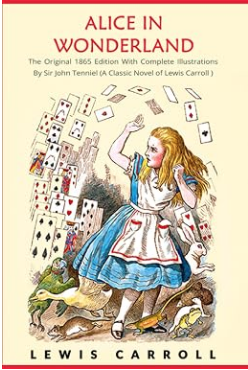
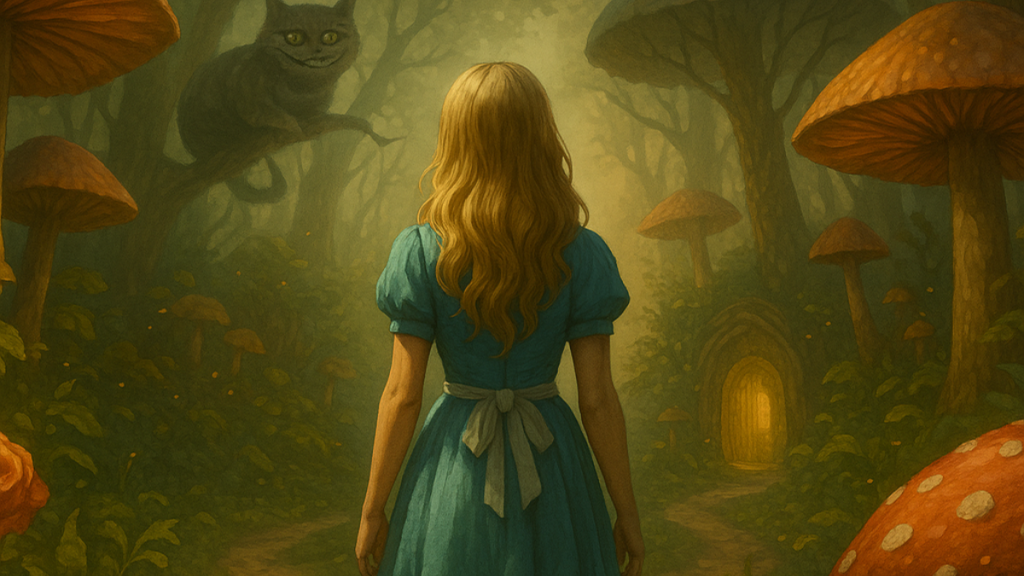
Alice’s Adventures in Wonderland tells the story of a girl who follows a White Rabbit down a hole and lands in an absurd world full of extravagant creatures, rules that make no sense, changes in size, and situations that defy logic.
Across her journey, Alice comes up against confusion, identity, and chaos. It looks like a children’s story, and the book is a satire of Victorian society and a psychological journey packed with symbolism, logic games, and reflection on identity and growing up.
Why Alice in Wonderland still catches us even though we are not children anymore
Something that has always fascinated me is that Alice in Wonderland does not follow a classic plot. It is not trying to get from point A to point B, and there is no clear mission. It is a dream, a maze, an ongoing chaos, and somewhere inside that chaos there is something that hooks us without our quite knowing why.
When you reread it as an adult, you realize it is actually about something very ordinary: bewilderment, confusion, the sense that things are changing too fast and you do not really know who you are in the middle of all that.
Alice’s fall is the perfect metaphor for it. She does not only fall into a hole, she falls into a new mental state, into a stage where she has stopped being a child and does not know what growing up means either. It is that moment when you notice something inside you shifting, before you can put a name to it.
Wonderland is not pretty. It is contradictory, absurd, uncomfortable, and I think that is exactly why it connects with us. Because real life is often like that too.
This post contains affiliate links
The author under the magnifying glass: who Lewis Carroll really was
Before we get into the chapters, I want to talk a bit about the author, because his figure explains a lot about the book, including the parts it never says out loud.
Lewis Carroll was the pen name of Charles Lutwidge Dodgson. Mathematician, logician, photographer, Oxford lecturer. A shy man with an extremely complicated inner life. The perfect mix for building a world where logic bends and snaps at every turn.
The mathematician who played with the impossible
Once you know Carroll was a mathematician, you understand why the book is so full of paradoxes, logic games, and situations that look impossible while having an almost perfect internal structure.
The circular dialogue, the riddles with no solution, the rules that only work while somebody is saying them out loud, the size changes that wreck every proportion. All of it is Carroll laughing at logic from the inside.
Alice in Wonderland is a mental laboratory dressed up as a children’s story.
The author’s shadow: the controversy and what we will never know
There is a delicate, complicated subject whenever Carroll comes up, which is his relationship with children, especially with Alice Liddell, the real girl who inspired the character.
Honestly, there is no single truth here. There are interpretations, historical silences, ambiguous letters, and endless debate. Some people describe him as an extremely sentimental man, socially clumsy, who found comfort in the imagination of children. Others analyze him from far harsher angles.
I do not think we need to turn the author into a monster or a saint in order to talk about the work. What matters is that the shadow exists and travels with the book, giving it an unsettling quality you notice when you read it as an adult.
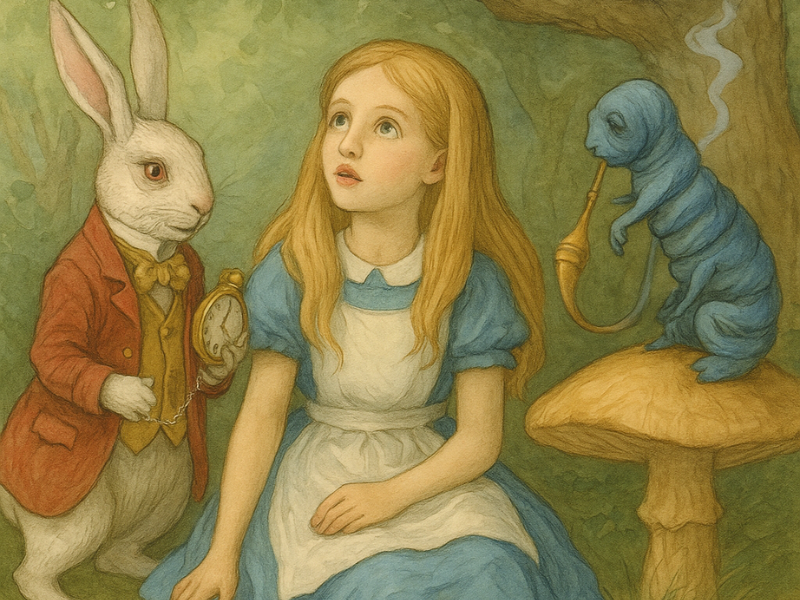
Alice in Wonderland chapter by chapter, with spoilers
Chapter 1: Down the rabbit hole and the endless fall
This scene is one of my favorites, because I remember it from childhood as something magical and now, as an adult, I see it as a gorgeous portrait of losing control. Alice does not fall in fear, she falls in curiosity. She thinks, she talks to herself, she rambles.
The fall is almost hypnotic, like when you notice your life is changing and still have no idea where you are headed. The White Rabbit, always running, is anxiety made flesh, that constant sense of being late without knowing what for.
Alice never asks where the rabbit is going, she simply follows him, and that says more about her than any description could.
Chapter 2: The pool of tears
Here the central theme of the book begins: identity. Alice changes size with no control over it. She grows, she shrinks, she gets distorted. Think about it and it is unsettling, almost distressing.
It is the perfect metaphor for those moments when you do not recognize yourself, when you feel like you no longer fit your old life and do not fit the new one either. The pool of tears is a powerful image. You cry so much that you drown in your own emotions.
Chapter 3: The absurd race and the soggy animals
This chapter has always struck me as a hilarious jab at politics, and at how people argue when they want to come out on top without saying anything useful. Carroll gives us a group of soaking wet animals who stage a circular race where everybody runs pointlessly, with no clear rules, and everybody still believes they won. Tell me that does not remind you of certain modern debates.
Alice tries to bring order because she still holds that childhood belief that if you explain yourself well, people understand you. The animals do their own thing, though. Each of them talks about something different, nobody answers anybody, and they all act like chaos is the normal state of affairs.
The worst part is how realistic that attitude is. Sometimes it does not matter how hard you try to be logical, people hear only what they want to hear.
Chapter 4: The Rabbit, authority, and total loss of control
In this chapter the White Rabbit treats Alice like his housemaid, as if it were obvious she is there to serve him. The surprising part is that Alice, confused, goes along with it. Carroll is pointing at something very real: when you are unclear about who you are, it is very easy for other people to decide for you.
I love the scene at the Rabbit’s house because it mixes humor with discomfort. Alice changes size again, drastically. She is so big she cannot fit inside, and when she tries to fix it, she makes everything worse.
The metaphor could not be clearer: feeling too big for the mold you have been handed and too small to impose your own rules. It has more to do with adult life than it looks.
Bill the Lizard, the animals, the shouting, the complete chaos. Carroll gets you laughing while you feel that strange low-level dread creeping in.
Chapter 5: The blue Caterpillar and the question that breaks you open
The Caterpillar is one of those characters who seem calm, almost indifferent, and then drop the heaviest philosophical bomb in the book. The scene is beautiful. The Caterpillar smokes, looks at Alice calmly, and asks her who she is.
She, who has gone from towering to a few inches tall, who has cried an entire pool, who has been treated like a servant and understands none of it, answers that she does not even know anymore.
It sounds simple, and it is a hugely important moment. Alice’s identity starts to fracture. The Caterpillar does not help her, does not comfort her, does not hand her answers. He just throws reality in her face.
His famous advice that she will get used to it has always struck me as harsh, almost cruel, and also necessary. There is a point in life where you realize not everything can be controlled, that changing is part of the process, and that no instruction manual exists.
In that sense the Caterpillar is more wise than kind, and maybe that is exactly what Alice needed.
Chapter 6: Pig and pepper, or when domestic chaos throws you off
This chapter has always left a strange feeling in my body. The first time I read it as a child it seemed chaotic and a little gross. As an adult, I see something darker behind it.
The Duchess’s house is an uncomfortable space, full of smoke, shouting, flying objects, and a baby crying nonstop. The cook throws in so much pepper that even Alice sneezes. The Duchess yells, talks nonsense, and handles the baby roughly. Then, suddenly, the baby turns into a pig.
Yes, it is absurd, and it is also symbolic. Carroll is talking about everyday emotional violence, the kind that happens inside a home and that we sometimes normalize even though it leaves marks. The Duchess represents irrational, volatile authority, the figure who can be charming one minute and terrifying the next.
The baby who turns into a pig can be read as social pressure molding and deforming other people’s identities. Almost a critique of an education built on shouting and rigid rules. Alice tries to stay logical in the middle of the chaos, and logic is no use here. This part of the book is a small domestic nightmare dressed up as absurdist humor.
Chapter 7: The Mad Tea Party
Here comes one of the most famous scenes in the whole book, and for good reason. The eternal tea, the table covered in cups, the impossible conversation, time standing still. At first glance it looks like a funny scene and nothing more, and when you read it closely you see an enormous critique of social nonsense.
The Hatter, the March Hare, and the Dormouse represent three ways of losing your mind: hyperactivity, anxiety, and total avoidance. Alice tries to understand them, asks questions, hunts for an explanation. They answer with lines that sound like jokes and actually run on an internal logic only they understand.
The Hatter saying he quarreled with Time is one of the most interesting moments in the book. Carroll turns time into a character, one more capricious and incomprehensible authority. It is very poetic that time stops at six o’clock. You can read it as emotional stagnation, as paralysis, or as punishment.
Alice, trying to be rational, ends up more frustrated than enlightened. This scene shows the collision between wanting to understand and having to accept that sometimes there is nothing to understand.
Chapter 8: The Queen’s garden and the perfect world that is not
When Alice finally reaches the garden she has been chasing since the beginning, what she finds is not an idyllic place. It is another space full of rigid rules and absurd expectations.
The roses painted red strike me as a very powerful image. The cards have to paint them because the Queen wants red roses, not white ones. It is a critique of the facade, of pretending to be what you are not, of following pointless rules purely to stay out of trouble. I cannot count the times I have felt that in adult life we paint our own roses in order to fit in.
If you are picturing the talking flowers here, that is Disney’s doing. The 1951 film borrowed them from Through the Looking-Glass and dropped them into this garden. They are worth mentioning anyway, because they work the same way: beautiful on the outside, cruel and snobbish underneath, sizing Alice up and filing her into categories like a shop window display. They are a metaphor for the people who smile at you while criticizing you behind your back.
The Queen of Hearts and fear as a system
The Queen is one of the best known characters and also one of the most exaggerated. Her line about taking off heads has turned into a popular joke, and if you think about it carefully, she is irrational fear made flesh.
The Queen does not rule because she has any legitimacy, she rules because she threatens. Her power rests on fear, and translated to real life, that is far too recognizable. How often do we obey absurd rules simply because we are afraid to question them?
The King tries to act as a counterweight and nobody listens to him. He represents the figure who looks like he has power and actually counts for nothing. He is almost decorative, like certain authorities who are there purely for appearances.
The Mock Turtle and the sadness behind the humor
These chapters have a melancholy tone I did not understand as a child and now find beautiful. The Mock Turtle talks about her past with a mix of nostalgia and absurdity. Her story is not epic or important, and she lives it with real intensity.
Carroll reminds us that the things other people write off as trivial can be fundamental to you. The Gryphon at her side, always in a rush, does not seem to understand her sadness, and even so he acts as a kind of accidental guide for Alice.
The trial, or the justice system as farce
The trial is a direct swipe at Victorian justice. The evidence proves nothing, the witnesses say nothing useful, the rules change halfway through, and the verdict seems to have been decided in advance.
The letter presented as evidence is one of the best jokes in the book. It says something that means nothing, and everybody works hard to interpret it as definitive proof.
Alice, who had always been a spectator, steps into the center, and this is where her final transformation starts. She stops going along with it, stops keeping quiet, stops accepting the absurd as inevitable.
This part is a very real portrait of how society tries to mold us, and of how one day you say enough.
The waking and the symbolic close
People say the ending is abrupt, and it seems perfect to me. Alice wakes up and the dream stays with her like an echo. She has learned something she may not be able to explain, and it has changed her permanently.
The dream was not a dream
Literally it is, symbolically it is not. The whole trip was an internal process, a necessary chaos. Alice comes back, and she is not the same.
The hidden layers of the Mad Hatter
The mercury theory
For years people have repeated that hatters went mad from using mercury in felt making. It is an interesting theory because it fits that image of the unbalanced Hatter, full of tics and disconnected phrases.
Past that historical explanation, though, there is another nuance. The Hatter is the only character who seems genuinely trapped. The others are absurd because they are. He is absurd because of time.
His madness is structured. He is a character living under an eternal punishment, trying to keep up the conversation as if nothing were wrong, while his reality is broken.
Absurd logic as a mathematical challenge
Every line the Hatter says is a problem with no solution. He poses riddles that seem to have a trick to them and that actually have no possible answer. Carroll enjoyed himself enormously treating logic like modeling clay.
Alice falls into his traps over and over because she keeps trying to answer literally, and there is a curious lesson in that. Some conversations in life cannot be won if you accept the other person’s rules.
Every time I reread the book, the chaos Alice lives through feels almost therapeutic. It shows us that losing control is sometimes the only way to find yourself.
The mathematical theories behind Alice in Wonderland
This part has always struck me as amazing, because once you know Carroll was a mathematician you understand that nothing here is arbitrary. Everything follows a logical pattern, however absurd it looks.
The symbolic logic hidden in the dialogue
The circular conversations are not simple humor, they are exercises in deformed logic. When a character asserts something impossible, Carroll is imitating logical paradoxes.
For example, the Hatter plays with impossible propositions. The wordplay works like proofs with no solution. The Queen changes the rules as she speaks, which is the exact opposite of what a coherent logical system would do.
Carroll knew it and did it deliberately. His humor had scientific structure.
Set theory in the size changes
Here is one of my favorite parts. Alice does not grow or shrink at random, her size depends on her relationship with her surroundings.
In mathematical terms, she is playing with proportions, with sets, and with limits. When Alice grows too big, her body breaks the relationship between the whole and its parts. When she shrinks, she loses her ability to interact with her surroundings. It is brilliant.
Impossible spaces, bent geometry
There are moments in the book where the architecture of the space simply makes no sense. Rooms that do not fit together, directions that contradict each other, settings that feel more mental than physical.
Carroll was building non-Euclidean spaces before Escher turned them into art.
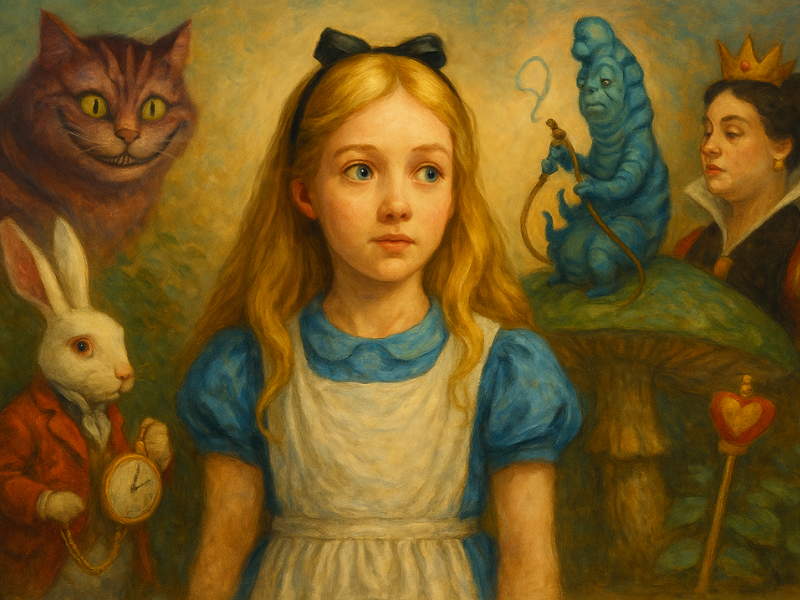
Conspiracy theories about Alice in Wonderland
There are theories for every taste, and some of them are pretty unhinged, though they are part of the book’s mythology by now.
The psychedelic trip theory
The most repeated theory is that Alice in Wonderland is a drug trip. Very popular, very widespread, and almost certainly false.
Carroll did not take psychedelics. The mushrooms, the mysterious bottles, and the transformations are not metaphors for substances, they are metaphors for internal change.
Even so, I understand why the theory sticks. The book’s aesthetic is so hallucinatory that it reads like it was written mid-trip.
The repressed mind hypothesis
Another theory says the book is a manifestation of the author’s internal conflicts. There is no evidence, only intuition.
Carroll was a man full of contradictions, rational to an extreme with a wild imagination. That tension shows up on every page.
Alice in Wonderland as a covert attack on Oxford
This theory strikes me as hilarious because it actually holds up. Wonderland would really be Oxford, with its absurd rules, its bureaucracy, and its eccentric dons.
The animals would be caricatures of his colleagues. The Queen, academic authority. The trial, a mockery of examinations.
The more I think about it, the better it fits.
Wonderland as a state of mind
Past the fantasy, Wonderland is an emotional state as far as I am concerned.
Chaos as an opportunity
Alice does not find answers, she finds questions, and that is what growing up is. Sometimes chaos is the push we needed without knowing it.
Losing logic in order to find yourself
Carroll tells us that sometimes you have to stop trying to understand everything in order to start understanding yourself. Alice finds herself once she stops looking for rules.
The deep psychological symbolism Carroll never explained, and that is there anyway
One of the things that draws me most to this book is how, without setting out to do it academically, Carroll built a journey full of psychological symbols that map perfectly onto how we often feel in real life. Alice is not traveling through a country, she is traveling through her own mind.
The hole as an emotional fall
The fall down the rabbit hole is not only a pretty way to open the story, it is a clear metaphor for losing your footing. For that moment when your life changes, when you get overwhelmed, when you face a problem you do not know how to handle.
It could stand for a thousand things:
- falling into a crisis
- entering a period of change
- feeling disoriented
- going through a breakup, a loss, a turning point
- having to rethink your identity
In other words, falling is not a stumble, it is a passage.
The size changes: identity mid-metamorphosis
Alice grows and shrinks depending on the situation, and it is not a physical joke, it is the visual representation of something all of us have felt. One day you feel enormous, too visible, uncomfortable in your own skin. Another day you feel tiny, insignificant, unable to influence anything. Sometimes you have trouble recognizing yourself, other times you feel like you are changing faster than you can process.
The metaphor of a body that does not fit is perfect for describing adolescence, and it works for adult life too. Anybody who says they have never had a day where they felt out of proportion is lying.
Wonderland as the pure unconscious
Plenty of analysts say Wonderland is the unconscious, and it makes sense.
Characters come out of nowhere. The rules are never clear. Emotions get exaggerated. Spaces change without warning. Conversations swing around with no logic. Nothing is stable.
It sounds like a dream, yes, and also like those moments when you are so overloaded that your thoughts stop following a coherent line.
The philosophy behind Alice in Wonderland, deeper than it looks
Carroll never claimed to be a philosopher, and the way he writes constantly invites you to ask important questions.
Existentialism without meaning to
The Caterpillar asking who she is lands the way somebody asking what you want to do with your life lands. It is a question with no quick answer. Identity is something we build across a lifetime, not something we discover.
That moment, simple as it is, is almost existentialist. We are not a fixed being, we are a process in constant motion.
The critique of rigid logic
Carroll seems to keep telling us that reason has limits, that not everything that looks logical is true, and that language can be every bit as confusing as emotion.
The conversations with the Hatter or the Queen prove it. Words are there to command, not to communicate. It reminds me a lot of people who talk a great deal in order to say nothing.
Time as a flexible concept
Decades before modern physics overhauled our idea of time, Carroll was already playing with the notion that it is not linear. Time stops, time gets angry, time depends on who is using it.
It can look like a game, and it is a powerful idea. When you lose track of time, your perception of the world changes completely.
Little known facts about the book and how it came to be
There are real details behind this story that rarely get told and that I find fascinating.
It was invented during a boat trip
It all started on an outing with the Liddell sisters. Carroll improvised the story to entertain them, and Alice Liddell was so taken with it that she asked him to write it down.
Imagine creating a world classic purely by improvising. Literally, a story told on a whim changed literary history.
The original manuscript was darker
The first manuscript was rawer and stranger than the version we know. Carroll softened certain elements because Victorian society could be very sensitive about the grotesque. Even so, it is still an unsettling book.
The Cheshire Cat already existed as a popular symbol
It was not purely Carroll’s invention. In Cheshire there were shops and taverns using the grinning cat as a sign. Carroll took that icon and turned it into one of the most memorable characters in world literature.
Adaptations and versions: how the story changes depending on who tells it
There are so many Alice adaptations that we could spend hours on them alone. Each one keeps a different piece of the book.
Disney and the softer but still psychedelic version
The 1951 adaptation is the best known one. Disney softened the darker tone and, oddly enough, kept the hallucinatory look. That has created a public image of Alice that is very different from the original book.
A lot of people believe the book is for children because they met the movie first.
Tim Burton and the Gothic approach
Burton turned the story into an epic adventure with a twisted, almost baroque look. It is not faithful to the text, and it does capture that feeling of being inside a visual nightmare.
Lesser known and more faithful adaptations
There are stage versions, European productions, and experimental animations that respect the original dialogue and the mathematical absurdity. They are hidden gems, better suited to adults than to children.
Carroll’s language: a creative laboratory full of games
Carroll enjoyed language so much that he handled it like clay. The result is dialogue that looks like jokes and is closer to logical proofs in disguise.
Wordplay that exposes weaknesses
A lot of the wordplay shows how language, twisted slightly, turns ridiculous. Carroll makes fun of Victorian poems, stock phrases, badly explained rules, social norms, and dishonest arguments.
In other words, he makes fun of everything that carried an air of formality.
An elegant attack on the education of his day
The poems he parodied were famous in his time. Children recited them by heart to prove they were well brought up. Carroll deformed them to show how absurd those educational demands were. It would be like a child reciting a motivational poem today and somebody caricaturing it to point out how shallow it is.
The cultural impact of Alice in Wonderland: from Victorian classic to pop icon
It is remarkable that a book from 1865 keeps turning up in tattoos, films, music videos, fashion, pop philosophy, and memes.
Alice as a symbol of defiance
A lot of people, women especially, see in Alice a figure who questions authority without losing her curiosity. She is a child who will not be intimidated by irrational adults, and that is fairly radical even now.
The White Rabbit as modern anxiety
He has become an icon of constant rushing, work stress, and the feeling of never getting anywhere. He is perfect for describing our era.
Hidden theories few people talk about
There are interpretations that tend to stay in the background and that offer genuinely interesting readings.
Alice as a representation of a psychotic episode
It is a hard theory, and some people see various symptoms in the narrative:
- distortion of time
- problems with identity
- altered sense of size
- impossible conversations
- loss of logic
- exaggerated emotions
It does not mean Carroll was describing an illness, only that he captured very well how reality feels when you are overwhelmed.
Alice as a symbol of feelings with no name
Sometimes we feel things we cannot explain. That is Wonderland: emotions that do not have words yet.
An early feminist reading
Without forcing anything, the book also shows how absurd the social expectations placed on Victorian girls were. Alice breaks them without even noticing.
Wonderland compared with Through the Looking-Glass: two trips, two mindsets
People mix them up a lot, and Alice’s Adventures in Wonderland and Through the Looking-Glass are completely different books. They share a protagonist, yes, and they do not share logic or structure, and when you read them as an adult you can feel that Carroll was exploring two different ways of thinking.
Wonderland: pure chaos
In the first book everything flows like a dream nobody is steering. Alice moves without direction, drops into scenes with no linear connection, and lives through an almost organic chaos. It is an emotional, impulsive, irrational trip, like those stretches of your life where you simply go along with it because you have no idea what is happening.
Through the Looking-Glass: the world as a chessboard
In the second book everything works like a board. Alice advances square by square and every character represents a piece. It is all more considered, more structured. It is a rational, strategic, almost mathematical journey.
If the first book is emotional chaos, the second is the attempt to organize that chaos. Two stages all of us go through: first the bewilderment, then the attempt to give it shape.
Supporting characters who hold the book up from the shadows
Some characters look almost incidental and contribute enormously to what the book means. Let’s go through them.
The Cheshire Cat: the lucid mind inside the chaos
The Cat is one of my favorite characters because he seems to understand everything without needing to explain it. He appears, he disappears, he grins, he watches, and he drops lines that sound obvious while being loaded with depth.
His bodiless grin is one of the most powerful images in the book. It symbolizes pure consciousness, the part of you that knows you are in chaos and smiles anyway. It is your most observant self.
The White Rabbit: anxiety with legs
The Rabbit is wonderful because he represents that very modern feeling of being in a hurry without knowing what for. He carries his watch, saying he is late, and we never learn late for what. He is the adult chasing other people’s expectations without asking whether they matter to him.
Alice follows him without thinking, which is what we often do when we slip into a rhythm that is not ours.
The March Hare and the Dormouse: dysregulation and avoidance
The March Hare is pure hyperactivity. He never stops, he does not understand pauses, he jumps from topic to topic. The Dormouse is the opposite, a sleeping character who wants no part of anything.
Between them they represent two very human defense mechanisms, overstimulation and shutting down.
A Jungian reading: shadows, archetypes, and the inner journey
Even though Jung was born after the book, his theory fits like a glove. It is as if Alice in Wonderland were a Jungian journey disguised as an absurdist story.
The Shadow: the inner chaos you do not always want to look at
Wonderland could be Alice’s complete Shadow, everything she does not control, does not understand, does not know how to integrate. Every character represents a repressed part:
- the Queen: rage
- the Duchess: aggression
- the Caterpillar: doubt
- the Rabbit: anxiety
- the Hatter: disordered thinking
- the Cat: lucidity
- the Dormouse: avoidance
Alice faces all of them, as in a process of individuation.
The Child archetype
Alice is pure curiosity. She represents the part of us that dares to ask what nobody else asks. Her journey is a reminder that growing up is not about ceasing to be a child, it is about working out which parts of that child are still alive.
Order and chaos in constant struggle
Alice tries to impose order on a world that runs on its own rules. Carroll seems to be telling us that growing up means learning to live with both. Not everything can be controlled, and not everything should be left to chance.
The structure of a dream: Carroll got there before neuroscience
What is fascinating is that Carroll describes dream logic exactly the way modern neuroscience explains it today.
Transitions with no explanation
In dreams we switch settings without finding it strange, and the same happens here. Alice accepts every change as natural.
Characters who change roles
In dreams, people show up dressed as ideas, and the book does the same. The animals talk while behaving like archetypes.
Internal logic but not external
Everything makes sense to the dreamer and none of it makes sense to whoever hears the story from outside. That is exactly how real dreams work.
The Victorian era and its neuroses: what Carroll criticized without saying it
The book is written with a very fine layer of irony aimed at nineteenth century British society. Carroll was extremely critical, and he disguised it as humor.
Absurd education
Children were made to memorize moralizing poems. Carroll parodies them to show how ridiculous they were. An attack on the idea that education is about repeating rather than thinking.
Female morality
Victorian girls had to be proper, quiet, discreet. Alice is the opposite. She argues, she asks, she rebels, she does not fit the mold. It is a more modern critique than it looks.
Rigid, empty institutions
Justice, the monarchy, bureaucracy. All of it appears as farce. Carroll laughs at systems that look solid and fall apart the moment you look closely.
The lucid dream: Alice trying to control the uncontrollable
Some people read the story as a lucid dream that never quite works.
Alice tries to intervene
She asks, analyzes, argues, tries to solve things, hunts for logic, corrects the other characters. She does what somebody would do on realizing they are dreaming and wanting to steer the dream.
The dream always wins
Wonderland overwhelms her. The scenes change, the characters ignore her, the rules transform.
It is a clear metaphor for life. You can try to control everything, and some things simply do not depend on you.
The importance of waking up: the ending as rebirth
The ending is very short and very symbolic.
Integrating the experience
When Alice wakes up, she does not say what a silly dream. She reflects on it, accepts it, integrates it.
That is exactly what happens when you go through an intense emotional experience. You cannot explain it, and it changes you.
The older sister as external consciousness
The sister turns up to remind her that the experience is still valid even though it was not real. She is like that rational voice that helps you organize your feelings.
Why Alice in Wonderland still lands in adult life
This book has not aged. If anything, it gets more current.
Because all of us have been Alice
Disoriented, curious, sick of absurd rules. Trying to understand a world that does not always make sense, growing up faster than we wanted to.
Because we live surrounded by absurdity
Endless meetings, incoherent rules, people who talk without listening, contradictory expectations.
Carroll understood our era without having lived in it.
Because the inner journey never ends
Alice wakes up, and her transformation keeps going. I think we cross plenty of Wonderlands of our own across a lifetime.
A contemporary feminist reading: power, control, and resistance
The book was written by a Victorian man, and Alice has become, over time, an unexpected feminist icon. Not because Carroll designed her that way, but because her attitude, her habit of questioning everything, and her resistance to authority figures fit a current feminist reading very well. It is odd to think a nineteenth century girl would end up representing such a modern force, and it makes sense. Unlike other children’s characters of the era, Alice is neither passive nor obedient, and she does not settle for what adults tell her. She argues, she asks, she gets annoyed, she contradicts, she demands explanations, and she does not accept rules just because. In a context where girls were required to be docile, she is a genuine revolution in a pinafore.
The most interesting part is that no authority figure manages to dominate her emotionally. Not the Duchess, not the Hatter, not the Queen of Hearts. Alice may feel confused, and she is never submissive. Her judgment is her strongest tool and she does not hesitate to use it, even knowing she is surrounded by absurd characters and rules that do not work. That capacity to hold herself steady in a world that does not understand her says a great deal about her, and it explains why so many modern readers see themselves in this girl who keeps her composure even when nothing makes any sense.
Another powerful angle in this reading is the size metaphor. When Alice shrinks, people ignore her. When she grows, suddenly they listen. It is a very clear representation of how society assigns value to women based on their role, their presence, or their attitude. In that sense, growing is not only a physical change for Alice, it is an act of authority. Shrinking, meanwhile, is an emotional state where she feels her voice slipping away. This is a long way from an innocent story.
The Queen of Hearts deserves a nuance from this perspective too. She is not an example of female power, however much she might look like one. She is more the caricature of authoritarian power, power built on fear rather than on real authority. Carroll is not ridiculing a powerful woman, he is ridiculing any figure of power who shouts more than she reasons, which includes every system propped up by threats. The Queen is the warped mirror of leadership based on terror instead of respect.
Alice represents the opposite. She is autonomous, she uses her critical thinking, and she does not let the chaos carry her off. Her strength is not in imposing, it is in discerning. That is why, without ever intending to, the book has ended up lending itself beautifully to a twenty first century feminist reading: a girl who questions, who thinks, who stands her ground and dares to say that something makes no sense, even when every adult around her insists otherwise.
Hidden symbols almost nobody mentions that change the reading
There are very subtle details in the book that usually go unnoticed and that add fascinating layers. One of them is the locked doors at the start. Alice tries to open all of them and cannot. To me they represent those invisible limits we feel when we want to enter a world we do not understand yet, or one that is not ready for us yet. The key, which appears later, symbolizes the possibility of change, and patience too. Not everything opens when we want it to, it opens when we are ready.
The bottles labeled drink me and the cakes labeled eat me carry a meaning past the humor. They represent outside influence, the social rules that tell you how to behave, or who you should be in order to fit in. Alice hesitates before drinking. She thinks, she weighs it, she does not act on impulse. It looks like a minor detail and it captures her reflective character very well. She does transform, and she does not do it without thinking.
I love the smoke around the Caterpillar as a symbol. It is the perfect representation of mental ambiguity. Alice is at a critical moment, full of doubt, and the Caterpillar appears wrapped in a cloud that distorts everything. It is like talking to somebody who asks questions that throw you off balance, and precisely for that reason force you to grow.
The Cat’s bodiless grin is another beautiful symbol. It represents identity that does not depend on the physical, presence without presence, the essence that stays even when everything else disappears. It is almost philosophical. That floating grin has something purely true about it. The Cat exists without needing a body, which makes him the freest character in the book.
The cards as workers say a lot too. They have no depth, no volume, no real personality. They are there to obey, which portrays perfectly the people who live inside a system without questioning it. It is a simple visual image with brutal symbolic force.
Alice and classical mythology: unexpected parallels
Carroll was a mathematician, and you can tell he had a wide literary background, because there are echoes of classical myth throughout the book. The descent down the rabbit hole is a mythic descent in every sense, similar to Persephone in Hades, Orpheus looking for Eurydice, or even Dante entering the Inferno. All of these stories begin with a physical descent that stands for an emotional or spiritual one. Alice falls toward an unknown world that, as in those myths, forces her to confront herself.
The White Rabbit can be read as an ambiguous guide, exactly like Hermes or Hecate in the old myths. He is not a clear mentor and not a villain either. Sometimes he helps and sometimes he does not. He simply opens the door to the journey. The same goes for the book’s hybrid creatures, mixing human traits with animal ones the way Greek or Egyptian mythology does. Everything in Wonderland has that symbolic quality reminding us that absurd stories can also be, underneath, stories of initiation.
The theme of the double: Alice facing herself
This gets developed further in Through the Looking-Glass, and the idea of the double is already here. Alice asks herself several times whether she is still the same person after each change in size. That doubt is essential to any growth process. This is not about fiction, it is about identity. Every character who crosses her path is a partial reflection of her. The Rabbit as her anxiety, the Cat as her lucidity, the Queen as her fear, the Caterpillar as her confusion, the Hatter as her chaotic thinking. All of them are fragments of a self in mid-transformation.
Humor as a sharpened weapon
Carroll did not write humor for fun, he wrote it to dismantle social structures. Absurdist humor is useful for pointing out how arbitrary rules are, how pompous certain speeches are, and how easy language is to manipulate. Every absurd conversation hides a critique. When the Queen changes the rules of the game mid-play, Carroll is telling us that rules often exist not to create order but to maintain power. His humor is so elegant that it goes down without resistance and leaves you thinking afterward.
Censored versions and quiet changes
It is not widely known, but some Victorian editions altered certain passages. A few poems were softened because their parodic tone seemed too irreverent. Other versions cut grotesque details, like the baby turning into a pig, because it might be inappropriate for a child audience. There were even illustrations that made the Queen look less aggressive. All of this shows that the book has always carried a tension between its deeper message and the social expectations of each era.
A more serious political reading
Carroll never called himself political, and the book is full of veiled criticism. The trial is a parody of the legal system of his day, which often ran on unreliable evidence, arbitrary decisions, and a great deal of theater. Wonderland, packed with rules that make no sense, reflects the British bureaucracy that complicated simple things with astonishing efficiency. The Queen is the caricature of capricious authority, and the King represents the kind of symbolic power that exists purely because it does. None of this is accidental.
Alice and surrealism: an accidental precursor
Surrealism as an artistic movement would arrive much later with Dalí, Buñuel, and Breton, and it is striking how much Alice in Wonderland anticipates its foundations. Carroll wrote a story where the unconscious is in charge, where images turn illogical, and where reality folds to make room for the impossible. In a way, the book is premature surrealism, a terrain where free association, constantly shifting symbols, and dreamlike scenes mix naturally.
The most interesting part is that the unconscious functions here as the main setting. Carroll is not trying to represent reality, he is representing the way the mind creates images with no apparent order. That sense that anything might turn into something else from one moment to the next recalls Dalí’s paintings, where objects melt, duplicate, or simply behave as if they had lives of their own. Even Alice’s constant metamorphosis, growing, shrinking, crossing impossible spaces, fits perfectly with what would later become surrealist aesthetics.
On top of that, Carroll breaking the rules of time, space, and logic turns reading it into an experience very close to a Buñuel film, where a conversation can lead into absurdity, a door might not open onto what you expect, and characters act according to rules nobody explains to you. The book runs on a mental freedom plenty of later artistic movements would have envied.
A neurodivergent reading: why so many people see themselves in Alice
In recent years, interesting interpretations have emerged linking Alice’s experience to neurodivergent ways of thinking, like ADHD, autism, or high sensitivity. Not because Carroll addressed any of this directly, but because the sensation of being in a world that does not run on clear rules is very familiar to a lot of neurodivergent people. Wonderland is a place where everything changes too fast, where conversations get interrupted, where the rules are never explained, and where the environment can be overwhelming. It is easy to see why so many people identify with that.
Alice tries to understand everything by asking questions. She always asks, even when nobody is listening. She asks because she wants to understand how the world around her works. That recalls people who need clear information in order to feel safe. When the characters answer with nonsense, she insists, gets annoyed, gets frustrated. That frustration is very real. So is the sensation of being surrounded by input that has no order to it. The scenes where everybody talks at once, changes topic, or answers something completely unrelated capture very well what some people go through in complicated social situations.
Even the changes in Alice’s size could be read as a metaphor for how perception of your own body can shift under anxiety, stress, or sensory dysregulation. In that sense, the book is about feeling out of scale, out of proportion, out of context. Few things describe the experience of not fitting in better than that feeling that the world and you are out of sync.
Symbolic creatures: small mirrors of the mind
Some characters look like they are there purely as backup and actually add an important psychological layer. The Dodo, for example, is a very likable character plenty of people skip past, and he is a direct stand-in for Carroll himself. Because of his stammer, Dodgson would pronounce his own surname as Do-do-dodgson, so he painted himself into the story as this slightly clumsy, slightly slow, endearing bird. It is his way of appearing in the story without putting himself at the center.
The Mock Turtle is another fascinating character. Her exaggerated melancholy, her sadness about things that seem absurd, and her slow way of narrating her past are loaded with emotional symbolism. She represents warped nostalgia, that feeling where we miss things that were maybe never as good as we believe. Her story is a perfect example of how memories take on a sad tone even when there is nothing objectively dramatic about them. Her pain is pure and real to her, however comic it sounds to whoever is listening. That mix of laughter and sorrow is one of the most human things in the book.
The playing cards as soldiers are a brilliant idea too. They are flat, with no depth, no ability to rebel, no identity, no life outside obeying orders. They represent total conformity. They are characters designed to follow, not to think. That critique still holds up today.
The dream as literary structure, and the twist Carroll gives it
Dreams have always had an important role in literature. From Dante to Calderón by way of Shakespeare, plenty of stories use the dream as a metaphor for self-knowledge. Carroll did something different, though: he broke the idea that a dream carries a clear message. In the classical tradition, dreams usually contain revelations. In Alice, they do not. The dream is pure confusion. There is no obvious moral. There is no explicit lesson. What Alice lives through is an internal process closer to emotional fragmentation than to spiritual enlightenment.
Even so, the book fits into a modern tradition of narratives where strangeness is the main character. In fact, plenty of later authors seem to have inherited that unsettling tone: Kafka with his absurd bureaucracy, Borges with his conceptual labyrinths, Cortázar with his narrative jumps, Murakami with his scenes that blend dreaming and waking. The idea that reality does not have to be coherent, and that the most important things can happen in spaces where logic fails, connects Carroll to all of them.
Alice and Kafka: two souls of the absurd
The comparison with Kafka is especially interesting. Their styles are different, and both share that sense of a lost war against a system with no interest in being understood. The trial, where the evidence means nothing and the guilty seem to have been decided from the start, recalls the atmosphere of The Trial enormously. In both works, the protagonist tries to apply logic in an environment that does not respond to logic, and in both cases the search ends in frustration.
The characters who represent institutions in Alice, like the Queen or the King, work the same way as Kafka’s undefined authorities. They are not real people, they are symbols. They are masks for a system running on inertia that nobody questions except the protagonist. Carroll portrays power as a farce, and Kafka would do the same decades later.
Its impact on modern psychology, past the metaphor
One of the surprises here is that the book ended up giving its name to a real phenomenon: Alice in Wonderland syndrome. It is a neurological condition that alters the perception of the size of your body or of objects. In other words, exactly what Alice experiences. It is incredible to think Carroll described something with such precision that medicine recognizes today. The book also gets used in therapy to work on identity, emotional confusion, or the sense of mental chaos. Plenty of therapists find in this story a symbolic way of talking with patients who cannot find words for what they feel.
The trial under the magnifying glass: what that climax really means
The trial scene can look like a simple joke, and it is one of the most powerful moments in the story. Alice grows while she speaks, as if every word were an act of self-assertion. It is physical growth standing in for emotional growth. After everything she has been through, there comes a moment when she can no longer swallow absurd rules. She stands her ground. She gets indignant. She speaks up and refuses to be intimidated. This is the point where she finally claims her own voice.
The trial is the final test. It is the instant where she has to decide whether to keep participating in a system that makes no sense or to challenge it. She challenges it without hesitating. For me this is the real climax of the book, the moment when Alice stops trying to fit into an absurd world and decides she does not have to.
Why this book is still alive: an emotional explanation
This book keeps catching us because it describes very human sensations. That confusion we feel when something changes too fast, that mix of curiosity and fear, that need to understand and that frustration when nothing fits. Alice is us, trying to find our footing in a reality that sometimes seems written by a Mad Hatter. Carroll’s chaos is honest, and that is why it resonates. The fall is still a powerful image: falling is not always failing, sometimes it is simply the start of the journey.
Alice from cognitive science: how your brain reads this chaos
One of the most fascinating things about the book is how it activates cognitive processes we understand far better now thanks to neuroscience. When we read Alice in Wonderland, the brain enters a peculiar state. It tries to find sense where there is none, tries to complete invisible patterns, tries to organize impossible conversations, and enjoys the chaos anyway. It is as if Carroll had built a kind of mental workout without knowing it. Bewilderment generates surprise, and surprise generates dopamine. That is why, even though nothing is logical, we keep reading.
The human brain is built to look for rules, almost obsessively. Carroll breaks them deliberately, forcing you to face the unexpected. That mix of frustration and pleasure creates a unique experience. Every absurd scene is a small challenge that hooks you without your noticing. It is no accident that we remember the images from this book so well. Memory holds onto the strange, the symbolic, the dreamlike with more intensity. The painted roses, the smoking Caterpillar, the vanishing Cat. These images stay with you because they resemble a dream, and dreams get stored in a special corner of emotional memory.
The author’s shadows: a debate that never ends
Whenever Lewis Carroll comes up, the question of his private life follows. It is an uncomfortable subject, full of interpretation and silence. Carroll was a contradictory man. Rational to an extreme, shy to the point of social paralysis, obsessive about some things, absurdly creative about others. His relationship with Alice Liddell, the girl who inspired the character, has generated rumors, suspicions, and analysis that would now be impossible to fully dismantle. We live in a time when we reinterpret the past with new eyes, and that affects authors too.
The book does not need us to turn it into a personal confession from the author, though. It is not a disguised diary or a coded admission. It is more an explosion of imagination reflecting its creator’s internal tension, the fight between mathematical logic and total freedom. His shadow is there, not to scandalize us but to remind us that authors have dark corners too, the same as their books.
The initiation ritual theory: Alice in Wonderland as a passage into a new life
There is a lovely theory that reads the book as a rite of passage, and once you look at it that way, everything fits. Alice starts by separating from her world when she falls down the hole. Then she goes through a transition full of tests, doubts, changes, and encounters. At the end comes the return, which in this case is waking up. It is the classic structure of initiation myths, where the protagonist has to leave the familiar behind, face bewilderment, and come back transformed. What is interesting is that Carroll does it without solemnity, without moralizing, without explicit lessons. His rite is more honest: the chaos is the test, and the final reflection is the real transformation.
Compared with quest myths: Alice next to Odysseus, Dante, and Gilgamesh
It might sound like a stretch, and if you analyze the narrative structure, Alice shares an essence with some of the great literary heroes. Odysseus faces creatures that represent parts of himself, the same as Alice. Dante descends into a hell full of symbolic figures who force him to reflect, exactly like our protagonist. Gilgamesh lives through an emotional journey where he discovers who he really is, which happens to Alice too. Think about it and she is living her own myth, wrapped in absurdist humor instead of epic solemnity.
Falling and growing: the two movements that shape the whole book
The fall is the beginning and the growth is the climax. They are the two great symbolic movements of the journey. Falling means surrendering to uncertainty, leaving safety behind, stepping into the unknown. Growing means finding your voice, asserting yourself, taking back your space in an environment that no longer intimidates you. Alice truly grows at the trial, because that is where she finally stands her ground. She becomes big once she understands that she should not adapt to the absurd, she should set limits on it. It is beautiful that Carroll uses something as physical and as visual as size to talk about courage and identity.
Why Alice in Wonderland keeps landing in adult life as an uncomfortable truth
When you finish rereading the book as an adult, you realize it is not a fantasy story or a simple exercise in imagination. It is an emotional experience reflecting the bewilderment we feel when life stops being clear. That is why it endures. That is why it keeps coming back. That is why it resonates even with people who have never had any interest in children’s literature.
Alice faces rules that make no sense, conversations that lead nowhere, authority figures who shout a lot and reason very little, and a series of tests that ask for resilience rather than intelligence. It is the story of anybody who has had to grow up in a contradictory world. Of anybody who has entered a period of change without a map. Of anybody who has had to work out who they are while everything around them moved too fast.
Maybe that is why it keeps catching us. Because we feel a little like Alice every time we try to understand a reality that does not quite match what we think it should be.
The loveliest part is that Carroll gives us no answer. He does not tell us what to think or how to interpret it. He leaves the chaos as it is and invites us to find our own meaning. That is what makes this book more than a classic. It is an emotional mirror that changes depending on who is looking into it.
Frequently asked questions about Alice in Wonderland
Is Alice a children’s book?
A child can read it, and an adult understands it. I think that sums it up pretty well.
Did the author leave hidden messages?
Yes, though not conspiratorial ones. Mathematical, philosophical, and social messages.
What does the White Rabbit symbolize?
Hurry. Anxiety. That feeling of being late that follows so many people around.
Is it just a dream?
It is a dream, and that does not matter. What matters is what it means.
After going through Alice’s whole journey together, from the rabbit hole to the waking, I am left with a question I always ask myself when I finish this book and would like to share with you: which part of Wonderland are you in right now? Sometimes we feel small, sometimes big, sometimes confused, sometimes worn out by all the absurd rules. Sometimes we follow our own White Rabbit without quite knowing why, and sometimes a floating grin surprises us and reminds us that we are not as lost as we thought.
You can find it in plenty of brick and mortar bookstores and online.
Tell me what stirred you, which interpretation surprised you most, or which part of the book stayed with you. I would love to hear from you, argue with you, and keep exploring this journey that, however much time passes, keeps revealing new things.