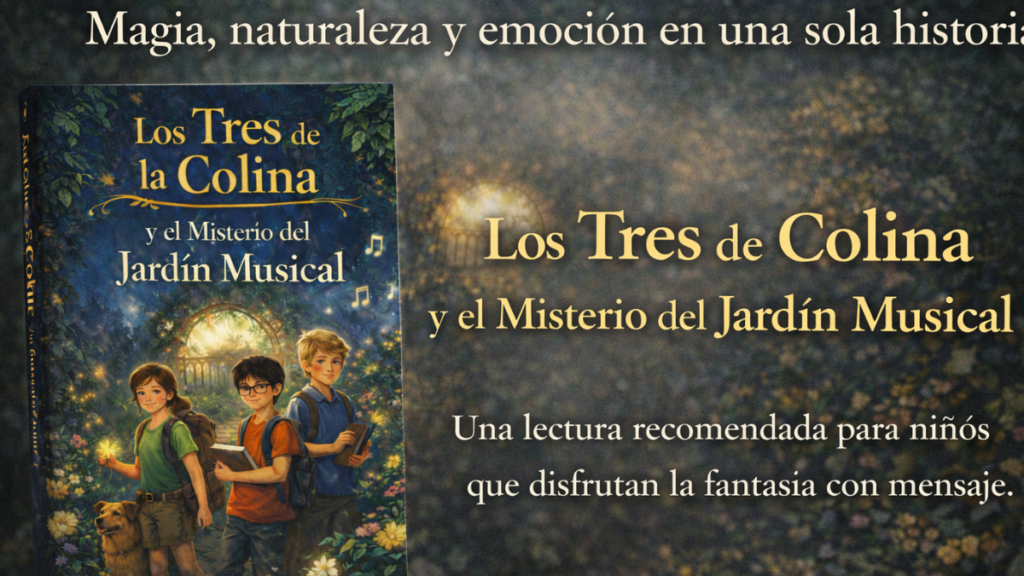
Discover The Trio of the Hill and the Mystery of The Musical Garden, a magical middle grade novel full of adventure, feeling, and real values. I break down the story, the characters, the deeper message, and why this book is an essential read for kids and families.
Some books simply entertain, and then there are the ones that open a door, that plant something inside you and start growing without your noticing. The Trio of the Hill and the Mystery of The Musical Garden belongs firmly in the second group.
When I started this story I did not expect it to grab me the way it did. I thought I would find one more children’s adventure novel, pretty, entertaining, competent.
What I did not imagine was that behind that musical gate there was a story loaded with feeling, symbolism, nature, science, friendship, and a serious reflection on the noise of the world we live in.
Today I want to tell you why this children’s book is far more than an adventure in a forest. I want to talk about its real magic, its message, its characters, and why I think it is essential reading for kids and for adults who still know how to listen.
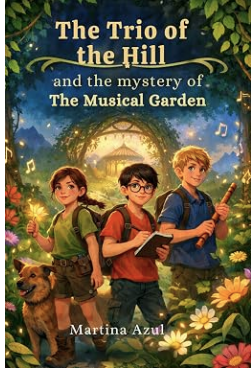
Three friends discover a secret garden where music has real power, and they have to protect it before it falls into the wrong hands. A magical adventure about friendship, courage, and balance.
This post contains affiliate links. If you buy through them, you support my work at no extra cost to you.
A children’s novel that combines mystery, feeling, and real values
The first thing that caught my attention was the tone. From the opening pages, the setting in Silver Hill drops you into a small town, the kind where summer smells like dry grass and warm stone. It is not a randomly chosen setting, it is a place that invites exploration, calm, and connection with nature.
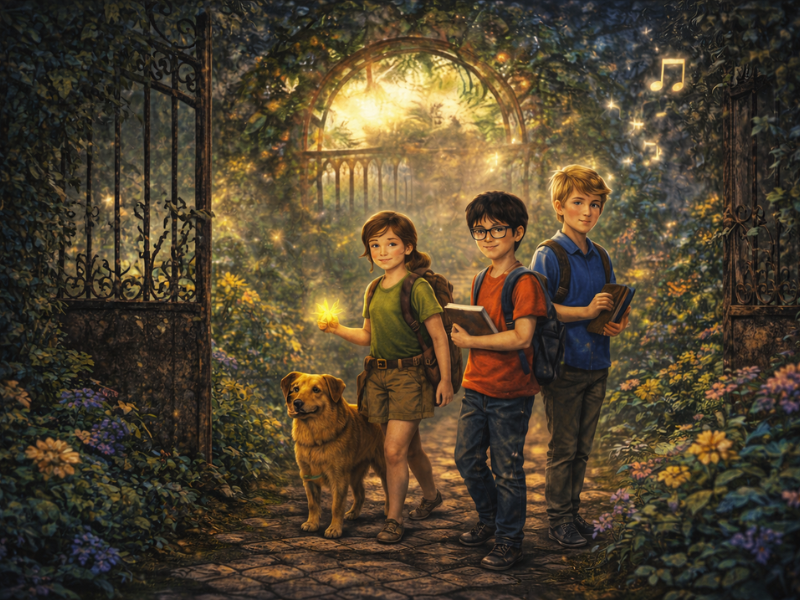
The leads, Lia, Marco, and Bruno, the Trio of the Hill, are not heroes, they are real kids. They have doubts, insecurities, impulses, fears, and that is exactly why they work so well.
The Musical Garden is a beautiful metaphor. A place where every flower makes a sound, where the music answers what you feel, and where silence carries meaning too. It is impossible not to see the parallel with the world right now. We live surrounded by constant noise, screens, hurry, distraction. This book reminds us to stop and listen.
What The Trio of the Hill and the Mystery of The Musical Garden is about
The discovery that changes everything
The story starts out looking simple. Three friends planning to explore the forest over the summer, nothing out of the ordinary. Until the gate appears. A gate that should not be there. A gate that makes sounds, a gate that seems to be waiting for them.
When they step into the Musical Garden, the world changes. The flowers sound like instruments, the air vibrates. Everything responds to human emotion, and that is where the story starts to lift off.
The deeper conflict behind the magic
It is not only a magical garden. There is a threat. A man called Doctor Vesper, who wants to capture the Golden Note, bottle the music, turn something living into a product.
I find this part especially strong. The antagonist is not a cartoon villain, he is progress with no soul. The metaphor is obvious without being heavy handed. It is elegant, and in children’s literature that is an enormous achievement.
Characters who connect with kids and adults
Lia, intuition and emotional leadership
Lia is drive, sensitivity, and courage. She has the energy that pushes the story forward. I love that her strength comes from intuition rather than aggression. She feels the garden before she understands it. She represents emotional connection with nature, the ability to read a silence.
Marco, the logic that needs a heart too
Marco is science, data, compasses, measurements. He is also insecurity and the fear of not fitting in. Fear of being too rational in a world that seems to run on feelings.
His arc is lovely, because he learns that logic and emotion are not at odds. That you can measure the world and feel it at the same time.
Bruno, strength and vulnerability
Bruno seems like the most impulsive one, the most physical, the one who acts before thinking. He is also the most emotionally transparent. His frustration, his need for everything to come out perfectly, his instinct to protect.
The trio works because each one brings something essential. There is no single lead here, there is a team.
That is a wonderful message for young readers.
The Musical Garden as a symbol of our society
This is where the book won me over completely. The garden is not only a fantastical setting, it is an allegory of balance, of harmony between emotion, nature, and community.
The Golden Note represents something that feels scarce now. Coherence, being in tune with yourself. A point where everything vibrates in balance.
When the antagonist wants to bottle it, the message is clear. Not everything can be turned into a product, and nothing gets monetized without consequences.
In a world where everything gets measured in performance, productivity, and results, this children’s novel raises something uncomfortable and necessary. What happens when we stop listening?
Why I recommend this children’s adventure book
I could just say it is entertaining, and that would be selling it short.
I recommend it because it combines a story that hooks you from the start, a mystery that keeps the pace up, and a deep message that never turns preachy. Real characters who are easy to identify with, and a setting that wakes up your imagination.
It is ideal for readers between eight and twelve, and for adults who want to share the reading and the conversation.
You can find it on Amazon in different formats.
A read that starts conversations at home
This book has something I think is pure gold. It generates dialogue. Natural questions come up after every chapter.
What would you do if you discovered something magical?
Do you think technology always improves what it touches?
Is it possible to listen without judging?
It is a perfect novel to read together and talk about. For working on values without it feeling like a lesson. It reminds me of Enid Blyton’s Famous Five books, and of The Secret Garden.
The narrative structure that catches you without your noticing
There is something very smart about how the story is built. It starts in summer, showing a small town and a routine, with that sense that everything is calm. That makes the discovery of the gate hit harder. This is not a fantasy world from the first line. It is a real world that suddenly cracks and lets the magic through.
The structure moves in layers. First the discovery, then the fascination, then the conflict, and later the real threat. Every chapter adds a piece without overloading anything. Even the everyday moments in The Paper Galleon, Aunt Juana’s shop, or out by the Silver Hill mines earn their place, because they anchor the fantasy to reality.
The right pace for readers aged eight to twelve
One of the biggest challenges in children’s literature is the balance between description and action. It is handled very well here. There is enough detail to picture the Musical Garden, the flowers that sound, the thick fog, the wrought iron gate. It never gets heavy, though.
The introduction of the man in the gray trench coat, for instance, is not abrupt. It is unsettling, and the tension builds gradually. That creates a real sense of threat without any need for explicit violence.
The Silent Gardener and the weight of a legacy
This character strikes me as one of the strongest in the novel. He is not simply a magical guardian. He is memory, tradition, the knowledge that is not in books.
He represents something our society often ignores. The wisdom that cannot be measured with data. The experience that will not fit on a chart.
The Resonance Seeds as a symbol of responsibility
The three Resonance Seeds are not just any magical artifact. They are a brilliant metaphor, because they resonate with the truth. That is powerful.
In a world where everything seems to need a tutorial, this book proposes something else. Responsibility does not come with detailed instructions, it comes with intuition, consistency, and connection.
Each seed vibrates with a different quality. Intuition, logic, and strength. On their own they are not enough, and together they create balance. It is no accident that there are three of them.
The antagonist as a reflection of the modern world
The man in the gray trench coat does not want to destroy for the sake of destroying. He wants to own, to capture. He wants to bottle the Golden Note and sell it as a product.
The idea of bottling sound is a metaphor for how we sometimes try to package living experiences in order to sell them. Turning peace into a product, nature into a resource, feeling into a business.
This is not about demonizing technology. Marco is a scientist and the book never ridicules him. It is about intention.
Technology with no heart is noise. Logic with no emotion is silence. That balance runs through the whole novel.
Music as a universal language
Another strong point is the use of music. Music here is not decoration. It is language, communication, and pure feeling.
The flowers do not respond to orders, they respond to feelings. When the kids argue, the music distorts. When they are honest, it harmonizes. It is a beautiful way of teaching emotional intelligence without ever using that label out loud.
Young readers can grasp that what they feel affects their surroundings. That their emotions have an impact, that they are not irrelevant.
What surprised me most
I will admit I was expecting a straightforward adventure, and I found something far deeper.
The sensitivity of the writing surprised me. The way it talks about silence as something that is not emptiness but forgetting. The way it argues that listening is an active act. I was also surprised by how it manages not to moralize. At no point did I feel like I was being lectured.
Is this a good children’s book for schools?
Absolutely. As a children’s book with values it works very well in a classroom. It lets you work on emotional education, teamwork, respect for nature, critical thinking, and the relationship between science and emotion.
On top of that, it opens up very interesting debates about consumption, progress, and responsibility.
Frequently asked questions about The Trio of the Hill and the Mystery of The Musical Garden
What age is it recommended for?
Mainly for readers between eight and twelve. Slightly younger readers can enjoy it too if somebody reads along with them.
Is the symbolism too complex?
No. The symbolism is there for anybody who wants to see it. A child can enjoy the adventure without analyzing the metaphor. An adult can go deeper.
Is it a standalone or part of a series?
It is book one of two in The Trio of the Hill series, and you can tell from how the world is built. There is plenty of road ahead.
Is it scary?
Not in the classic sense. It creates tension and unease, not terror. It is an adventure with conflict, not a horror story.
Does it work for adults too?
Yes. In fact, I think a lot of adults can reconnect with something important through this book.
Why I think this story can stay with you
Some books you finish and forget, and some books leave an echo. This is one of the second kind.
Because it talks about listening in a world that shouts, about balance when everything seems polarized, and it puts at the center something we often ignore, our inner harmony.
It is no accident that the Golden Note holds the valley together. Every person has their own note, and when they mute it out of fear, out of pressure, or because of outside noise, something falls out of tune.
That is the message I am taking away.
If you are looking for a different kind of children’s book, here it is
If you want a fantasy novel for young readers that is about more than surface level magic, a story that combines nature, feeling, and adventure, a book you can talk about after reading it, The Trio of the Hill and the Mystery of The Musical Garden is a beautiful choice.
Now I want to ask you something.
Do you think we really know how to listen these days? Or do we live surrounded by noise that keeps us from hearing what matters?
I would love to hear from you in the comments. Which part resonated most with you? Would you dare to walk through that musical gate?