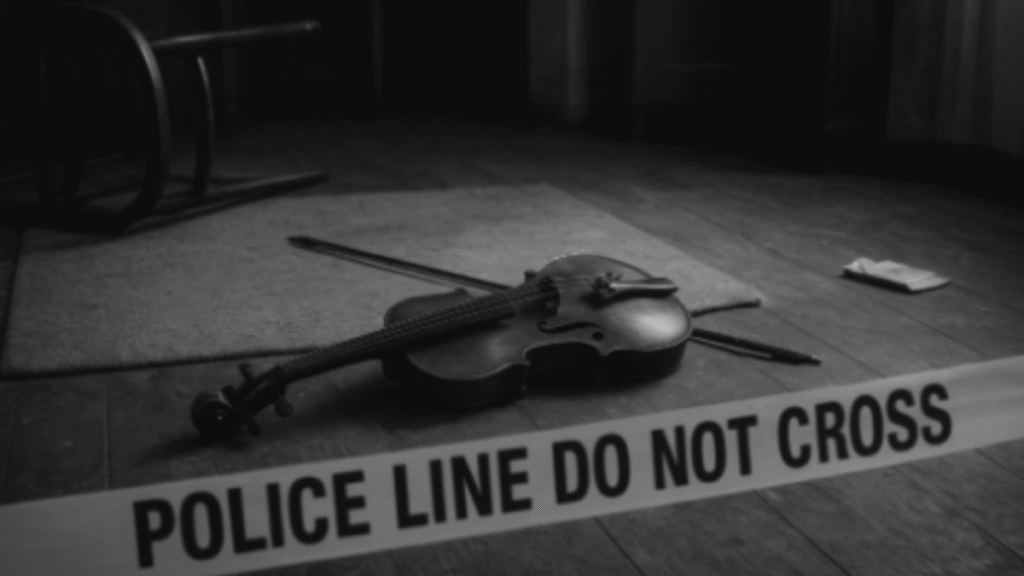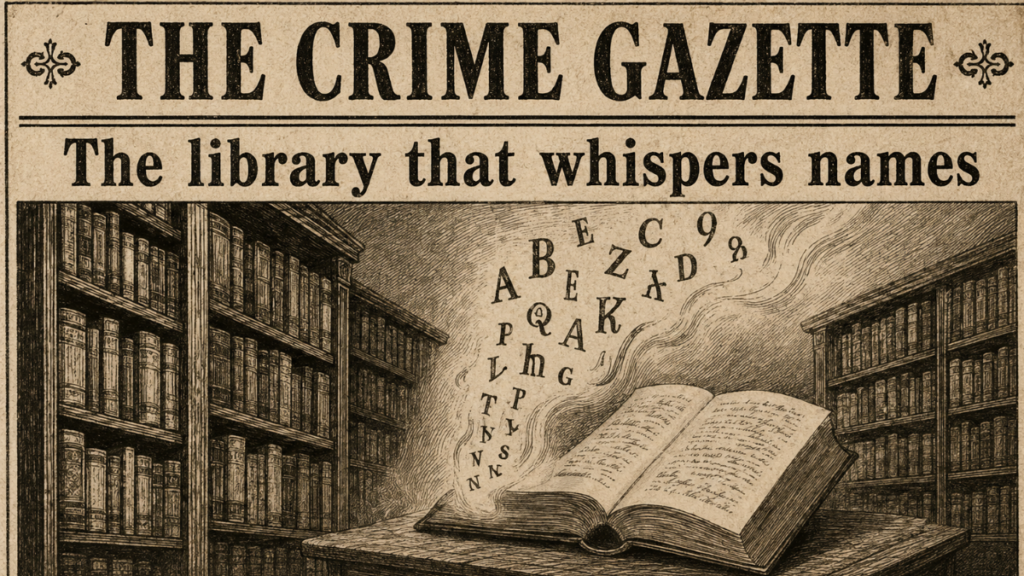
Discover the mystery of the library that whispers names in The Crime Gazette. A dark, unsettling chronicle full of buried secrets.
Weekly Edition, Mysteries and Unexplained Events
The library that whispers names
Six months ago, Santa Justa woke to a new murmur among its stone streets and amber streetlamps: the murmur of a library that, so they say, whispers names. This is not a poetic flourish from the local press, nor one more superstition among many, but a continuous, persistent, and according to some, dangerously accurate phenomenon. At midnight, when the town hall clock reluctantly strikes twelve, the shelves of the municipal reading building seem to settle themselves, and certain volumes fall open at specific pages where, between the lines, an icy breath pronounces recognizable surnames. Days later, the people who heard their names disappear without explanation.
The Crime Gazette has sent this correspondent to account for the facts with precision, restraint, and the respect owed to the affected families. What follows has been corroborated with librarians, residents, police officers, and a handful of reckless night owls who, flashlight in hand, have decided to defy superstition in search of answers. The result is a mosaic of matching testimony, unsettling gaps, and a sensation that is difficult to put into words: the certainty that silence, in Santa Justa, has learned to speak.
The building dates to 1894. Its neoclassical facade, with a plain pediment and two Tuscan columns, never gave anyone cause for scandal. Beneath its slate roof rest more than thirty thousand volumes, a modest catalog but a beloved one. Until last spring, the institution had only made the papers for its children’s book club and its bookbinding workshops. It was on the night of April 14 that the filing cabinets began to shift, loose papers began to form small currents of air, and the names, those cursed names, began to lift off the page as though they had been hiding among the fibers since the day of printing.
The origins of the phenomenon and the first signs
The library’s director, Doña Adela Garmendia, remembers assuming at first that it was a prank. “It was 11:45 at night,” she says. “We were closing up. Rafael, the librarian on duty, was turning off the lamps and I was checking the front desk. Suddenly I hear someone say my surname, as clearly as if they had said it into my ear. ‘Garmendia.’ I thought it was Rafael asking me for the keys. Rafael was at the far end of the room, though, and when I turned, I saw him pale, his eyes fixed on an open volume of local history. Out of that book, the way you blow ash off a surface, came a whisper: ‘Garmendia.’ I swear it.”
That same night, according to the log, five books were left open on different reading tables, as though they had been consulted in a great hurry. In each of them, the same pattern: the text seemed to fade for an instant and the white of the paper appeared to vibrate. Out of that emptiness came syllables that gathered with patient care until they assembled surnames known in the town. There were people who heard nothing, the library being capricious, and people who took in a chill that ran from their wrists to the back of the neck. At 12:10 the names stopped. At 12:11 the clock in the entrance hall halted without warning, only to restart at 12:12 with a dry knock of the pendulum. It was the prelude to a habit.
The following days confirmed the pattern: opening with no hands, whispering with no mouth, a stopped clock, an exact restart and, somewhere between forty and seventy two hours later, the disappearance of one of the people named. Not everyone mentioned went missing, which has fed an argument between chance and fate that still divides the town. Enough of them did, though, for the phenomenon to install itself firmly in conversations at the market, on the benches in the square, in the school corridors and, inevitably, in the provincial literary societies that came sniffing for mystery and ink.
Testimony under the oil lamp
Rafael Serrano, a veteran librarian, offers perhaps the most painfully precise account. “There is no sound of a throat in it,” he explains, “no breathing. It is as though the paper thinned out until it became air, and the air suddenly knew how to pronounce. The first time I heard my own name, I did not sleep for three days. Nobody made me come back the next night, but I did not want to leave Adela on her own. That night we heard ‘Muñoz,’ ‘Iriarte,’ ‘Sorbella.’ We did not know any Sorbella. She turned out to be a girl who had only been in town a few months. Three days later she quit her job without notice. Nobody saw her again.”
Ana Muñoz, a shopkeeper, admits she went to the library despite the town’s recommendation not to stay in the building after closing. “I wanted to hear my grandmother,” she says. “No name was called that night, and I thought that meant I was safe from something I do not understand. Then I heard other surnames and I could not sleep after that. I went home and sat with my children. I read them a story. I told them that if they ever heard their name coming out of a book, they should cover their ears. My mother told me you cannot run from the voice of paper. Since that night, I keep the radio on low. I cannot bear the silence.”
On the other side of the fear, some young people have shown up with enough nerve to challenge the library’s ghost, if there is one. Among them, three high school students who call themselves The League of the Margins, after their habit of scribbling irreverent notes in the margins of obsolete textbooks. All three kept watch with cassette recorders, phones, even a directional microphone bought by mail order. “The recordings get ruined,” one of them explains. “You hear sentences that were not there, as though the tape were absorbing noise from another time. Once, rewinding, we heard our own conversation, only with different words.”
The police investigation and containment protocols
Local police, with support from the Guardia Civil, have cordoned off the library on several occasions after sundown, allowing entry only to authorized personnel. Thermal cameras, humidifiers, motion sensors, and high sensitivity ambient microphones have been installed. The report sent to this newsroom, which we have seen, acknowledges “anomalies that are difficult to reproduce under laboratory conditions,” with particular mention of a “localized thermal variation of up to 7.4 °C, around 13 °F, beside the Genealogy Section” during the whispering intervals.
The town council has recommended limiting nighttime visits and has reinforced security with two officers on duty from 11:00 p.m. to 1:00 a.m. Residents have also been asked to “refrain from unauthorized vigils” that could feed collective anxiety. A council spokesperson, who prefers to remain anonymous, admits that part of the problem is no longer the phenomenon itself but “the suggestibility that sticks to everything like dust,” leading people to see signs where there may be none. Even so, nobody denies that there are missing people, and that far too often their surnames were heard among the shelves first.
The library board has taken quiet measures: it has moved the frequently “active” volumes, sealed some early printed books behind glass, and sent the books that most often seem to open on their own into storage. That last decision has not gone down well with university researchers, who are demanding free access to the entire collection, convinced that the key lies not in concealment but in systematic observation.
A timeline of notable nights
April 14. First record of whispers. Five volumes open on their own. The entrance hall clock stops briefly. Three surnames pronounced, one of them unknown in the town.
April 22. Apparent reorganization of the Genealogy Section. Cross referenced indexes appear stacked in alphabetical order with no staff involvement. The clock stops again at 12:11. Four surnames are heard. Two people leave town the following day.
May 10. Provincial journalists attempt to capture audio. The material is corrupted by low frequency noise. Police establish a perimeter. One officer claims to have seen “a sharp shadow with the shape of shoulders” at the end of the reference aisle.
June 2. A particularly intense night: more than ten surnames in under fifteen minutes. A local doctor, a volunteer witness, suffers a drop in blood pressure and has to be treated. The national press runs a front page with the headline “The House of Names.” Tourists arrive out of morbid curiosity. Access restrictions are imposed.
July 11. Absolute silence. No whispers, no strange movement. The calm lasts three nights, which gives rise to the theory that the phenomenon works in phases. On the fourth day, the whisper returns with a single surname, spoken three times.
A midnight expedition
This correspondent, armed with a notebook, a mechanical pencil, and a thermos of coffee, has spent two full nights in the library with the director’s permission. What comes back first is the smell: paper gilded by the years, bookbinding glue, varnished wood. At around half past eleven, the building breathes. There is no other word for it. It breathes. It widens. The shelves creak discreetly, readjusting their millimetric weight. A book falls of its own accord onto the reading table. The sound it makes is not hollow but solid, almost like a heart landing. The green shaded lamp burns without a flicker. The clock in the entrance hall keeps time.
12:06 a.m. The air turns cold around ankle height. My hands stay warm. I go over to the fallen volume: a directory of provincial noble families. I open it politely, the way you open a door that is not yours. A puff of dust, light as a yawn, brushes my fingernails. And then it happens. It is not a voice, I repeat, there is no throat involved. It is a clear pronunciation with no saliva in it, made of air, that slides out: “Montesa…” I set the book down slowly. I say quietly that I am only passing through, that I will not be asking questions at midnight. Another syllable falls from the neighboring shelf: “Baeza…” The clock in the entrance hall stops. My pen hangs in the air as though someone invisible were holding time between two fingers.
The rest is a sum of long minutes. The paper seems to grow lighter. The building, attentive, holds its breath. At 12:12 the pendulum knocks and the seconds resume their march. The lamp, obedient, goes on lighting the room. I have written down two surnames and a time. I close the notebook. I feel the library, satisfied, gather itself in, like a cat readjusting its spine. The next morning I ask the librarians whether they know anyone with those surnames. The answer is a shrug at first, then a no and, finally, an anecdote: the surname Montesa appears in a lending record from fifteen years ago. About Baeza, nobody knows a thing.
Competing theories: from magnetism to guilt
Professor Ibáñez, a physicist, argues that “aged wood that has absorbed humidity for decades can generate acoustic resonance phenomena” and that “very low frequency noise alters the perception of time in susceptible subjects,” which would account for the capricious clocks and the literal whispers. Father Ciriaco, the parish priest, maintains that “the word always looks for a body” and that “it is no surprise it finds one in the fiber of paper that has held, like a reliquary, the handwriting of so many lives.” The forensic psychologist Martínez points to collective suggestion: “a town feeds its own myth in order to give meaning to its losses.” None of these hypotheses fully satisfies anyone who has heard their own name advance, like a drop of water, out of the white of a page.
Another theory has emerged with force, homespun but endlessly persuasive: guilt. Muñoz the shopkeeper says the names appear when you put a foot where you should not inside your own conscience, and that the library does not punish, it warns. A businessman who prefers not to give his name confesses that after hearing his surname one night, he hurriedly sold off part of his holdings and left before “the paper came to settle accounts.” It is possible that the library does not choose victims but moral debtors. Or perhaps it chooses at random and the town, hungry for order, imposes a story on the ruin. Nobody knows. Nobody will say for certain.
The effect on Santa Justa: when silence weighs
The phenomenon has reshaped local habits. Nobody celebrates birthdays at midnight anymore. The bars close earlier, not for fear of fines but out of respect for the hours when the paper clears its throat. Some residents sleep with the radio on low, others with earplugs. Prayer cards and charms have come into fashion, small scapulars with handwritten prayers. The library, far from emptying out, fills up during the day: some come to apologize, just in case; others return books overdue by years, as though settling a fine could sweeten the voice of the night.
The children, always steadier than the adults, play riddle games with made up names and do their homework learning to love encyclopedias, as if knowledge, that old antidote, could counter the new fear. Director Garmendia has instituted a story hour at six in the evening, so that the voice of the library can also be a kind thread of silk. “It is not fair,” she says, “for children to associate this building with panic. This is where words come to make a home. At night, sometimes, they go on patrol. During the day, though, every book is a mother.”
Municipal measures and the fight over access
The town council has debated in public session whether to close the building for a month for technical inspection. Shopkeepers fear the economic blow of losing the flow of curious visitors. Residents are asking for calm and routine. Academics, for their part, are demanding that nobody “shut the only window onto a genuine phenomenon.” The final motion, which this Gazette can report ahead of publication, establishes a temporary regime: the library will stay open, with a reinforced nighttime protocol, two librarians on the floor until closing, a mandatory incident log, and a monitoring committee made up of scientists, police, and two representatives of the affected families.
An anonymous box has also been set up where anyone can confess, if they wish, whatever weighs on them. It is not a mystical invention, it is low grade wartime psychology: if the town believes that atonement brings relief, then the paper, which has been reading us for a century, might lower its voice a notch. For now, the box is heavy. Nobody knows who opens it or how what goes in there is filed. Once again, paper swallows secrets the way time’s stomach swallows stale bread.
A document found among the shelves
Last Tuesday, the floor assistant Estefanía L. found a typewritten, unsigned sheet wedged between two volumes of administrative law. The text is short and reads like a household protocol for surviving midnight. It says: “If you hear your surname, do not answer. If you hear it twice, sit down. If you hear it three times, ask someone to name you with another word: friend, neighbor, child. The library is listening. If you trade your name for a bond, it will recognize you as alive.” The authenticity of the page is uncertain, its effectiveness unknown. There are already people who, in the absence of science, would rather have a neighborhood ritual.
Another note, handwritten, turned up in the Travel Section: “Nobody ever leaves the books they have read entirely. That is why books call. They think they can summon you the way you summon a character. If you do not want to go, write your own name in the margin first. That way they will know you are already inside.” Perhaps these are nothing but winks from some satirical spirit. Or perhaps the library has found emissaries with everyday pens to negotiate with our fears.
An open epilogue: what the paper whispers
In Santa Justa, everybody now knows how to listen. Those who deny the phenomenon sharpen their reason until they can hear the crack in every explanation. Those who embrace it sharpen their souls until they feel the edge of the syllables. Between the two extremes, the library carries on with its trade: holding words, filing lives, guarding the no longer of so many biographies and the still yes of others. When a name filters through at midnight, the town holds its breath as though witnessing a birth in reverse: instead of bringing someone into the world, it fears their absence.
The Crime Gazette offers no verdicts. Only a watch. As long as there are pages, there will be voices to pronounce them. Perhaps the library does not whisper to frighten us but to remind us that every life, before it goes out, asks to be named: not by the echo of fear, but by the warm hand of someone who, on hearing our name, gives it back to the world with a “you are here.” And perhaps, only perhaps, that is enough to keep the entrance hall clock from stopping again at 12:11, or to make it stop the way you pause briefly to straighten the cards, take a breath, and go on reading aloud.
Would you dare spend a night in the library of Santa Justa? Do you think the whispered names are a warning, a punishment, or a mirror? Leave your theories and your own stories in the comments: at The Crime Gazette, every reader is an investigator too.
Do not leave without reading the latest issue of The Gazette. You might be able to help us solve the outstanding crimes.