Discover the mystery of the perfume that did not exist, an unsettling story about an impossible scent that shook reason itself, in The Crime Gazette.
The Crime Gazette
Weekly Edition, Mysteries and Unexplained Events
The perfume that did not exist
The town woke up talking about the smell. Not the coffee, not the early bakeries, not the October jasmine that climbs the iron railings wherever it pleases. The smell. A scent with no name, they say, that spread through the Hall of Mirrors at the Grand Casino during the charity gala. The people who were there describe it with words that do not fit together: cold magnolia, peach without sugar, rain on brass, freshly cut bread, and something faint that, nobody can say why, calls to mind a jacket kept in a closet in a house where people always spoke quietly. It was not perfume, they insist. There are plenty of smells in this world. This was something else.
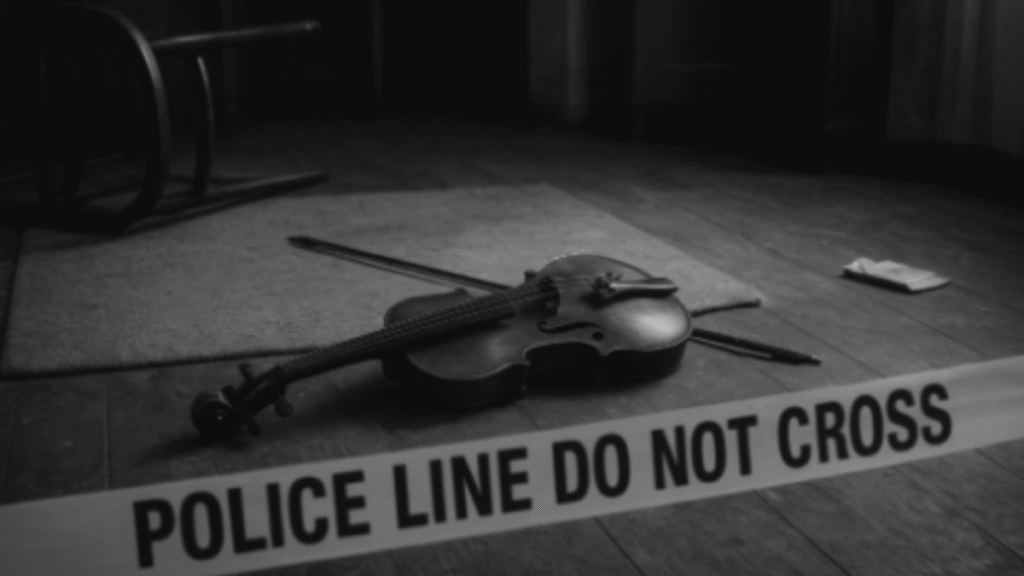
The evening had been running along with its dark suit courtesy. At 11:07 p.m., by the hall clock, the scent arrived. At 11:10 three women agreed in a small circle that the place had finally stopped smelling of expensive varnish. At 11:13 a violinist lost the pitch on a long note, as though his nose had unscrewed his ear. At 11:15 a collector of mustaches told his wife, “it smells like a visitor who never comes.” At 11:19 a young woman in a wine colored dress fainted. She was not the only one. There was discreet paleness, deep breathing, chairs creaking as surprised bodies dropped into them. The orchestra stopped out of decorum. The piece, like the night, was left without the ending anyone had planned.
The medical report spoke of drops in blood pressure, anxiety attacks, and “psychophysiological reactions conditioned by suggestion.” The police spoke of a “minor incident.” The Gazette, which sniffs out the fine print, showed up the next day with a soft covered notebook and a measuring rule that works for both professions: if everybody names the same thing without conferring, maybe it is not in the bottles. Maybe it is in the memories.
The night of the Hall of Mirrors
Mirrors, which by definition hand back whatever you give them, behaved like accomplices that night. They made the room deeper, the dresses longer, the smiles lighter. On the center table, white flowers with no scent, on the organizers’ advice, so nothing would intrude on the dinner. The chef, tidy and proud, swears no dish smelled like anything other than what it was supposed to smell like. “No truffle, no vanilla, no smoke. I run an honest kitchen.” The waiters, questioned patiently by this Gazette, confirm that the cellar never let the breath of the oak escape and that nobody smashed a bottle of cologne in any corner. Something came in, and the moment it had a name, it stayed.
A rough chronology was drawn up. 11:07 p.m., the air changes. 11:09, the first remark. 11:13, the violinist goes flat. 11:15, the fainting. 11:17, the mirrors give back more shine than usual, a debatable detail, noted anyway. 11:21, the scent grows stronger near the north door. 11:24, the scent seems to move toward the middle of the room, or else the guests, hungry for a pattern, put it there. At 11:27, a master perfumer invited to the gala for his patronage delivers the line that gave this chronicle its title. “What we are smelling does not exist.”
One clarification. It is not that there was nothing in the air. There were the usual molecules, the ones that give every night a smell that tells it apart from the afternoon and the dawn. According to the master, though, no known accord could produce that heart of “old cleanliness” crossed with “fruit that never ripens.” The paradox settled in like a chair set down properly. It smelled of something impossible. When something impossible walks into a room packed with people who have memories, every memory lights its own candle and says, I know that one.
Witnesses: a dictionary of one smell
Doña Matilde, a lady discreetly perfumed, described the scent as “the drawer where my mother kept the good tablecloths, with the starch gone soft and a little bag of dried flowers.” Don Aurelio, a retired surgeon, said, “rubbing alcohol from an old medicine cabinet, but no hospital attached. Clean without frightening you.” The orchestra’s violinist talked about “a note of rain on an iron railing.” A young waiter, unable to find the words, offered the most useful line of all. “It smells like being safe.”
Others took it as a warning. “I felt my grandmother right behind my ear. My grandmother was severe. That smell straightened my back,” said a guest who asked not to be named. A tailor at the gala said, “That is not in any bottle, because it is in people’s houses.” The perfumer, consulted again by this newsroom, reached for another metaphor. “It is an accord of evocation more than of essence. I cannot measure it with my palette. With luck, I can chase its shadow.”
The accounts split into two families, the people who felt comforted and the people who felt warned. Real perfumes do the same thing sometimes. The identical violet molecule calms one person and tightens another one’s throat. The perfume that did not exist opened a crack down the middle of the room. Did it smell like a return or a departure? Like childhood or like mourning? Like something about to happen or something that already had?
An investigation in bottles: the electronic nose
The municipal environmental lab, which normally deals in nitrates rather than poetry, set up its electronic nose in the Hall of Mirrors the following day, a bank of sensors able to “smell” volatile compounds and draw their portrait as peaks and valleys. Air samples were taken at different heights, in the curtains, under the tables, in the carpet. The result was so reasonable it felt like a provocation: traces of wax, a little varnished wood, minimal kitchen residue, nothing that could combine into the previous night’s social symphony. An honest technician left a note in the margin. “If it is anything, it is very little. If it smelled like a lot, then it is not our little.”
“Sensors do not feel tenderness,” said a young chemist, “but they measure what is there.” Somebody proposed comparing the gala air against the neutral air of another room. Minor differences, all explainable. They ruled out a cleaning product leak, a careless aerosol, aromatic sabotage. Anyone laughing at that last one has never seen how seriously sabotage is taken in high end hospitality. No employee brought in any substance. Nobody sprayed anything invisible.
The suggestion hypothesis picked up steam. Somebody names a smell, somebody else recognizes it, the room shares it. Social psychology knows more about that than chemistry does. Even so, the Gazette would rather not hang a “suggestible crowd” sign on a neighborhood that has genuinely smelled bread in the mornings, rain on the stonework, and hot oil during the festivals. A town with a trained nose is not fooled easily. Or it is fooled better, which is a different thing.
The perfumer who came without a bottle
The master perfumer, invited to the gala for his generosity toward a workshop of young apprentices, agreed to see this newsroom at his studio: white walls, wood, rows of numbered bottles labeled in tiny handwriting, and a table covered in blotter strips like birds laid out to dry. “I brought my hands, not my formulas,” he said, amused. With the honest clumsiness of the layman, we asked him to describe the impossible.
“The first thing you do when you smell something is go down into your childhood,” he said. “The second is look for the family resemblance. Is it floral, woody, oriental, citrus, leather? This was as if somebody had taken a household memory and polished it until the edges came off. Let me explain. It smelled of a tablecloth drawer, yes, but with no damp. Of fruit, but with no sugar. Of metal, but with no blood. It was a smell with no conflict in it, which is already unusual, because matter smells with its own interests. Here you had a peace treaty between opposites.”
The master tried to rebuild it with his palette: a bit of aldehyde, that cleanliness our grandmothers used, an iris heart for fine powder, a peach pit with the sweetness taken out, a whisper of ozone for the rain on the railing, and that civilized brass that says “old” without saying “rust,” a hint of isobutyl quinoline, perhaps. “I made it. What came out was a gorgeous smell. It was not that one,” he admitted. “The perfume at the gala had intention. Mine only had a formula.”
A wider chronology of the phenomenon
- Monday, three days before: unscented flowers arrive at the hall. The room is aired out in the afternoon. Staff comment that the carpet “smells new,” which it is not.
- Wednesday, one day before: orchestra rehearsal. Nobody records anything unusual. The violinist who would later go flat asks for a different chair. “The other one smelled like a tailor’s varnish.” A line added out of vanity.
- Thursday, the day itself: the gala. At 11:07 p.m. the smell arrives. By 11:27 the room adjusts, or the smell settles down. At 11:40 it turns up again by the donors’ table. At 11:50 it seems to leave with the flow of people heading out to the garden for air.
- Friday, one day after: technicians take samples. Nothing with a strong enough signature.
- Saturday, two days after: the town starts telling its own version. The first “I smelled it too” accounts appear in places nowhere near the gala, a lobby with checkerboard tile, the hallway of an old building, the inside of a tailor’s shop. Narrative contagion? Residue clinging to a dress? A shared memory being handed around?
Old houses talk quietly
The Gazette visited three lobbies in hundred year old buildings. The caretakers, with an apothecary’s expertise, listed a whole catalog of smells: mild bleach, beeswax, loose change, bread rising up the stairwell, a hidden cat when it rains. None of them said “unknown perfume.” When this reporter showed them a small bag of dried flowers he had in his pocket, though, two of them closed their eyes for a second, like somebody stepping into a room that used to be theirs. “That is what Sunday smells like after lunch,” one said. “That, and my father’s jacket, when he came home from Mass and fell asleep on the couch,” added the other. Smell and story danced an old fashioned waltz.
Can a room smell like a collective childhood? The answer is a partial yes. Air accumulates, fabric holds on, floors have things to say. A carpet can become a library if enough remembered footsteps live in it. Here, though, the phenomenon had two peculiarities. It appeared all at once, and it had the courtesy not to lead us to any bottle. “I did not know whether to kiss the air or ask it who it had come looking for,” one guest told me, quietly in tears. “I never mix perfume with dinner, and I felt like the dinner had filled up with the smell of a person.”
The rumor of the lost bottle
Once a mystery has a name, the apocrypha show up right behind. A story went around about a one of a kind bottle blended by a retired perfumer for her husband, a man with a fine nose who died suddenly one February morning. It was said the bottle stayed in a drawer, and that by mistake the gala flowers had been stored in that same closet days earlier, soaking up the accord of a dead man’s love. It was also said that the perfumer, at the gala that night by chance, knew the smell did not belong to this world and closed her eyes in gratitude. None of it could be verified. The perfumer exists. She would not give an interview. The closet, if it exists, is in a house that is not mine. The rumor did have the intelligence of consolation about it, though. It gave the air a mother and a father.
Competing theories
The chemical theory: an accidental combination of inert molecules, wax, cleaning aldehydes, kitchen lactones, ozone from an electrical discharge, which lined up into an unusual accord. Upside: it explains without poetry. Downside: it does not explain the intention the witnesses describe.
The social theory: one remark sets off a chain of recognition, and the brain goes looking and finds. Upside: we know smell and memory are loyal business partners. Downside: some people smelled it in silence before anybody named it.
The domestic theory: the smell is a short circuit between the memory of people’s houses and that room, an emotional bridge somebody (or something) threw across that night. Upside: it explains why it tasted like a return to some people and like a warning to others. Downside: it defends itself badly against sensors.
The minimal theory, this reporter’s favorite: not everything that smells can be distilled. Some accords only exist when somebody needs them. That night, a group of people needed, all at the same time, to feel at home in a place that was not home. The air obeyed with the obedience of an old carpet.
A small experiment
The perfumer proposed a serious game: bring ten people from the gala to his studio, hand them strips with comparable accords, old cleanliness, dried fruit, rain on metal, starch, low oak, and ask them to pick the closest one. It was done. The result was not unanimous, and it was interesting. Most of them chose different strips, and yet, when they smelled the whole set together, five of them said, “now, yes.” “What if the perfume that did not exist was a chorus?” the master said. Choruses, like memory, confirm and confuse at the same time.
The turn: the handkerchief from the jacket
A week later, a short and fragrant clue turned up. The cleaning company found a folded handkerchief along the baseboard of the Hall of Mirrors. Cotton, with tiny embroidered initials: E. L. It did not smell of any cologne anybody knew. It smelled of a recent ironing and of shy lavender. Nobody claimed it. Is the handkerchief the origin? No, though the gesture of folding it and losing it belongs to the same language. What gets lost in a room sometimes leaves its goodbye filtering through the air. The handkerchief is in an envelope, in police custody. This Gazette smelled it from a respectful distance and will not pass judgment. It smells like something that left politely.
Consequences: from etiquette to silence
The event company has added a new line to its etiquette manual. “Guests are asked not to name perfumes that are not present.” It sounds like a joke. It is a protocol. The Casino, for its part, has decided to air out the Hall of Mirrors with the windows open at six and shut them at seven with a smell that is not a smell, the smell of incoming air. The orchestra, out of gentle superstition, rehearses a piece without vibrato on Thursdays, the way you tap a glass to hear it before pouring water.
The master perfumer has given his failure a beautiful name, “Accord of the Empty Room.” He will not sell it. He keeps it as a reminder that the nose answers to bosses who do not appear on his palette. The women who attended the gala have gone back to their everyday perfumes. One of them has bought a laundry soap that smells “like Sunday.” The violinist plays more in tune than ever. He says that since that night he breathes before every note, like somebody opening a window on the inside.
Epilogue: what will not fit in a bottle
If everything that ends up in a bottle were perfume, and if every perfume could be explained by chemistry alone, we would need neither memoirs nor diaries. The perfume that did not exist existed enough to get a whole town talking about handkerchiefs, tablecloths, jasmine, and rainy railings. It brought no death and no theft. It brought a civic act, all of us telling each other who we used to be inside our houses. This Gazette, which believes in the courtesy of things, thanks the air for reminding us that sometimes a mystery does not announce itself with noise but with a smell that came off nobody’s shelf.
If it comes back, let it find the table set: decent tablecloths, flowers that do not shout, windows on generous hinges. If it does not come back, let us at least be left with the discipline of smelling slowly before we name things quickly. Because by calling everything “perfume” that is not, we forget that some scents only let themselves be spoken when life decides to take attendance in a low voice. That night it took attendance. For once, almost all of us answered here.
Did you smell it? What did it remind you of, a return or a warning? Share your account in the comments. At The Crime Gazette, every reader is an investigator.