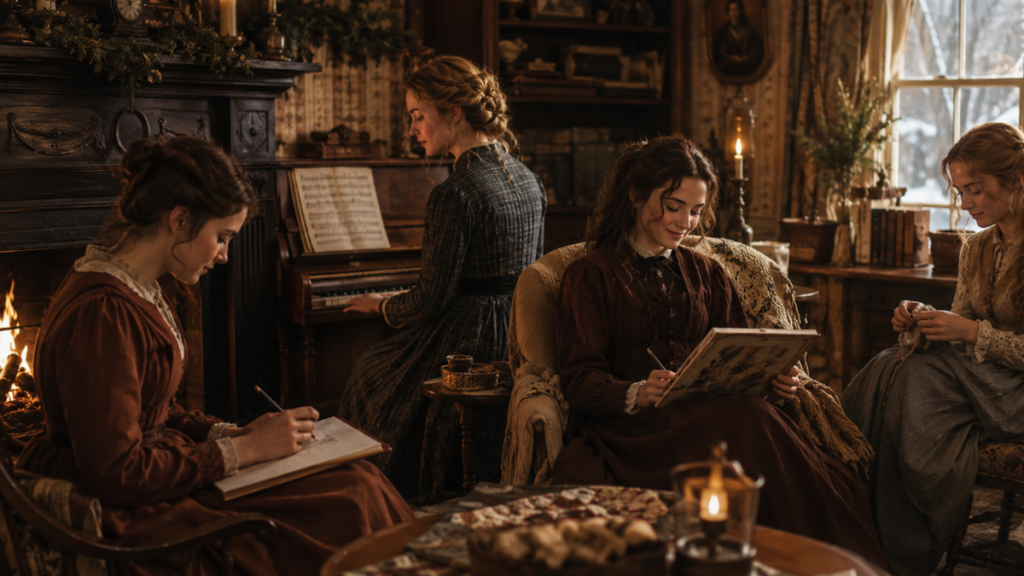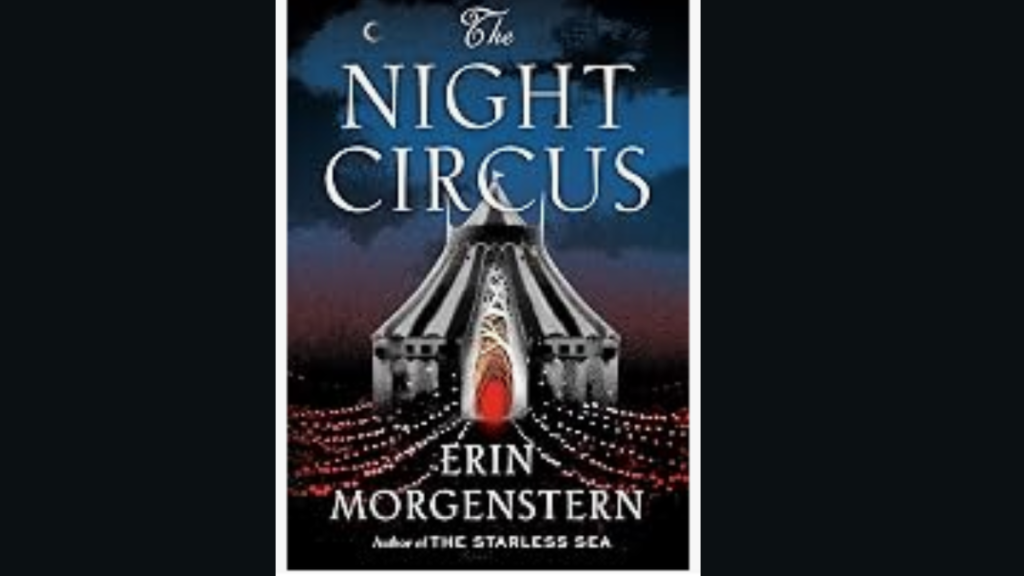
The Night Circus by Erin Morgenstern: context, a spoiler free look at the plot, symbols, characters, aesthetics, themes, style, trivia, frequently asked questions, and why this hypnotic novel keeps enchanting readers.
The Night Circus by Erin Morgenstern is a romantic, atmospheric fantasy novel in which a mysterious circus that only opens after dark becomes the stage for a magical duel between two young illusionists, Celia and Marco, whose fate changes forever when love starts breaking the rules of the game.
“The circus arrives without warning. No announcements precede it. It is simply there, when yesterday it was not.”
Narrator
Why this book had me from the first page
When I opened The Night Circus for the first time, I realized I was not holding “just another story”. It was an experience. I mean that calmly: this novel is not read, it is visited. What you find inside its pages is a place that only opens at night, with no advance notice, with black and white tents that seem alive, and an impossible clock that beats like a mechanical heart. You wander through the smell of caramel, the frost of an ice garden that crackles under your fingers, a cloud you can climb, a carousel that defies physics, and a hall of mirrors where you recognize yourself as someone slightly different. At the center of it all, a promise: magic exists, and it has a price.
It is no accident that so many people recommend it for “when you need to believe in something again”. This post is my personal map, and a pretty thorough one, so that if you have not been to the circus yet you feel like walking through its gates, and if you have already been, you go back with fresh eyes and spot details you might have walked past the first time.
Be warned, though: this is a very descriptive book, so if you are the kind of reader who wants action and intricate plotting, you might find yourself a little bored.
Who Erin Morgenstern is and the context this enchanting novel came from
An author who paints with words
Erin Morgenstern (United States, 1978) trained in art and theater. That detail is not decorative: it explains the way she composes scenes as though they were paintings and designs the circus like an immersive installation. She does not write “about” magic, she designs spaces you can feel, smell, and hear. Her second novel, The Starless Sea (2019), confirmed that signature: literature about literature, worlds inside worlds, and a deep love for the rituals of reading.
The soil it grew in, 2000 to 2010: sensory fantasy and contained worlds
The Night Circus was published in 2011, in the thick of the fantasy series boom and the rise of visual culture, from Tumblr to Pinterest, that embraced the aesthetic as an experience in itself. While much epic fantasy was betting on sprawling maps, wars, and bloodlines, Morgenstern proposed the opposite: a closed, portable world that fits inside a single night and still feels infinite. Chromatic minimalism, sensory maximalism.
A word of mouth phenomenon
It was never marketed as the next great series, yet the book spread through recommendations. Readers gave copies away, book clubs held “circus nights” with black and white outfits, rêveurs, dreamers, turned up at events wearing red scarves. Word of mouth did the rest.
Spoiler free synopsis: the contest, the circus, and a love that breaks the rules
The wager
Two veteran magicians, Prospero the Enchanter and the enigmatic Mr. A. H., seal an ancient rivalry by each training a pupil. Their “game” is not a duel of wands, it is a confrontation between schools of magic. Prospero commits his daughter, Celia Bowen, when she is still a child. Mr. A. H. picks a talented orphan, Marco Alisdair. Both will grow up without fully knowing what they are facing, until the board appears.
The board
The board is a circus. Le Cirque des Rêves opens with no warning, materializes in the small hours, and closes at dawn. Everything is black and white: stripes, spirals, shadows stretching under perfect tents. The circus travels the world like a comet, and wherever it settles it draws a devoted audience: the rêveurs, recognizable by a touch of red in their clothing.
The game gets complicated
Celia and Marco “play” by creating and sustaining impossible tents, adding pieces to a living organism that feeds on their magic. Magic, as Morgenstern keeps reminding us, is never free. The price spills over onto the performers, the circus workers, and anyone who gets too close to the center of the board. Once love enters the scene, the rules stop seeming reasonable.
Characters who breathe: clockwork pieces with a heart
Celia Bowen, the alchemy of the tangible
Discipline, sensitivity, and a stubborn will to turn the impossible into matter. Her magic touches the real: it repairs, transforms, creates. Celia is more than “the illusionist”, she is the pulse of the circus. Her arc is lovely: from a prodigy shaped by a demanding father to a woman who chooses who she wants to be, and at what cost.
Marco Alisdair, the architect of the invisible
His magic clings to the symbol: runes, circles, bindings, thoughts. Backstage is his territory. He designs, he enchants, he ties the circus to its inhabitants. Marco is the mind that plots, Celia the hands that manifest. When they collaborate without knowing it, the circus breathes like a perfect creature.
Prospero and Mr. A. H., opposing pedagogies
Prospero is glitter, ego, spectacle. Mr. A. H. is silence, method, absence. Both use their pupils as chess pieces. Morgenstern neither demonizes nor redeems them, she lets us readers judge the damage done by teaching someone without ever looking at the person.
Poppet and Widget, the twins born with the circus
Symbol children. Poppet reads between the lines of the future, Widget narrates what nobody else sees. They are not cute decoration, they are guardians of the circus’s spirit, able to hold it up when the adults falter.
Isobel, Chandresh, Tsukiko, Herr Thiessen, and the rêveurs
- Isobel, the knot that binds and unbinds: a magician of knots, a witness, and at times a catalyst.
- Chandresh Lefèvre: the visionary patron who convenes that first impossible dinner.
- Tsukiko: the unflappable contortionist, a favorite for many readers thanks to a revelation that reframes the whole story.
- Herr Thiessen: a clockmaker who understands time as a mechanical poem. His clock is the heart of the circus.
- The rêveurs: us, the readers, walking together in a red scarf, marveling at the same moments.
Sets you will not forget: tents, clocks, flavors, and weather
The ice garden
A tent made of cold breath: crystalline trees, petals that chime like little bells, benches that creak. It is not simply “pretty”, it works as Celia’s manifesto: making the impossible tactile without letting it lose any delicacy.
The cloud maze
Climbing, feeling the matter give under your weight, and being held up anyway. Trust as a mechanism for ascent. The metaphor is obvious and beautiful.
The hall of whispers, the carousel, the wishing tree
Every tent is a verb: to whisper, to spin, to wish, to remember. All of them are telling you something about the duelists, about the price of wonder, and about how the audience cooperates with the magic.
Thiessen’s clock
A device that marks the hours with scenes. It does not exist “only” to measure time, it exists to tell stories at the pace of gears. It may be the object readers love most in the whole book.
How it is told: structure, point of view, and time
A nonlinear narrative with dates
Dates at the start of chapters, jumps forward and back, and a cadence that asks the reader to do their share. It is not confusing, it is participatory. Time here is a carefully calibrated spiral.
Second person in the interludes
“You enter the circus…” Those passages turn you into another character in the book. They are short and enormously effective: they stop you looking in from outside.
Restrained polyphony
It is not an endless chorus, more of an echo chamber: several figures add layers of romantic fable, quiet thriller, chronicle of an artistic production, and travel notebook.
The themes beating under the ink
Love and fate: are rules obeyed or reinvented?
The story does not ask whether love is “strong”, it asks whether love is “responsible”. The solution Celia and Marco find does not deny the original pact, it transforms it.
Art, collaboration, and authorship
The circus is a collective work. The contest may be a duel, yet every tent proves that wonder is better when it is shared. The book talks about the ethics of spectacle and about how a living project is sustained without devouring the people who create it.
Freedom versus guardianship
The sons and daughters of demanding masters carry marks. The novel explores how to step out of the shadow without denying what you learned. Growing up also means editing your inheritance.
The price of wonder
Astonishing people is exhausting. Sustaining a miracle indefinitely takes energy and sometimes sacrifice. Morgenstern does not romanticize it, she shows the cost with respect.
Identity, memory, and storytelling
Who you are depends on what you tell, what you remember, and what you choose to forget. Widget, with his “tell me a story”, is key here: he narrates in order to fix things in place, in order to save them.
Black and white, with one red thread: aesthetics as grammar
The restricted palette
Black and white: elegance, restraint, focus. The trick lives in the detail, not in bright colors. The limitation drives invention. With two tones, this circus does everything.
The red of the rêveurs
A scarf, a ribbon, a glove: the touch of red. It is a quiet badge of belonging. It is also a reminder that the audience completes the spell.
Typography, layout, and the physical book
Editions with red and black inks, designs that play with stripes. The book as an object behaves like one more piece of the circus.
A style you can taste: sensory prose and musical breathing
Sentences that ask to be touched
Ice that splinters, sugar that crunches, smoke that tastes of vanilla. The synesthesia is not a whim here, it forces you to be inside rather than merely watching.
The rhythm of a big top
Short chapters, scenes described like acts in a show, reopenings at nightfall. It is easy to stop, and impossible not to come back.
Restraint and silence
Not everything gets explained, and the shadows matter. The author understands that mystery is a storytelling tool too.
Reception, legacy, and the community of rêveurs
Clubs, recipes, playlists, and scarves
The book generated creative communities: 3D printed clocks, nighttime playlists, caramel recipes, routes of “imaginary tents” through real cities. It is not a loud fandom, it is a persistent and careful one.
Comparisons and inheritances
If you love The Shadow of the Wind for its atmosphere, The Ocean at the End of the Lane for its mythic intimacy, or The Starless Sea for its impossible libraries, you will feel at home here.
Adaptations
There has been plenty of back and forth with rights and screen projects. The difficulty is not “telling the plot”, it is translating the way the book breathes. Either way, the novel stands perfectly well on its own: it needs no screen to stay alive.
How to read The Night Circus and enjoy it fully
Pace and ritual
This is not a thriller. Treat it like a night visit: a couple of tents per session. Low lights, something warm to drink, a whispering playlist. Read it at night if you can.
Rereading is recommended
Second readings reveal symmetries, mirror games, and small clues planted on purpose. It is one of those books that grow with you.
The perfect gift
It is a perfect book for readers of fantasy, of atmospheric romance, and of sensory storytelling. It is accessible without being simple and beautiful without being twee, which makes it a great book to give someone.
A word with the doubters: what if I am not a fantasy reader?
I understand. This is not about complicated magic systems or endless genealogies. It is about atmosphere, emotion, and a place where you can be amazed without bumping into anything. If you have ever thought “I would love to feel the way I did as a child, when everything was new”, this book is a safe door.
If you are a hard fantasy reader with a taste for technical maps, think of this as a lyrical interlude. An elegant breather between battles.
I also recommend the books of Mathias Malzieu if you want to keep going with fantasy and magic.
A close look at key scenes, without spoiling them
Chandresh’s dinner
The founding act. The choreography of dishes, toasts, and silences is a statement of intent: the circus is born as a total work of art.
The first time you “enter”
The second person works. You feel the change in temperature, the smell of cold smoke, the collective murmur. From that point on, you accept the rules of the game.
A revelation about Tsukiko
When it lands, and if you know, you know, you understand that the circus keeps its own old duels too. It is a mirror of the current contest and a warning.
How the board resolves
There is no explosion, there is elegance. The solution is consistent with everything the book has been saying about love, authorship, and responsibility.
What it is not, so you avoid disappointment
- It is not a series with a brutal cliffhanger. It is self contained.
- It is not standard YA, though YA readers may well love it.
- It is not an enemies to lovers romance full of verbal sparks. The romance is restrained, grave, beautiful.
- It is not a catalog of magic “tricks”, it is an aesthetic manifesto.
Frequently asked questions
Is The Night Circus self contained?
Yes, it closes its main plot. Echoes remain that could be explored, though the story itself is complete.
How “fantasy” is it?
Fantasy of atmosphere: the magic is plain to see, handled with minimalist elegance. The effect matters more than the mechanics.
Is there a lot of romance?
There is romance, yes, woven into the ethics of the story. It is more a love that sustains and complicates the work than a romance that monopolizes it.
Is it slow?
It is unhurried on purpose. Enjoy it like a walk at night: no rush, senses wide open.
What kind of reader is it ideal for?
For anyone who loves the sensory and the aesthetic, the architecture of intimate worlds, and for readers looking for something other than traditional epic fantasy.
Can I read it if I do not like fantasy?
Yes. If you enjoy atmospheric novels, Zafón, Ishiguro at his most subtle, even Donna Tartt for the craftsmanship of detail, this one may surprise you.
What minimum age would you recommend?
From about 14 or 15 for regular readers. Adults enjoy it enormously.
Which edition should I choose?
Look for one with good design, since many play with inks and endpapers. It is not essential, though it adds to the experience.
Why it still shines today
Because sometimes the world asks us to rest from the noise. The circus offers a full silence, the silence of a tent where sugar snow suddenly starts falling. Because it talks about sustaining beautiful projects without breaking yourself along the way, about working as a team, about loving without possessing, about remembering that the audience matters. It is also a conversation about art that takes care of people.
You can find it on Amazon.
Recommendations if you fall for the circus
- The Starless Sea (Erin Morgenstern): impossible libraries, doors, and bees.
- The Ocean at the End of the Lane (Neil Gaiman): intimate myth, childhood, and shadows.
- Piranesi (Susanna Clarke): symbolic architecture, silence, and light.
- The Shadow of the Wind (Carlos Ruiz Zafón): atmosphere, a city as a character, and a love of books.
See you under the stripes
If you made it this far, thank you. I love thinking that in some way we have walked through the circus together: that you sat down to listen to the ice crackling, that you touched the cloud, that you watched the clock waiting for its next beat.
Now I want to hear from you. Which tent was your favorite? Which character do you keep? Are you still in black and white, or are you already wearing the red scarf? Leave me a comment, share this guide with the person who needs a night of magic, and subscribe so you do not miss the next literary journeys. The gates open at nightfall. Always.
You can watch the review on YouTube