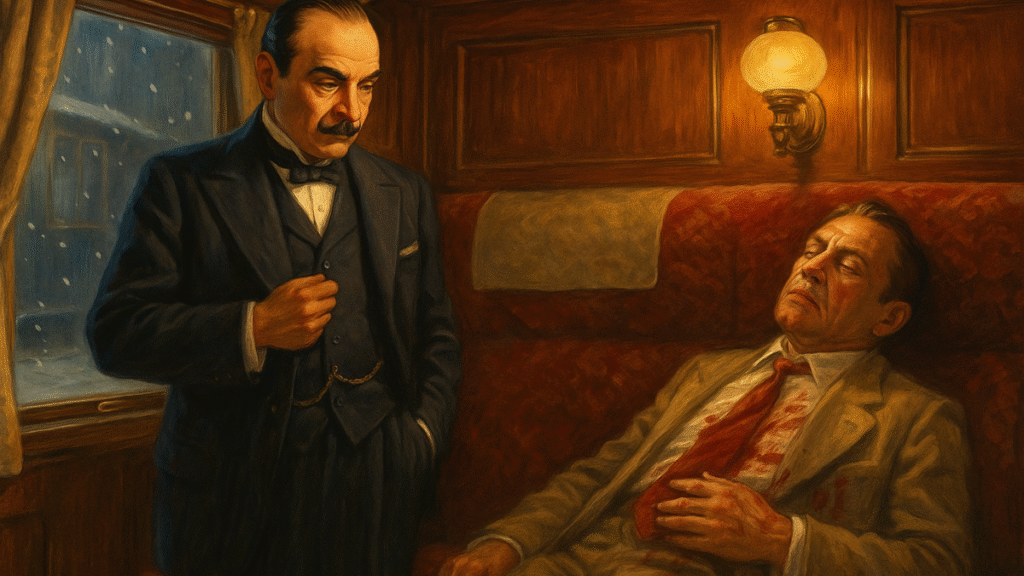
Step aboard Murder on the Orient Express, the most iconic novel by Agatha Christie. I will walk you through the story, the world it was written in, how Poirot’s mind works, and why this book is still a masterpiece of mystery.
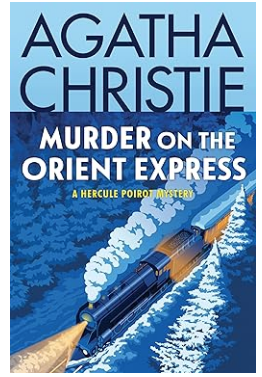
Murder on the Orient Express is one of Agatha Christie’s masterpieces and one of Hercule Poirot’s most iconic cases. The story begins when a man is found murdered in his compartment while the luxurious Orient Express sits stranded in the snow. With every passenger a suspect and a closed setting nobody can escape, Poirot has to unravel the most surprising and morally complicated crime of his career. A brilliant, elegant mystery with an ending that breaks every rule of the genre.
One crime, one train, and a detective you cannot forget
The first time I opened Murder on the Orient Express, I did not expect it to grab me the way it did. I figured it would be one more mystery novel, entertaining enough, nothing out of the ordinary. I ended up reading late into the night with that wonderful feeling of being inside a mental game you cannot figure out how to crack.
The best part is that Christie lays the clues out right in front of you, calmly, like it is nothing, and it is on you to notice them, connect them, and, if you can manage it, get ahead of Poirot. I will tell you right now that beating him is basically impossible.
This is a story that lets you travel without moving, suspect people without feeling guilty, and above all enjoy yourself, because Christie makes mystery delicious. There is a murder in it, yes, along with humanity, justice, pain, and an ending that makes you sit in silence for a minute to process it.
This post contains affiliate links
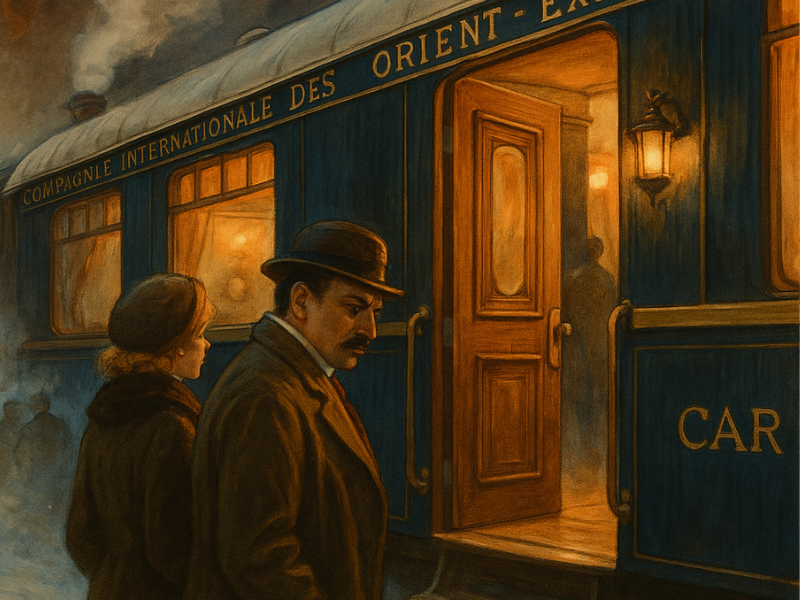
Agatha Christie, the woman who changed crime writing
I have always been fascinated by the idea of Agatha Christie writing this book. I do not picture her surrounded by drama or mystery. I picture her at home with a cup of tea and that very British calm of hers, while an entire universe of clues, suspects, and unexpected turns assembled itself in her head.
Christie was born in 1890 into comfortable circumstances, and her life was anything but quiet. She lost her father when she was young, her family went through money trouble, and during the First World War she worked as a nurse and then in a dispensary. That is where she learned about poisons, the kind of detail she would later use with almost surgical precision in her novels.
In 1920 she created Hercule Poirot, her most famous detective, who stood out from the start for something that broke the mold: his elegant figure, his obsession with order, his impeccable mustache, and above all his mind. A mind that could not let the smallest detail slip past. That may be the only thing he has in common with Sherlock Holmes, another wonderful detective.
How this book came about, and why it could not have been written at any other moment
Murder on the Orient Express was published in 1934, right in the middle of the interwar years. Europe was wounded, suspicious, trying to rebuild itself. People were traveling more, the trains filled up with passengers from everywhere, and glamour sat alongside insecurity.
Christie traveled on the famous Orient Express several times, and one trip gave her the key moment, a snowstorm that left the train completely stranded in the middle of a white, silent landscape. That stayed with her. Picture being stuck with strangers on a luxury train with no way to get off. Any story can be born inside that kind of forced confinement.
Beyond that, this was a period when the headlines were full of the Lindbergh baby kidnapping, a crime that shook the world and whose shadow falls clearly across this book. Christie took those collective emotions and turned them into a story that is as human as it is chilling.
What Murder on the Orient Express is about, no spoilers, I promise
The premise sounds simple. A man is found murdered in his compartment while the train sits completely stranded in the snow. Nobody could have gotten on or off. The passengers are the only suspects.
Poirot, aboard by pure chance, takes the case, and this is where the fun starts.
Every passenger has a convincing story, a reason to be there, and a personality distinct enough that you start building theories. The problem is that Christie has gotten ahead of all of them.
The ending is one of those that force you to stop, read it again, and think about what you would have done in that situation. Trust me, it is not as simple as it looks.
The characters who turn the train into a world in miniature
One of the loveliest things about this book is how the train becomes a setting that lives and breathes. Every passenger is a piece that fits into the puzzle in its own way. Here are a few of the ones that stayed with me:
Mary Debenham, a young Englishwoman who seems to be hiding far more than she says.
Mrs. Hubbard, a chatty American passenger who has an answer for everything.
Princess Dragomiroff, carrying a dignity that is almost impenetrable.
Colonel Arbuthnot, so British, so tough, so reserved.
Count and Countess Andrenyi, elegant and mysterious.
Then there is Ratchett, the victim, whose death looks less like an unexpected crime than a score being settled.
What makes this book singular
I will admit it, in plenty of mysteries you think you have caught the culprit by page 50. Not here. Christie takes your theory apart over and over, elegantly, without ever making a scene. Everything looks easy once Poirot explains it, and while you are reading, nothing is obvious at all.
Then there is the moral dilemma. This book forces you to ask what justice is, what revenge is, and what you would do at the edge. It is impossible to reach the last page without that knot in your chest that shows up whenever you run into something deeply human.
A trip through the history of the most famous train in the world
The Orient Express is not only a train, it is a fantasy on wheels. When Christie wrote this book, traveling on it was a luxury for a small handful of people. The compartments, the silver service, the carpeted corridors, all of it had an almost cinematic aura.
Past the glamour, the train represented something else, a crossroads of cultures at a time when Europe was looking for its identity. That sophisticated atmosphere, mixed with sudden isolation in the snow, is what makes the book such an enveloping experience.
Adaptations: which one is best?
I have seen almost all of them, and each has its charm.
The 1974 film is elegant and classic, with an incredible cast.
The 2017 version is more visual, more intense, with a more emotional Poirot.
The episode from the British series with David Suchet is the most faithful to the spirit of the book, and for a lot of readers it is the definitive one.
If you ask me, start with Suchet. If you like your movies more modern, the Branagh one will work for you.
What it left me with as a reader
This book reminded me that there are people behind every mystery, that even after a crime there can be pain, reasons, and deep wounds. It also gave me one of the best feelings reading can give me, being fooled elegantly by a brilliant mind.
Christie does not manipulate you, she invites you to play. You accept happily, even though the queen of crime always wins in the end.
Frequently asked questions
Do I need to read other Poirot books first?
No. You can enjoy this one without having read any of the others.
Is the ending surprising?
Enormously. Even if you have seen the adaptations, reading it in Christie’s own words is a different experience.
Is it a hard read?
Not at all. It is accessible, direct, and very entertaining.
What genre is it?
Detective fiction, classic mystery, crime.
Murder on the Orient Express is not simply a book where a crime gets solved, it is a trip through human feeling, through old wounds, and through the hard decisions people sometimes have to make. If you are interested, you can get it online.
The best part is that every time you read it, you find something new. If you feel like talking about it, I would love to hear from you. Did you suspect what was coming at any point?