Discover the hidden secrets of The Arabian Nights. I’ll tell you how these fascinating stories saved lives and why they still hold our minds captive today.
Have you ever felt that overwhelming need to devour one story after another, barely able to sleep, simply because your mind keeps asking for more? It happens to me all the time.
It’s an energy that pushes me to explore, to jump from one subject to the next, and to swallow whole any book that has a soul. If there’s one book in this world that perfectly captures what infinite curiosity and the urge to keep the spark alive really mean, it’s The Arabian Nights, without a doubt.
I want us to pull apart together this jewel of Eastern literature which, if you stop and think about it, is the greatest monument ever built to the power of words and to human survival. Get ready, because what sits behind these pages is a stunning maze.
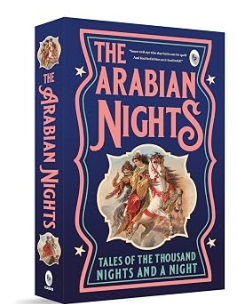
The Arabian Nights is a huge literary tapestry that blends the folklore, mythology, and street-smart humor of Persian, Arab, Indian, and Egyptian cultures. The book opens with the betrayal suffered by Sultan Shahriyar, who, driven mad by spite, decides to marry a new woman every night and have her executed at dawn. Scheherazade, the vizier’s daughter, comes up with a plan to stop the slaughter: she tells him a gripping story and cuts it off right as the sun comes up.
Along the way you’ll find moral parables, tales of courtly love, poetry, eroticism, and epic adventures starring genies, magicians, sailors, and kings. More than a simple book of entertainment, it’s a deep exploration of human psychology and one of the strongest defenses ever written of the power of words and imagination as tools for survival.
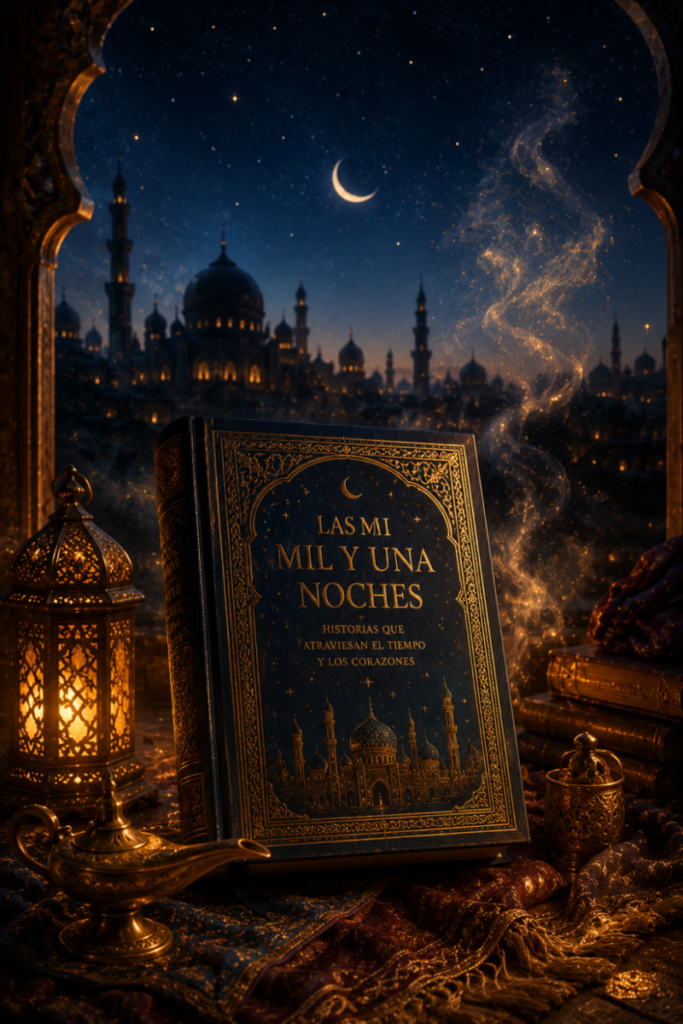
The images in this post were created with AI assistance for illustrative purposes
This post contains affiliate links. If you buy through them, you support my work at no extra cost to you
The Origin of a Textual Maze Born to Save Lives
To understand how big this work really is, the first thing we have to drop is the idea that it’s a children’s book. Forget the cartoon movies for a moment. The real backbone of this collection of traditional Arab tales is raw, intense, and beats with overwhelming force.
A King’s Bitterness and a Woman’s Courage
The story begins with a massive trauma. We have King Shahriyar, a powerful man who has been completely broken by his first wife’s betrayal. His pain and his rage turn into destructive madness: he decides that every night he’ll marry a virgin from his kingdom, and the next morning he’ll have her executed. It’s a brutal cycle of death that bleeds his people dry and spreads panic everywhere.
Then she shows up. Scheherazade. She isn’t just a brave woman, she’s a force of nature. She could have run away, she could have cried, but she chose to act.
Scheherazade had a master plan built on something we still use today to grab people’s attention: the art of the hook. She knew the only way to stop the horror was to strike at human curiosity, that same itch that keeps us up watching one more episode of our favorite show.
The Art of Suspense in The Arabian Nights
The mechanism Scheherazade invents is so brilliant that it surprises me every time I think about it. She starts telling the king a story on their wedding night. She uses all her eloquence, describes exotic landscapes, and brings in fascinating characters, magicians, genies, and betrayals. Then, right as the sun starts to rise and the executioner is already sharpening his sword, she stops the story at its highest point.
The king, eaten alive by the need to know what happens next, puts off the execution for one more day. That’s how it goes, night after night, for a thousand and one nights. Scheherazade doesn’t just save her own neck, she saves the future of every woman in the kingdom using nothing but her voice and her deep understanding of human psychology. It’s the triumph of intelligence over brute force.

The Russian Doll Structure That Challenges Your Mind
Once you get into these pages, you realize right away that this is not a flat, linear read. Not even close. The structure of The Arabian Nights is a technical marvel that scholars call a frame narrative, but that you and I can picture more easily as a set of Russian nesting dolls, the matryoshkas.
Stories Inside Stories in an Endless Loop
Picture the scene: Scheherazade is telling the king a story about a fisherman. That fisherman, in order to convince a genie, tells him the story of a king and his physician. That physician, inside his own story, brings up the parable of a falcon. It’s pure architectural madness, and it grabs you completely. That’s the heart of The Arabian Nights.
Sometimes you’re four levels deep into a story and you wonder how on earth you got there, but the beautiful part is that it all fits together in the end. This way of telling stories is no accident. It comes out of a very rich oral tradition, where the storyteller in the market square of Baghdad or Cairo needed to keep the crowd glued to the ground, making sure they came back the next day with a coin in hand.
How a Living Text Evolved Across the Centuries
Another thing that fascinates me and that I want to share with you is that this book has no single author. There was never one man sitting at a desk writing a thousand and one pages in one go. It’s a living text, a river that gathered water from many different cultures over hundreds of years.
- The original core comes from a Persian collection of tales called Hazar Afsana (A Thousand Tales), which already existed around the eighth century.
- Later on, the scribes and storytellers of Baghdad translated and expanded these tales, adding the flavor of the court of Caliph Harun al-Rashid.
- After that, the book traveled to Egypt, where it picked up stories of urban trickery, legends of hidden treasure, and tales of sea voyages.
It’s a multicultural tapestry that mixes traditions from India, Persia, Arabia, and North Africa. That’s why it’s so rich, so dense, and so full of details that wake up every one of our senses.
The Universal Themes That Still Connect With Us
Even though these stories were collected so many centuries ago, the themes they touch are still completely current. They speak to what drives us as human beings, to our deepest fears and our most burning desires.
Inevitable Fate and the Turns of Fortune in The Arabian Nights
One of the threads running through the whole work is the idea of destiny, what the Arab world calls maktub (it is written). In many tales we watch a poor, miserable man become a vizier overnight thanks to a stroke of luck or a magical object. In the same way, a powerful king can end up begging in the streets because of one bad decision or the envy of his enemies.
That volatility reminds us that nothing is permanent. It connects with that very familiar feeling that the world can change in a second, something we live through constantly these days.
Eroticism, Desire, and the Human Comedy
If you read the complete, uncensored translations, you’re in for a big surprise. The Arabian Nights is full of eroticism, sensuality, and mischievous humor. There are stories that work as full-blown comedies of errors, where women outsmart their jealous husbands with incredible cunning, and where physical desire is described with astonishing openness.
There are no prudish taboos in the original version. Passion, jealousy, revenge, and pleasure are all discussed without beating around the bush. It’s a faithful reflection of the society of the time, which was far more alive and far less rigid than boring textbooks have sometimes led us to believe.
A Close Look at the Most Iconic Stories
Let’s dig into the part you’ve probably been waiting for. We all know the names of the main characters, but most of the time we stay on the surface. Let’s scratch a little deeper to see what these stories actually teach us.
Aladdin and the Wonderful Lamp: Much More Than Three Wishes
Here’s a curious fact: did you know that the story of Aladdin was not part of the original Arabic manuscript? It was added by the French translator Antoine Galland in the eighteenth century, after he heard it from a Syrian storyteller named Hanna Diab. Even though it was a late addition, it became the most famous tale in the world.
If we look at the story with more mature eyes, though, Aladdin’s journey is the classic arc of personal growth. He starts out as a lazy young man who doesn’t want to work and who drives his mother to despair. His run-in with the fake uncle, the evil magician, forces him to grow up the hard way.
The lamp and the genie are nothing more than tools, because in the end it’s Aladdin’s own cleverness that lets him beat the villain and hold on to his love for the sultan’s daughter. It’s the story of how a nobody finds his own inner power.
Ali Baba and the Forty Thieves: The Cunning of a Woman in the Shadows
This is another of the tales Galland added that turned into a runaway hit. Everybody remembers the magic words “Open, Sesame,” which swing open the doors of the cave packed with stolen treasure. It’s the ultimate fantasy of instant riches.
The real engine of this story is not Ali Baba, though, who at the end of the day is a good man but a little naive. The true hero here is Morgiana, the household slave. She’s the one who finds the thieves hiding in the oil jars, the one who designs the plan to finish them off, and the one who saves the entire family from certain death, all thanks to her quick thinking and her nerve. Once again, the book shows us that intelligence and the ability to pay attention are the most powerful weapons in the world.
Sinbad the Sailor: The Endless Hunger for Exploration and Adventure
The seven voyages of Sinbad the Sailor make up a short adventure novel of their own inside the larger book. What I love about Sinbad is his motivation. He isn’t a man who travels out of need. Every time he comes back from an expedition he’s rich, he’s set for life, and he can enjoy all the luxuries of Baghdad. After a few months, though, he feels a restlessness inside, a call to adventure that makes it impossible for him to sit still at home.
Sinbad needs to go out into the world, face giant birds like the Roc, escape cannibals, outwit one-eyed monsters, and lose entire ships in terrifying storms. He’s resilience in human form. No matter how many times he’s shipwrecked, he always finds a way to build a raft, save his life, and start over from nothing.
Cultural Impact and the Western Fascination With the Magical East
When this book reached Europe at the beginning of the eighteenth century, it set off a real cultural earthquake. Picture European society at the time, laced up tight in the Enlightenment, in reason and rigid rules, suddenly discovering a universe where carpets fly, genies bend reality, and passions run wild.
The Orientalism Craze in Literature and Art
Antoine Galland’s translation set off a wave of Orientalism that flooded painting, fashion, music, and literature. Every major writer wanted to imitate Scheherazade’s style. Authors as important as Voltaire, Goethe, and later Jorge Luis Borges were completely spellbound by this infinite structure.
Borges, in fact, said that the phrase “a thousand and one nights” was one of the most beautiful in the language, because the word thousand already suggests infinity, so adding the one was like opening the door to one more story, to an eternal continuation that never ends. That idea of the infinite is what keeps the book from ever growing old.
Frequently Asked Questions About The Arabian Nights
What are the most famous stories in The Arabian Nights?
The most universally known tales are Aladdin and the Wonderful Lamp, Ali Baba and the Forty Thieves, and The Seven Voyages of Sinbad the Sailor. The book holds hundreds of other fascinating stories, though, such as The Fisherman and the Genie, The Ebony Horse, and The Three Apples, which are true gems of suspense storytelling.
Who really wrote The Arabian Nights?
There is no single author. It is a collective work that grew out of the oral tradition of several Eastern peoples. The main core of the tales is Persian in origin, but it was collected, translated, and expanded by writers, scholars, and storytellers in Baghdad during the golden age of the Abbasid caliphate, and later enriched with popular Egyptian stories.
Why is the book called One Thousand and One Nights?
The number one thousand and one should not be read as a strict mathematical figure in the Arab culture of the time. For them, saying a thousand meant a vast, almost uncountable amount. Adding that final one is a poetic way of saying that the story reaches beyond infinity, that there is always room for one more tale, and that life and language never stop.
Is it a suitable book for children?
The versions most of us know from movies or school adaptations are heavily sweetened and cut down. The complete original text was written for adults, since it contains a large dose of eroticism, violence, complex political intrigue, and deep philosophical reflection on the human condition, death, and fate.
Which English translation is the best one to read?
There are several excellent options. Husain Haddawy’s translation, based on the oldest Syrian manuscript, is one of the most respected for its accuracy and its readable, natural tone. Malcolm Lyons’s Penguin edition gives you the complete text in modern English. Richard Burton’s Victorian version keeps the raw and erotic material that other nineteenth century translations censored, although its language feels dated today.
What Scheherazade Teaches Us in the Twenty-First Century
In the end, when you close the last page of this enormous volume, you’re left with a feeling of pure awe. You realize that The Arabian Nights is a monument to hope and to the human ability to transform reality through art.
Scheherazade teaches us that even in the darkest situation, with the executioner’s sword grazing your neck, you are not completely unarmed. Your mind, your creativity, your ability to connect with another person and tell a story worth hearing are the most powerful tools you have. She didn’t need weapons to change the heart of a tyrant king. All she needed was to understand human psychology and to have the courage to start talking.
This book fills me with tremendous energy every time I think about it. It reminds me that curiosity is the engine that keeps us alive, that we should never stop exploring new horizons, and that every day is a chance to start a new chapter in our own story. Here are the online links at Amazon and La Casa del Libro.
I’d love to hear what you think about this magical universe. Have you had the chance to read any of the original stories beyond the commercial adaptations? Which character is your favorite, or which one caught your attention most after everything we’ve talked about today?
Stop by the comments section below and tell me everything, because I’m dying to read your thoughts and to keep this amazing literary conversation going. See you down there!