Everything you need to know about Alice Hoffman’s 4-book Practical Magic saga: the best reading order, the themes that make it stick, and the lowdown on Practical Magic 2 arriving in theaters September 2026.
If you’re here, something about this story grabbed you. I get it, because the same thing happened to me. I picked up Practical Magic without knowing what I was getting into, and by the last page I wanted to flip right back to the beginning and start over.
Turns out it’s not just one book. There are four. Four novels that build a sprawling family world across centuries, following women who carry a curse, who figure out how to love themselves despite it all, and who forge their own path even when everyone around them says they shouldn’t.
The timing couldn’t be better. In September 2026, Practical Magic 2 lands in theaters with Sandra Bullock and Nicole Kidman stepping back into Sally and Gillian’s shoes. So there’s really no better moment to talk about these books.
If you haven’t read all four yet, I’m going to break down every detail so you know where to start, what each one brings to the table, and why this saga keeps pulling readers in from all over.
Get comfortable, because this is going to be a long one. Worth it, though.
This post contains affiliate links; see the disclosure for details.
Who is Alice Hoffman and why she deserves your attention
Before we get into the books, it’s worth spending a minute on Alice Hoffman herself, because knowing who’s behind these stories changes how you read them.
Hoffman is an American novelist born in New York in 1952. She’s published over thirty novels, several short story collections, and a handful of YA books.
Her writing has this very specific quality: she mixes the ordinary with the impossible so seamlessly that you never feel like you’re reading fantasy, but you’re definitely not reading straight realism either. Some people slap the magical realism label on it, though she’s never been a huge fan of that term.
What I love about Hoffman is that she writes about real women. Women who second-guess themselves, who screw up, who are scared, who love in messy ways, and who eventually land somewhere that feels right. They’re people you recognize, and that’s what makes her books linger long after you’ve closed them.
She’s won multiple awards over the course of her career and her work has been translated into more than twenty languages. But if there’s one book she’s known for worldwide, it’s Practical Magic, especially after the 1998 film adaptation with Sandra Bullock and Nicole Kidman. The movie gave her mainstream visibility, but the novel has a depth the screen couldn’t quite reach. That’s usually how it goes.
In Spain, her books are published by Umbriel (an Ediciones Urano imprint), which has been rolling out her titles over the past few years: Practical Magic, The Rules of Magic, Magic Lessons, The Invisible Hour, and as of August 2026, The Book of Magic, the final installment of the Owens saga.

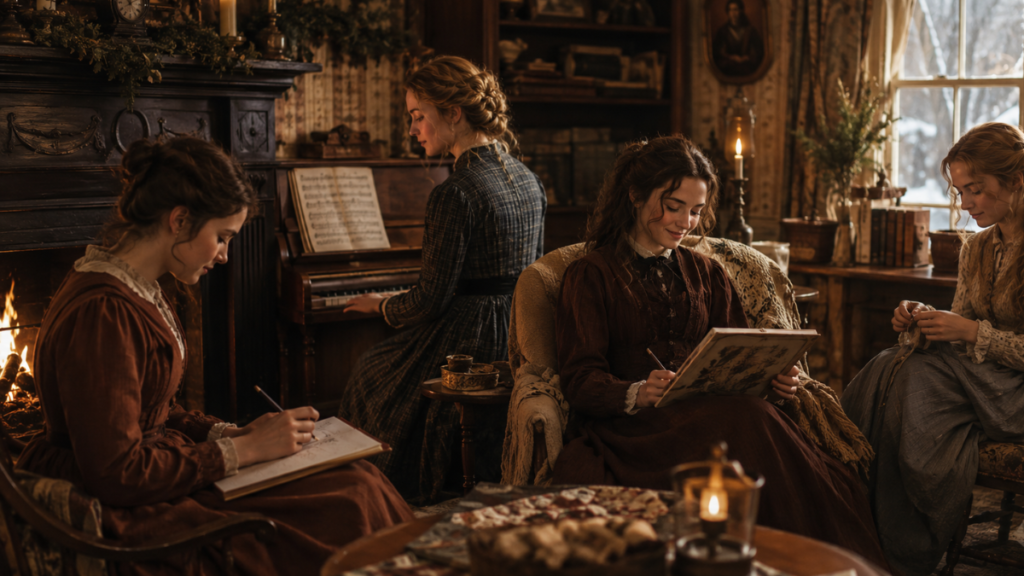
Image generated for illustrative purposes
Practical Magic: the novel that kicked it all off
What it’s about
Published in 1995, Practical Magic introduces us to Sally and Gillian Owens, two sisters raised by their aunts in a small Massachusetts town.
Aunts Bridget and Frances are known around town for being… different. People side-eye them, kids keep their distance, neighborhood moms steer clear. The house smells like lavender and rosemary, plants are everywhere, and the aunts whip up remedies that people quietly come asking for, only to deny the visit later.
Sally and Gillian grow up marked by that otherness, but they handle it in opposite ways. Sally craves normality: a conventional life, a husband, kids, a home where nobody looks at her funny. Gillian throws herself headfirst into the world, chasing big feelings, intense relationships, anything that tastes like freedom.
What ties them together beyond blood is a family curse that goes back generations. Any man who falls in love with an Owens woman is doomed to die. That curse shapes every choice they make, every relationship they try, and the whole way they understand love.
When Gillian shows up at Sally’s door one night with a very serious problem, the two of them have to face something together that’s way bigger than anything they’d bargained for.
I won’t spoil the rest because the details deserve to be experienced on the page. But I will say this: the plot isn’t the most important part of this book. How it makes you feel is.
What makes it so special
I’ve read a fair number of novels in this lane: families with secrets, opposite-pole sisters, curses, emotional baggage passed down the bloodline. But Practical Magic does something different, and I think it comes down to pacing and honesty.
Hoffman doesn’t try to dazzle you with flashy metaphors or a plot twist every three pages. She tells you the story of two women doing their best with the hand they were dealt, and she does it in clean, flowing prose that carries you forward without effort.
There are moments that make you smile and moments that punch you in the stomach, but none of it feels forced. It all happens organically.
What hit me hardest the first time through was the relationship between Sally and Gillian. It’s real. Not the idealized version of sisterhood where they always show up for each other. There’s resentment, distance, things left unsaid. But there’s also a bond that refuses to break, no matter how hard they both pull at it.
The way Hoffman handles the theme of being different is another standout. The Owens women are singled out for not fitting in, and that breeds loneliness, distrust, the constant push-pull between belonging and being yourself. It’s universal enough to resonate with anyone who’s ever felt like an outsider, which is basically all of us.
Then there’s the setting. Hoffman builds atmosphere with remarkably few words. You can smell the aunts’ garden, feel the bite of a Massachusetts winter, sense the shift in the room when someone knocks on the Owens’ front door. She puts you there before you realize it’s happened.
You can grab the novel on Amazon.
All 4 books in the Owens saga you need to know about
Here’s where things get exciting. If Practical Magic grabbed you, or if you haven’t read it yet but something about it is calling your name, you need to know it doesn’t stand alone. Hoffman built an entire saga around the Owens family, and each book peels back new layers.
I’ll walk you through them one by one in publication order, which isn’t the same as the story’s chronological order. Then we’ll talk about the best way to read them.
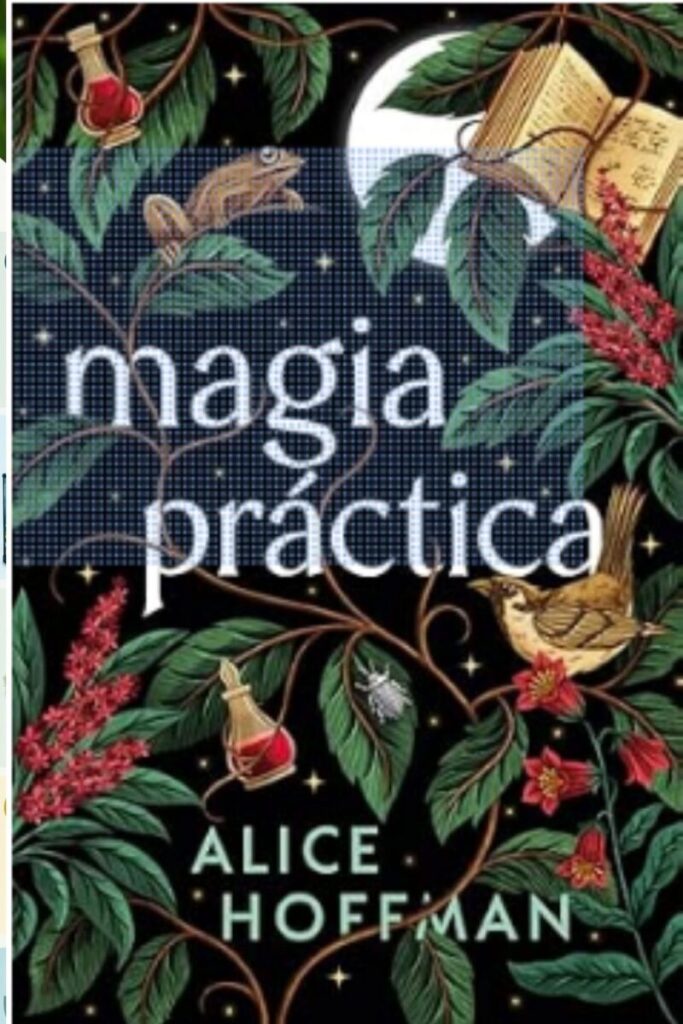
Book cover
1. Practical Magic (1995)
This is the one I already broke down above. It centers on Sally and Gillian Owens in the nineties, their relationship with the aunts, the family curse, and everything that spirals when Gillian comes asking for help.
It sets the tone for the whole saga. Domestic meets extraordinary, love and loss are handled without sentimentality, and you’re dropped into a world where the supernatural is just part of the furniture. Nobody makes a big deal out of it.
If you’re only going to read one of the four, make it this one. It’s the heart of everything.
A lot of people come to the book through the 1998 movie and expect something similar. The film is fun, I’ll give it that, but the novel is a very different animal. It’s more inward-looking, more restrained, darker in places.
If you walk in with Sandra Bullock and Nicole Kidman in your head, brace yourself for a different ride. Not better or worse. Just different. I think that’s exactly what makes it worth reading.
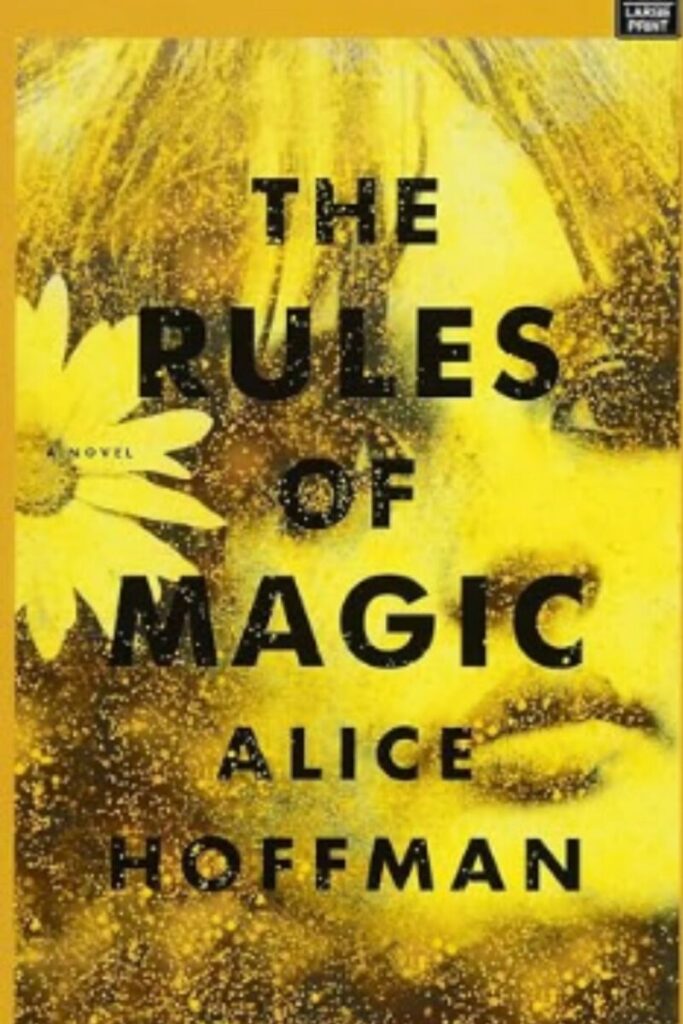
Book cover
2. The Rules of Magic (2017)
This one’s a prequel. Twenty-two years after Practical Magic, Hoffman circled back to tell the story of Aunts Bridget and Frances, along with their brother Vincent.
We’re dropped into 1960s New York, when the three Owens siblings are young, full of life, and just starting to understand what it actually means to belong to this family.
Their mother Susanna has spent their whole lives keeping them as far from the family legacy as possible. She’s laid down three rules: don’t practice anything related to what the Owens women can do, never fall in love, and don’t go digging into the past. All three of them break all three rules, naturally, because you can’t outrun something that’s woven into your DNA.
This book is essential for a couple of reasons. First, meeting the aunts as young women completely rewires how you see them in Practical Magic. They go from eccentric wise figures to real people with scars, love stories of their own, and impossible choices weighing on them.
Second, Vincent is one of Hoffman’s finest creations. A man in a family of fierce women, his arc has moments that genuinely gut you.
The historical backdrop adds serious texture too. Sixties New York, with everything that comes with it: the counterculture, the music, the social upheaval. Hoffman threads it all through the story without it ever feeling like set dressing.
If Practical Magic left you hungry to know more about the aunts, this book delivers exactly that, and then some.
You can find it here.
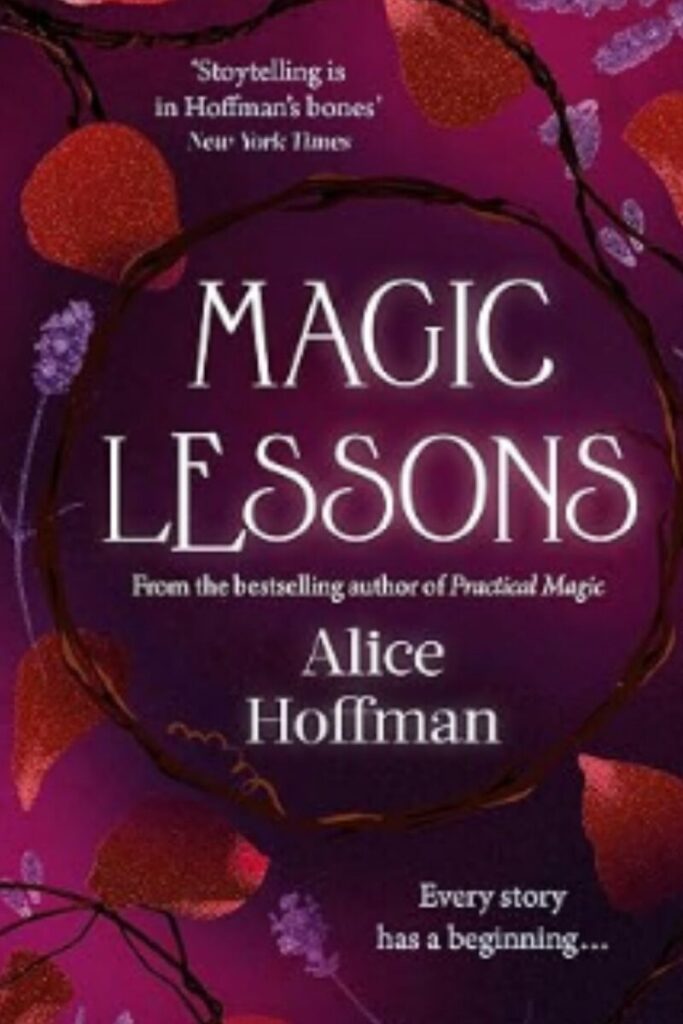
Book cover
3. Magic Lessons (2020)
Here Hoffman went way further back. She dropped us into 17th-century England, 1664 to be exact, to tell the story of Maria Owens, the woman who started the curse.
If the first two books left you with questions about the why behind everything, this is the one with the answers.
Maria grows up alone. Her mother abandoned her at birth, and she was raised by a woman named Hannah who taught her everything about herbs, remedies, and the art of watching the natural world closely.
When Hannah dies, Maria is on her own. She carves out a path that takes her from England all the way to Salem, Massachusetts. Yes, Salem. Not a coincidence.
What makes this book so powerful is that it shows you where all the family’s pain originates. The curse doesn’t materialize out of thin air. It comes from a specific betrayal, a specific man, a wound Maria can’t let go of.
When you see the exact moment she decides that no man who loves an Owens woman will walk away unscathed, you feel something complicated. Because you understand her. That’s what Hoffman does better than anyone: she puts you inside her characters without asking you to judge them.
The historical setting is brutal. We’re in the thick of the witch trials, and Hoffman pulls zero punches.
She shows you the violence, the fear, the hypocrisy of a society that went after women for knowing too much, for healing people, for refusing to shrink into the box the world had built for them.
You can find the book on Amazon.
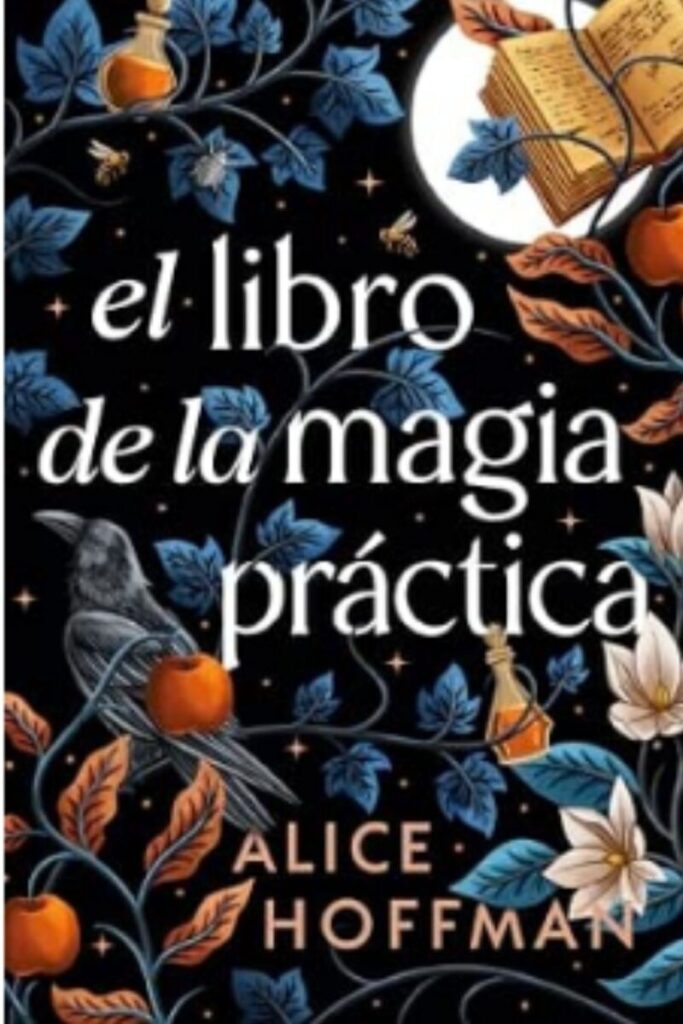
Book cover
All of it ties directly into the themes that surface in the later-set books, because deep down the rejection of people who are different hasn’t changed nearly as much as we like to think.
4. The Book of Magic (2021)
This is the finale, and Hoffman took her time getting it right. The Book of Magic brings us back to the present-day Owens family and turns the spotlight on the new generation.
The main story revolves around an attempt to break the curse once and for all. After centuries of living under its shadow, someone finally says enough. It’s time to end what Maria set in motion back in the 1600s.
That decision triggers a chain of events connecting every generation of Owens we’ve met across the saga.
What I appreciate about this book is that it closes loops without forcing fairy-tale endings. Hoffman doesn’t hand you a neat resolution where everything clicks into place and everyone lives happily ever after. She gives you something more honest: an ending where the characters come to terms with who they are, the good and the painful alike.
There’s a detail I find beautiful: how Hoffman threads callbacks between the books. Little nods, objects passed down through generations, phrases that echo in the mouths of characters centuries apart, recipes that pop up in one book and circle back in another.
If you’ve read the whole saga, these moments land with incredible weight because you can feel everything clicking into a larger tapestry.
I should mention the pacing. The Book of Magic is longer than its predecessors and moves at a different clip. There are stretches where the story slows down, breathes, sits with the details.
Some readers have found it slower than Practical Magic, and I see that. But I believe the pacing is intentional. Hoffman wants you to say goodbye to these characters slowly, in your own time.
In Spain, Umbriel published the Spanish translation in August 2026, so it’s brand new. If you’ve been waiting to read it in Spanish, now’s the time. You can find it on Amazon.
Reading order: where to start and how to keep going
You’ve got two options.
Publication order
This is the one I’d go with if it’s your first time.
First: Practical Magic (1995). Second: The Rules of Magic (2017). Third: Magic Lessons (2020). Fourth: The Book of Magic (2021).
The reasoning is straightforward. Hoffman wrote each book with the assumption that readers had already been through the previous one. The Rules of Magic hits harder if you already know the aunts as adults before meeting them as young women.
Magic Lessons punches even harder if you’ve already lived with the curse’s consequences across later generations before seeing where it all started.
The Book of Magic works as the perfect finale because it draws on everything you’ve built up across the first three reads.
Chronological order
If you’ve already been through the saga once and want a reread, or if you’re the kind of reader who likes following the characters’ actual timeline, go this route.
First: Magic Lessons (17th century). Second: The Rules of Magic (1960s). Third: Practical Magic (1990s). Fourth: The Book of Magic (present day).
This order has its own appeal because you watch the family evolve from start to finish, like a generational chronicle. But you lose some of the effects Hoffman designed into the publication sequence.
For instance, uncovering the curse’s origin in Magic Lessons is way more powerful if you’ve already spent two books living alongside that curse without knowing where it came from.
My take: publication order first time through, chronological on the reread. That way you get the best of both.
Practical Magic 2: the Owens saga hits the big screen in 2026
If you’re reading this in September 2026, the Owens family is as relevant as ever. On September, Practical Magic 2 opens in theaters: the long-awaited sequel to the 1998 film that so many of us have watched more times than we can count.
The movie is based on The Book of Magic, the fourth and final novel, which alone should give you a pretty good idea of the direction. Sandra Bullock and Nicole Kidman return as Sally and Gillian, nearly thirty years after the original.
Stockard Channing and Dianne Wiest are back as the aunts. Joining the cast: Joey King as Sally’s daughter, Lee Pace, Maisie Williams, and Xolo Maridueña.
Susanne Bier directs, with a screenplay by Akiva Goldsman (who also wrote the first film), Georgia Pritchett, and Kelly Marcel. Alice Hoffman is on board as executive producer, which adds some reassurance about staying faithful to the source material.
The official synopsis centers on the Owens sisters facing the dark curse that threatens to tear their family apart for good.
If you’ve read The Book of Magic, you’ll recognize the setup. If you haven’t, the movie is a great excuse to dive into the saga.
What strikes me about this sequel is the format. The first film crammed the novel into under two hours and lost a lot of nuance along the way.
This time around, with a longer runtime and a bigger book as source material, there’s more room to let the story breathe. Early reviews out of the London premiere describe a film that preserves the original’s spirit but carries a more grown-up tone, fitting the passage of time for both the characters and the actresses playing them.
Regardless of how the film turns out, the release is a chance for a whole new wave of people to discover the Owens saga. If you already know it, this is a great time to reread the books and walk into the theater with everything fresh in your head.
Themes running through the saga and why they hit so close to home
One of the reasons these books connect with so many people is that the themes Hoffman digs into are universal. You don’t need to believe in anything supernatural to see yourself in what happens to the Owens family. Here are the main threads woven through the saga.
The weight of family legacy
We all carry something inherited from our family. Maybe it’s a worldview, a tendency to repeat certain patterns, a wound that traveled from your grandmother to your mother to you without anyone ever naming it.
In the Owens saga, that manifests as a literal curse. But it works as a stand-in for all those invisible burdens we haul around without choosing to.
What Hoffman explores across all four books is whether we can actually break free from that. Whether it’s possible to snap a cycle that’s been running for generations.
The answer she offers isn’t a clean yes or no. It’s closer to how things play out in real life: you can reshape the legacy, give it a new meaning, but first you have to stare it down and understand where it came from.
Being different as both a superpower and a weight
The Owens family is different, and there’s a cost. People avoid them, whisper behind their backs, cross the street when they see them coming. Other kids don’t want to play with their children. In the books, that otherness is tied to the supernatural, but anyone who’s ever felt like they didn’t belong recognizes it immediately.
Hoffman doesn’t sugarcoat it. She doesn’t tell you that standing out is always beautiful and empowering. She shows you that it hurts, that it isolates, that sometimes it makes you desperately want to blend in. But she also shows you that denying who you are costs even more, and that acceptance, when it finally comes, changes everything at the root.
Love in every shape
Love sits at the center of the Owens saga, but it’s not all romantic. Hoffman writes about the love between sisters, between aunts and nieces, between mothers and daughters, between friends. She writes about what you’d do for someone you love, where love reaches its limits, how it can simultaneously be the thing that saves you and the thing that wrecks you.
The family curse is a curse rooted in love, and that’s no accident. Hoffman uses the supernatural to explore something every single one of us has felt: the fear of loving because love opens the door to loss.
Sally refuses to fall in love because she’s watched what happens to the men who get close to Owens women. Maria cast the curse because a man destroyed her. Breaking it, when it finally happens, has less to do with any ritual and more to do with accepting vulnerability.
The pull toward nature
This one threads through every book in a quiet but persistent way. The Owens women are tuned into the natural world: they know plants, they know which herbs heal and which ones harm, they read the seasons, they sense shifts in the atmosphere before anything visible changes.
In a world that’s become pretty disconnected from all that, reading about characters who maintain this relationship with the earth and with growing things has something genuinely comforting about it.
Hoffman writes about gardens, kitchens, and preparations with enough detail to make you want to plant rosemary on your balcony and figure out what every herb near you is good for. It’s not a botany textbook, but it stirs that curiosity about the natural world that a lot of us have buried somewhere.
The 1998 movie versus the books: what shifts and what gets lost
I can’t write about Practical Magic without bringing up the original film, because for a lot of people it was the gateway into this whole world.
The 1998 movie, directed by Griffin Dunne, runs at a much lighter register than the novel. Bullock as Sally and Kidman as Gillian work well on screen, their chemistry is great, and there are scenes seared into the collective memory: the midnight ritual, the aunts sipping margaritas in the kitchen.
But the script streamlines the story significantly and turns what’s a layered family drama on the page into something more like a rom-com with a supernatural twist.
The book is darker. There’s a melancholy running underneath that the film doesn’t touch. Sally and Gillian’s relationship is thornier in the novel, with more emotional distance and more unresolved baggage.
Gary Hallet, the investigator, gets way more screen time in the movie than page time in the book. He matters in both, but his footprint is smaller on the page. The resolution of the central conflict is different, too.
What the film nails is the visual atmosphere of the Owens house and the sense of women rallying around each other. That final scene where the town’s women show up to help the sisters is powerful in both versions, even though it plays out differently. The soundtrack helps build an atmosphere that complements the story well.
But if all you know is the movie, you’re missing a lot. You’re missing the depth of the characters, Hoffman’s prose, and the nuance of a story that tackles heavy subjects without ever getting preachy about it.
Who these books are for and who they’re not
These books are for you if you like stories that take their time, that don’t barrel from one event to the next. Hoffman writes with patience, builds worlds through atmosphere, and lingers on sensory details.
If you’re the kind of reader who grabs a warm cup of something, settles into a corner, and lets a book carry you somewhere, this is your lane.
They’re for you if you love family sagas, if you get a kick out of seeing how one generation’s choices ripple into the next, if you enjoy tracing threads between characters living centuries apart. That’s essentially what the Owens saga is: a family chronicle that stretches across time.
They’re for you if you appreciate the blend of ordinary and extraordinary. No epic battles here, no invented worlds. There are kitchens, gardens, small-town streets, complicated marriages, sisters fighting. The supernatural is always present but always in service of the emotional story, never the other way around.
They’re for you if you want complex female characters. Women who aren’t neatly good or bad, who have real flaws and real strengths, who make questionable calls and live with the fallout. If you’re over flat characters who only exist to serve a plot function, the Owens family will win you over.
That said, they might not be for you if you want fast action, if lengthy descriptions lose your attention, or if you need a lot happening per chapter to stay locked in. Hoffman’s pacing isn’t everyone’s thing, and that’s completely fine. It’s just taste.
They’re also not the pick if you’re after hard fantasy with a well-defined magic system and clear rules. The magic here is fuzzy, instinctive, more like a heightened sensitivity than a superpower with a manual. If that frustrates you, this probably isn’t where you want to be.
What to read next when you’re left wanting more
If you finish the Owens saga and want to keep going, you’ve got options. Within Hoffman’s own catalog, several novels share this saga’s DNA even though they’re not part of the Owens storyline.
The Invisible Hour is one of her most recent, and it carries the same instinct for weaving the everyday with the impossible. The Museum of Extraordinary Things is another strong pick, set in early 1900s New York, with characters living on the margins and an atmosphere that echoes the Owens universe.
If you want to step outside Hoffman but stay in the world of family secrets and women who break the mold, check out A Discovery of Witches by Deborah Harkness, a longer saga with heavier fantasy elements, or The Mayfair Witches by Anne Rice, which goes darker and more gothic.
For something rooted in Spain with touches of magical realism and multigenerational sagas, Alaitz Leceaga is worth a look. The Forest Knows Your Name and Daughters of the Earth are two of her best-known titles. If history, landscape, and family secrets are your thing, they’re likely to pull you in.
If you’re stocking up on reads for next Halloween, this post has more picks you might enjoy.
The common thread to look for: the supernatural as an extension of the emotional, female characters with genuine depth, and stories that put human relationships ahead of action.
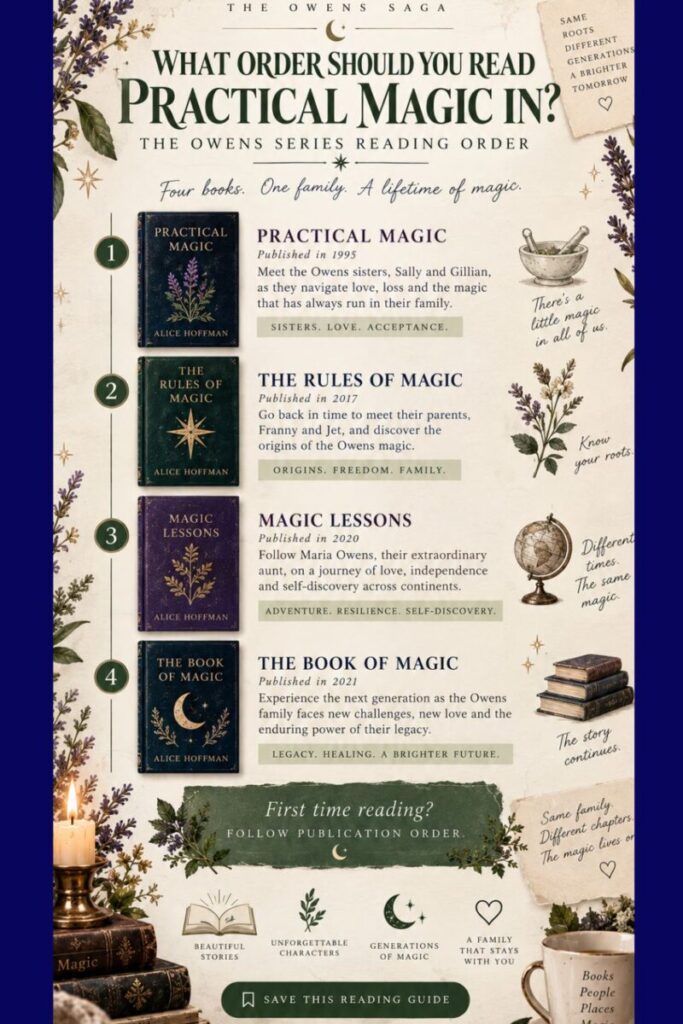
Practical Magic saga infographic
Frequently asked questions about Practical Magic and the Owens saga
Do I need to read the books in a specific order, or can I jump in anywhere?
Technically, you can start wherever you want. Each book works on its own and Hoffman gives you enough context so you’re never lost. That said, the experience is much richer in publication order, for the reasons I outlined above. The callbacks between books, the cross-references, the tiny repeating details — they all land harder if you’ve taken the full journey. My recommendation: Practical Magic first, then The Rules of Magic, Magic Lessons, and The Book of Magic to close it out. That’s the path Hoffman built over the years and the one that pays off the most emotionally.
Is the 1998 movie faithful to the book?
Not really. The film borrows the core premise and the main characters but streamlines the plot, lightens the tone, and changes a good number of details. The novel is more introspective, more restrained, and quite a bit darker in stretches. If you loved the movie, the book will surprise you because it operates on a different frequency and digs to places the film didn’t have time for. If you read the book first, the movie may feel a bit thin. They’re different creatures that share a title and a starting point. Both are worth your time, but they’re not interchangeable.
Are these books okay for teens, or are they strictly adult reading?
The saga is written for an adult audience. There’s nothing graphic, but the themes — tangled relationships, grief, morally gray decisions — are aimed at readers who can sit with that kind of complexity. That said, a sixteen- or seventeen-year-old can absolutely read and enjoy them, especially Practical Magic and The Rules of Magic, which are the most accessible of the four. If you’re looking for a Hoffman entry point for younger readers, her YA novel Aquamarine is a great way into her world.
Are the books available in Spanish?
Yes. Umbriel, an imprint of Ediciones Urano, has published Practical Magic (October 2025) and The Book of Magic (August 2026) in Spain. Magic Lessons and The Rules of Magic are also available in Spanish. The translations are solid and let you enjoy the full story. As always with novels that lean heavily on language and sentence rhythm, some nuance gets lost in translation. If you’re comfortable reading in English, I’d suggest giving the originals a shot at least once — Hoffman’s prose has a cadence that’s tough to replicate. But if you prefer Spanish, you’ll absolutely get the heart of what she’s saying.
Will Alice Hoffman write more Owens books?
She’s positioned The Book of Magic as the saga’s conclusion, so the four novels form a complete arc. That said, she hasn’t ruled it out entirely and has mentioned that the Owens family still lives rent-free in her imagination. There’s nothing officially announced, but given her connection to these characters, it wouldn’t be shocking if she returned to that world someday.
There’s something magnetic about the Owens family. I’ve been recommending these books for years and watching all kinds of readers, people with completely different taste, end up hooked on this story. I think the reason is that Hoffman taps into something we all carry.
The longing to belong somewhere. The need to figure out where you come from before you can know where you’re headed. The fear of being truly seen and it not being enough. The hope that whatever’s been holding you back can be broken, even if it’s been there for centuries.
That’s all in the Owens books, wrapped up in a story that’s a genuine pleasure to read and that stays parked in your brain for days.
These aren’t books that flip your life upside down overnight. They’re the kind that stick around, that pop back into your head at unexpected moments, that make you look at your own family a little differently.
If you haven’t read them yet, give them a shot. With Practical Magic 2 hitting theaters now, there’s no better time to dive in and walk into the screening knowing where these sisters come from and what’s really on the line.
I’m curious which one landed the hardest for you. The cool thing about these stories is that every reader latches onto a different piece, and I love hearing about it. If you’re planning to catch the sequel, swing back afterward and let meEverything you need to know about Alice Hoffman’s 4-book Practical Magic saga: the best reading order, the themes that make it stick, and the lowdown on Practical Magic 2 arriving in theaters September 2026.