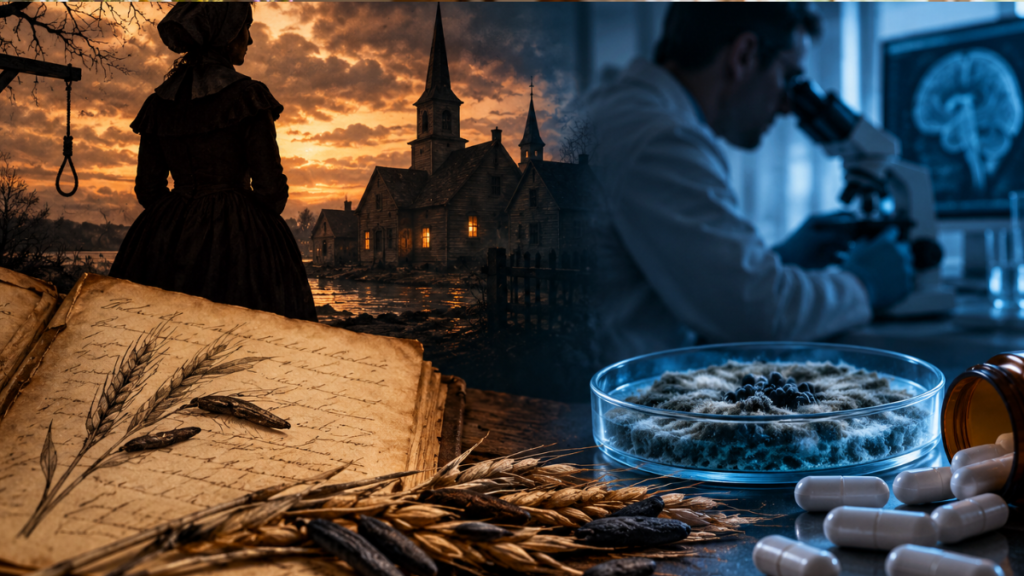
Dive into the most thorough breakdown of Acceptable Risk by Robin Cook. Uncover family secrets, real history, and the limits of science.
When you pick up a Robin Cook book, you usually know what you’re getting into. You’re picturing fluorescent-lit hospital hallways, doctors rushing around with patient charts, state-of-the-art labs where a scientist stumbles on a deadly virus, and conspiracies reaching the top levels of the healthcare system.
That’s his usual playground, the space where he operates with a confidence few authors in the genre can match. With Acceptable Risk, though (published in some Spanish editions as Los archivos de Salem or Riesgo aceptable), he decided to take a sharp turn.
It’s exactly that change of direction that makes this book so unique in his body of work and worth a closer look.
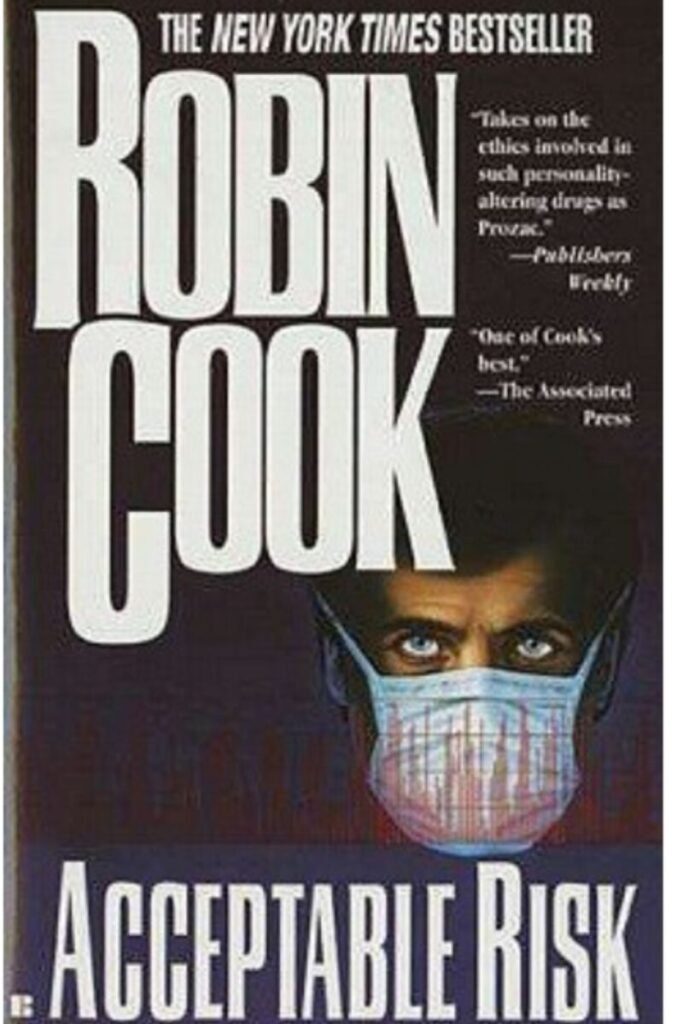
Kim Stewart, a young nurse, inherits an old family property in Salem tied to an ancestor who was accused of witchcraft during the infamous trials of 1692. While Kim digs through old documents and family secrets, Edward Armstrong, a scientific researcher and Kim’s partner, discovers a fungus on the estate that may be connected to the strange events that took place three centuries earlier.
The discovery opens the door to developing a new drug with striking effects on human behavior. But what initially looks like a groundbreaking medical advance soon raises unsettling questions about side effects, the boundaries of scientific research, and how far ambition can go when prestige and serious money are on the line.
Robin Cook blends Salem’s historical mystery with science, psychological suspense, and ethical dilemmas in a story where past and present end up dangerously intertwined.
This one doesn’t open in a Boston emergency room. It opens with an inheritance, with the weight of the past. This novel asks you to look backward before you can understand the danger lurking in the present, and that narrative structure is a breath of fresh air.

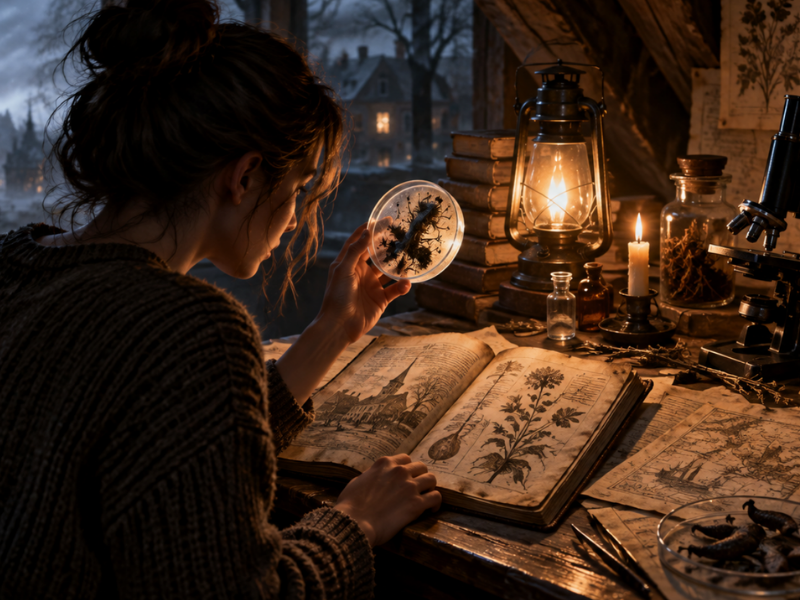
Images in this post were generated for illustrative purposes
This post contains affiliate links. See our disclosure for details.
The Starting Point: A House with Too Many Family Secrets
Our story kicks off with Kim Stewart. Kim is a young woman, a nurse by profession, who suddenly finds out she’s inherited a property in Salem, Massachusetts.
This isn’t just any piece of land. It’s an estate that’s been in her family for generations, going all the way back to the first settlers in the area.
You can imagine the weight of that. You’re not inheriting walls and a roof; you’re inheriting centuries of family history, of silences, of things nobody brings up at family gatherings.
What I find really interesting about Kim from the very first pages is how Cook shows us where she is in life. She’s not a woman on top of the world, confident and put-together. It’s more the opposite.
Kim feels a little lost, searching for her place, and this inheritance shows up like a kind of anchor. She sees the old house as a chance to reconnect with her roots, to understand where she comes from so she can figure out where she wants to go.
The house itself works almost like another character in the story. Cook takes his time describing it. He doesn’t pile on heavy descriptions that make you skip paragraphs, but he gives you just enough detail to feel the creak of the floorboards under your feet, the stale closed-up smell, the moisture built up in the corners, and that oppressive atmosphere of places that have been empty for a long time.
Inside the house, Kim finds old trunks, documents, and diaries that belonged to one of her ancestors, Elizabeth Stewart.
This is where the novel clicks and hooks you. Elizabeth wasn’t just anyone in Salem’s history. She was one of the women accused of witchcraft during the infamous trials of 1692.
Suddenly, the material inheritance becomes a moral one. Kim feels a powerful need to clear her family’s name, to find out what really happened to Elizabeth and why she was sentenced to death.
That deeply personal motivation is the engine driving Kim through the entire story, and it’s what sets her apart from Cook’s other protagonists, who tend to be driven more by professional ethics or survival.
The Collision of Two Worlds: Edward Armstrong and Unchecked Ambition
If Kim represents the past, memory, and intuition, Edward Armstrong is the embodiment of the present: pragmatism and scientific ambition. He’s a researcher, a brilliant scientist working on drug development at a cutting-edge research facility. He’s also Kim’s partner. That dynamic between them is essential to understanding how the novel’s conflict unfolds.
Edward doesn’t see the Salem house through the same eyes as Kim. Where she sees history and melancholy, he sees an opportunity. Walking the grounds of the estate, which have been essentially untouched since the 1600s, Edward spots something that catches his scientist’s eye: a strange fungus growing in the damp areas of the property.
From this point on, the novel starts picking up speed. Edward takes samples of the fungus and brings them back to his lab. This is where Robin Cook is at his best.
He drops us right into the world of pharmaceutical research. He walks us through the processes, the analysis, how a substance is isolated, and how the potential of a new discovery starts to come into focus. Edward finds that the fungus contains a highly potent psychoactive compound.
Edward’s motivation is also really well crafted. He’s not a villain out to destroy the world. He’s researching treatments for depression, a disease that affects millions and that, at the time the book was written, was just starting to be treated with a new generation of drugs.
Edward genuinely believes he’s found the key to creating the ultimate antidepressant. A drug that wouldn’t just eliminate the symptoms of sadness or apathy, but would give patients mental clarity, renewed energy, and unshakable self-confidence. They call it Ultra.
Edward’s problem is impatience. In the real world, as Cook knows well, the pharmaceutical industry is a marathon where the first one across the finish line with a patent takes home billions.
Edward feels the pressure from his superiors, the drive to stand out in a fiercely competitive environment, and a personal desire to make medical history. That combination is a ticking time bomb. Ambition starts clouding his ethical judgment. He begins cutting corners on safety protocols.
Instead of following the rigorous, slow, and frustrating steps of traditional clinical trials, he decides to speed things up. That’s the beginning of the end.
The Mass Hysteria of 1692
To understand the full scope of Edward’s discovery, we need to take a trip back in time and talk about one of the theories behind what happened in Salem. This is one of my favorite parts of the novel, because Robin Cook takes a documented historical event and weaves it into the scientific plot in a masterful way.
You’ve probably heard at least the basics of the Salem witch story. In the late 1600s, in a tightly knit, strict Puritan community in New England, a group of girls and teenagers started having bizarre episodes.
They had convulsions, screamed, writhed on the ground, and claimed to see spectral figures tormenting them. In a deeply religious society terrified of divine punishment, the explanation they landed on was the fastest and most destructive one: the devil was at work in their town through witchcraft.
A witch hunt followed. Neighbors started accusing each other. All it took was a personal grudge or a land dispute with someone, and you could point a finger.
The result was a series of trials driven by mass hysteria, a complete lack of real evidence, and panic. Dozens were jailed and several were executed. It remains one of the darkest chapters in American legal and social history.
For centuries, people have debated what triggered the girls’ behavior. Was it pure invention to get attention? Mass hysteria fueled by the social oppression they lived under?
In the 1970s, a historian named Linnda Caporael proposed a theory that Robin Cook uses as the central foundation for his novel: ergotism.
Ergot: The Fungus on the Rye
This is where history and biology shake hands. Ergotism is a condition caused by prolonged exposure to the toxins produced by a fungus called ergot, which attacks cereal grains, especially rye, under conditions of heavy rain and humidity, which happened to be the weather pattern in Salem in the months leading up to the trials.
When people consume flour contaminated with this fungus, they ingest a series of alkaloids with very powerful effects on the human body. To give you an idea of just how potent they are: LSD was originally synthesized from one of these alkaloids.
According to the theory the book follows, consuming contaminated bread caused Salem’s residents to experience physical symptoms like muscle spasms and a burning sensation in the skin, along with severe neurological symptoms such as hallucinations, paranoia, mania, and erratic behavior.
In the novel, Robin Cook lays out this theory in a clear, direct way through two parallel tracks: Kim’s research, as she reads the diaries of her ancestor Elizabeth, and Edward’s scientific conclusions in the lab.
It’s fascinating how Cook makes you see that those supposed acts of witchcraft, those demonic possessions, were nothing more than the symptoms of a mass food poisoning that nobody in the 1600s could have understood.
The tragedy of Elizabeth Stewart and so many others who were accused was being victims of ignorance, fear, and, quite literally, the bread on their table. When Kim uncovers this, her determination to clear her family’s name only grows stronger.
The Thin Line Between Cure and Poison
With all this historical and scientific context on the table, the present-day plot gets increasingly suffocating. Edward and his team, convinced they’ve refined the compound extracted from the Salem fungus to strip out its hallucinogenic effects and keep only the stimulant and antidepressant benefits, decide to take the riskiest step any researcher can take: testing the drug on themselves.
This is where the novel fully commits to psychological thriller territory. Cook shows us how Ultra starts taking effect. At first, everything seems to be going perfectly.
Edward and his lab partners experience an incredible surge of energy. They work marathon shifts without feeling tired, their minds process information at an unusual speed, and they make decisions with a confidence they never had before. They seem like upgraded versions of themselves.
But, as in any good medical suspense story, the bill comes due. The drug is profoundly altering their brain chemistry. Here the author raises a point I find brilliant about human nature and animal instinct.
The compound derived from the fungus doesn’t just eliminate depression; it starts stripping away the layers of civilization we’ve built up as a species.
The characters begin losing empathy. Their behavior turns erratic, selfish, intensely territorial, and ultimately violent. They’re regressing to a more primal state where the only thing that matters is dominance and survival of the strongest. It’s as if the fungus is waking up a predator that’s been dormant inside us for centuries.
Kim, who has stayed out of her partner’s experiments, is the one who has to watch this unravel from the outside. Her role becomes crucial, because she goes from being the heir searching for her past to becoming the only person with enough perspective to see that the man she loves is turning into a monster. Not because of a Salem curse, but because of chemistry and unchecked ambition.
Edward and His Team’s Descent Into Darkness
There’s a moment while reading where you realize there’s no turning back for the characters. Ultra, that miracle drug synthesized from the ergot fungus found on the old Salem property, starts showing its true colors.
What Robin Cook pulls off in this section is a well-executed exercise in psychological suspense. He doesn’t show the characters’ deterioration all at once; he turns up the heat slowly.
At first, as I mentioned, it’s all upside. Edward and his colleagues feel invincible. They work marathon days without feeling tired, their minds process information at unusual speed, and they have a clarity that makes them feel superior to everyone else.
It’s every researcher’s dream. The side effects, though, don’t take long to surface, and they’re nothing like the typical side effects of an ordinary medication.
The Gradual Loss of Human Empathy
The most disturbing thing about the drug’s effect isn’t any visible physical damage; it’s the moral and emotional transformation of everyone taking it. The fungus acts on the most primitive parts of the brain, the ones that govern basic survival instincts, dominance, and territoriality.
As the days go by, Edward and his team start losing something fundamental that makes us human: empathy.
Their conversations turn cold, calculating, and often cruel. They stop seeing each other as colleagues and start behaving like members of a pack that needs to establish a power hierarchy.
The lab atmosphere, once built on scientific collaboration, transforms into a hostile, paranoia-filled environment. They become territorial, distrustful of each other, and worst of all, distrustful of Kim.
Watching Edward’s transformation through Kim’s eyes is heartbreaking. She fell in love with a rational, caring man committed to helping others through science. Suddenly, she’s living with someone she barely recognizes. Someone who looks at her coldly, dismisses her warnings, and seems willing to throw away every ethical principle to push ahead with his experiment and grab the fame and fortune the pharmaceutical industry is dangling in front of him.
Kim Stewart’s Crucial Role as the Voice of Reason
At this point, Kim’s presence in the novel grows enormously. She’s our anchor to reality. While everyone around her is losing their grip under the drug’s influence, she stays clearheaded and alert.
I really like how Cook builds her character. She’s not the typical horror-movie protagonist making baffling decisions. Kim is a nurse with medical training, and she uses that training to observe, analyze, and draw her own conclusions.
She’s the first to realize Edward’s mood swings aren’t from work stress but from the substance he’s ingesting. She’s the one who takes on the responsibility of stopping him. Her arc is compelling. She goes from being a somewhat hesitant woman, overwhelmed by the family estate she’s inherited, to becoming proactive, determined, and brave.
She realizes she’s on her own, that she can’t go to the police or hospital authorities because Edward has covered up all evidence of the unauthorized experiment, so she has to act alone.
Solving the Mystery of Elizabeth Stewart
While all this medical drama plays out in the present, Kim continues her personal investigation in the old Salem house. Remember, her main goal at the start of the novel was to uncover the truth about Elizabeth Stewart, her ancestor who was condemned for witchcraft in 1692.
Robin Cook weaves these two investigations, the scientific and the historical, together in a way that flows very naturally. Kim spends hours in the basement and attic of the property, surrounded by dust and shadows, reading old diaries and documents from the era.
Through those readings, the author of the diaries transports us to the past. We live, through the texts, Elizabeth’s anguish: a woman who watched her community lose its mind and turn against her.
The Parallels Between Two Distant Eras
What makes the novel feel so complete is the constant parallel drawn between the 1600s and the present. In Elizabeth’s time, ignorance and fear of the unknown led to mass hysteria.
People ate bread contaminated by the fungus, experienced hallucinations and strange behavior, and society, unable to understand the medical cause, blamed the devil and witchcraft.
In the present, Edward and his team, despite having all the technology and scientific knowledge at their fingertips, fall into a strikingly similar trap. They believe they have everything under control, that they’ve conquered nature with their microscopes and centrifuges, but the substance is the one controlling them. The scientific arrogance of the twentieth century turns out to be just as destructive as the religious superstition of the seventeenth.
Kim finally discovers that Elizabeth was a victim of circumstance: of the wet climate that fostered the growth of ergot and the irrational fear of her neighbors. Knowing the truth gives Kim the strength she needs to face her own present.
She sees that history is about to repeat itself in that very house. The fungus that destroyed her family three hundred years ago is about to destroy the man she loves.
The Social Critique of the Modern Pharmaceutical Industry
You can’t talk about a Robin Cook book without pausing on the social commentary he always tucks between the lines. With his background in medicine, he knows firsthand how the industry that manufactures the drugs we take actually works, and in Acceptable Risk he throws a few very pointed darts.
Edward’s entire arc with Ultra is a sweeping metaphor for corporate greed. The book exposes how the pressure to be first to market can push researchers into cutting fundamental ethical corners.
It talks about preclinical trials, how side effects are sometimes downplayed in reports to avoid scaring off investors, and how the profit motive can cloud the judgment of people who, in theory, have devoted their lives to curing disease.
The Real Meaning of “Acceptable Risk”
As I mentioned earlier, the novel’s original title is Acceptable Risk. In pharmacology, that term refers to the balance that needs to exist between a drug’s benefits and its potential harm.
Every drug has side effects, from a simple aspirin to the most complex treatment. The job of regulatory agencies is to determine whether those risks are acceptable compared to the good the medicine does.
But the novel asks an uncomfortable question. Who decides what’s acceptable and what isn’t? When billions of dollars are at stake, can we blindly trust that pharmaceutical companies will put our health above their profits?
Through Edward and the executives at the research center where he works, Cook shows us the darkest side of the business. He reminds us that behind the white coats and sterile facilities, there are very powerful financial interests at play.
My Take on the Pacing and the Ending
If I’m being completely honest, I really enjoyed the journey this book takes you on: the setting, the historical mystery, and the psychological tension.
The way the old Salem house gradually turns into a kind of fortress, the isolation of the characters, and the mental deterioration of the scientists are all described with a rhythm that pulls you in.
The ending, though, left me with mixed feelings. Throughout the novel, Cook builds a pressure cooker. The tension keeps climbing, the characters are pushed to the edge, Kim is cornered in her own home, and everything points toward a memorable climax. But when that explosion finally comes, the resolution felt too rushed to me.
It’s as if the author looked at the clock, realized he was running out of pages, and decided to wrap up every plotline at once. The final pages are pure action, everything happens fast, and while the ending makes sense and closes the main story in a logical way, I think it’s missing some of the pacing and detail he maintained throughout the rest of the book.
I would’ve liked a longer epilogue, a moment to sit with the consequences of everything that happened. That said, I don’t think it’s a bad ending, just that the rest of the book is so detailed that the wrap-up feels a little rushed by comparison.

Acceptable Risk Infographic
Frequently Asked Questions About Acceptable Risk
Does the historical section about the Salem trials drag?
Not at all. If you’re not a big fan of straight-up historical fiction, don’t worry. The passages set in the 1600s are woven in between the present-day plot. They work as little breathers that help you better understand what’s happening now. Cook doesn’t get lost in endless period descriptions; he goes straight to the facts that matter for Kim’s investigation.
Does ergot fungus really produce the effects described in the book?
Yes and no. As I explained earlier, real ergot poisoning (ergotism) does cause hallucinations, spasms, and serious behavioral changes. In fact, there have been several documented epidemics across European history caused by eating contaminated rye bread. What Cook does is take that real foundation and push it into fiction, imagining that a specific strain could be isolated and modified in a lab to enhance certain psychological effects while eliminating others. It’s a creative liberty that’s very well justified within the story.
Are there graphic operating room scenes or heavy medical descriptions?
Unlike some of Cook’s better-known novels like Coma, Acceptable Risk doesn’t have detailed surgery scenes or bloody hospital descriptions. The action takes place mainly in Kim’s house and the research labs. The technical descriptions focus more on chemistry, how substances are extracted from plants, and how neurotransmitters work in the brain. Everything is narrated in a clean, easy-to-read way.
What kind of reader would I recommend this book to?
I’d recommend it to anyone who enjoys suspense thrillers, readers who like stories with a research angle, and people curious about human psychology. If you’re into movies or shows where a small isolated group gradually loses its grip on reality, you’ll love this. It’s also a great pick if you’re drawn to the Salem story but prefer a scientific lens over a paranormal one.
I’d love to know what you think about all of this. Does the theory that the witch trials were actually a case of mass food poisoning catch your attention? What are your thoughts on the limits of medical research and the risks pharmaceutical companies take?
If you’ve read the book, tell me whether you agree that the ending feels a little rushed, or if it worked for you. If you haven’t read it yet, let me know if this deep dive gave you the push you needed to add it to your reading list.
You can easily find the book on Amazon.
Feel free to drop a comment with your impressions. I’m always around and happy to keep the conversation going about books, science, and all those mysteries that make us think. See you in the next post, and until then, happy reading.