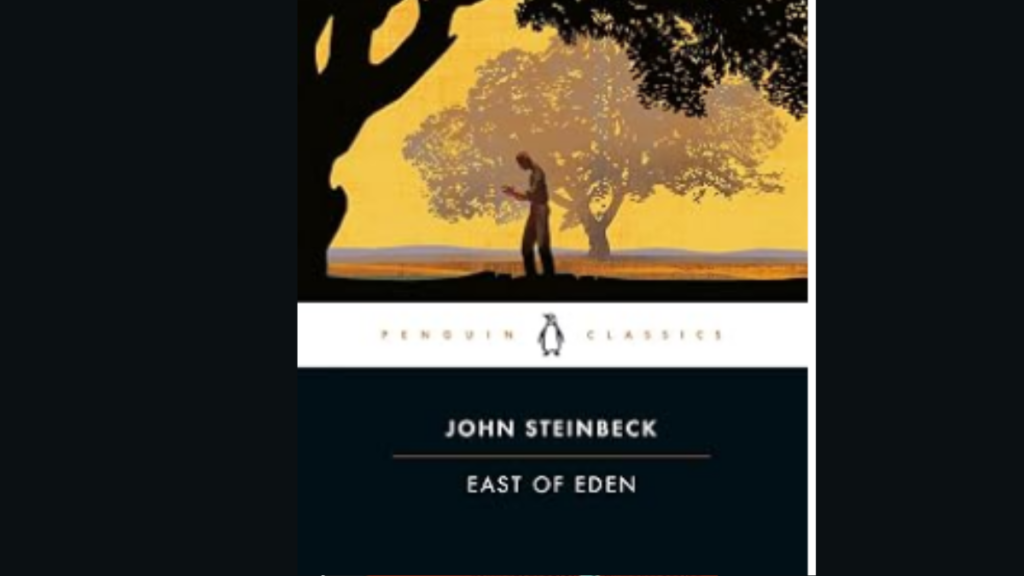
The masterpiece that burns in your soul
Discover East of Eden by John Steinbeck, an intense, profound, timeless work that will stay with you. A full personal analysis, background on the author, unforgettable lines, and every reason to fall in love with this literary gem.
“East of Eden” is a monumental novel by John Steinbeck that tells the story of two families, the Trasks and the Hamiltons, in the fertile Salinas Valley of California between the end of the nineteenth century and the start of the twentieth. Carrying a powerful symbolic charge drawn from the biblical story of Cain and Abel, the book explores free will, good and evil, and the search for redemption. It is a profoundly human, intense, moving work, and one the author himself considered his most important novel.
Some books you read and forget. Others you remember for a while. Then there are those immortal works that keep echoing in your heart years after you closed the cover. For me, East of Eden belongs to that last category. It is not simply a novel, it is an emotional whirlwind, an intimate fresco of human nature.
You probably know it as a colossal family saga set in the Salinas Valley of California at the dawn of the twentieth century. What you may not know is how Steinbeck, working with deceptively simple language, builds a world so rich that it pulls you inside it. Today I want to tell you why this book got to me and stayed lodged in my memory, written with all the affection I have for every page of it.
About the author: John Steinbeck, chronicler of the human soul
John Steinbeck (1902 to 1968) was one of the great writers of the twentieth century, awarded the Nobel Prize in Literature in 1962. In his work he portrayed life with an unflinching eye that never stopped being humane. Social injustice, poverty, hope, and resilience run through his novels again and again.
East of Eden is arguably his most ambitious book. Steinbeck spent years on it, and it turned out to be more than a novel. It reads like a legacy, a searching reflection on good, on evil, and on the human capacity to choose.
The historical and personal context behind the writing
1. The United States after World War II, the 1940s and 1950s
When Steinbeck started writing East of Eden, the world had just come out of World War II and the United States was going through profound change:
- Society was marked by the trauma of the war and the beginning of the Cold War.
- The economy was booming, alongside an intense search for identity, both national and individual.
- People were talking more and more about morality, freedom, and personal responsibility, the central themes of the novel.
Steinbeck channeled all of it into his story, focusing especially on the eternal conflict between good and evil and on our capacity to choose our own path.
2. A deeply personal project for Steinbeck
- Steinbeck wrote East of Eden as a literary inheritance for his sons, Thom and John IV.
- In a letter to his editor, he called this book the best he could write and probably the best he would ever write.
- It is not entirely fiction: the Hamilton family is based on his own mother’s family, which adds a layer of memory and tribute to his roots.
3. Biblical and philosophical influences
- Steinbeck drew directly on Genesis, specifically the story of Cain and Abel.
- The Hebrew word “timshel”, rendered in the novel as “thou mayest”, becomes the axis of the whole book: the idea that every human being can choose to do good or evil.
- That mattered enormously at the time. Amid fear of communism, rapid scientific advances, and the moral dilemmas of the twentieth century, Steinbeck was writing about free will, conscience, and humanity.
Knowing this background matters, because reading East of Eden with all of it in mind helps you understand:
- Why it is such an intense, emotional, reflective novel.
- Why it feels so timeless even while writing about past generations.
- How Steinbeck goes beyond the literary to offer a meditation on life itself.
Synopsis, mostly spoiler free
The novel opens with Samuel Hamilton, an upright Irishman who arrives in the Salinas Valley with his family to work the land. The heart of the story, though, beats with the Trask family: Adam, Cathy (later known as Kate), Cal, and Aron.
It is a modern, American reworking of the biblical story of Cain and Abel: betrayal, inheritance, guilt, and redemption. Across more than seven hundred pages, we watch these families fight for their dreams, carry their sins, and finally seek out redemption, or run from it.
Powerful themes in this book
Free will
One of the leitmotifs of the book is the question of whether we are born predestined or whether we get to choose our path. Steinbeck invites us to believe that any of us can choose the good, provided we are willing to face it.
Good and evil
In Cal Trask we find both the villain and the hero. He is a complex character who reflects our capacity to love and to wound. That duality turns him into a reluctant hero, imperfect and human.
Forgiveness and redemption
There are scenes where love surfaces unexpectedly and sets everything loose. Steinbeck knows that forgiveness does more than comfort, it is an act of private courage.
What families pass down
Mothers and fathers, siblings, generations still to come. Family here is no simple set of labels, it is an emotional fabric that defines us, saves us, or wounds us.
Style and atmosphere: everyday poetry
Steinbeck writes plainly, yet with such intensity that every sentence feels authentic, rooted in the soil, in the spirit of Salinas. Nature is almost another character in this novel: a fertile valley, mountains in the distance, apple and almond trees, dust storms.
The language is direct, with no unnecessary flourishes, as though every word had been chosen with precision. That makes it close, raw, and intimate all at once. When you read this novel, you are not simply reading it, it feels more like living it.
Lines I still remember
“It is not in our nature to live in a rush and let things pass us by. What we have to learn is slowness.”
“Now that you have seen the sons of Adam, do you not long to return to the pure world where there is no evil and no poison?”
“Then I understood what the Eternal meant: the choice is yours.”
Every time I reread one of these scenes, I feel the same intensity as the first time. It is as though Steinbeck bottled the emotion of being alive and released it slowly, so we could absorb it in real time.
Adaptations, have you seen them?
In 1955 Elia Kazan directed a film version starring James Dean and Jo Van Fleet, based on the final section of the book. It earned four Oscar nominations and won Van Fleet the award for Best Supporting Actress. It is evocative and beautifully made, though it only scratches the surface of the story.
Netflix has now put a date on its own version, and I am thrilled about it, because a longer format finally allows room for the full depth of the story. East of Eden arrives as a seven episode limited series on October 1, 2026, with all episodes dropping at once.
Florence Pugh stars as Cathy Ames and also serves as executive producer. The adaptation was written by Zoe Kazan, who runs the show alongside Jeb Stuart, and there is a lovely piece of symmetry here: Zoe is the granddaughter of Elia Kazan, the director of the 1955 film. The cast also includes Christopher Abbott as Adam Trask, Mike Faist as Charles Trask, Ciarán Hinds as Samuel Hamilton, Tracy Letts as Cyrus Trask, Hoon Lee as Lee, Martha Plimpton as Faye, Joseph Zada as Cal Trask, and Joe Anders as Aron Trask.
The novel is so rich that it needs real time to unfold. The screen versions are worth watching, though if what you want is to sink into this story, the book takes you far deeper inside it.
If you enjoyed Steinbeck’s moral reflection and human drama, another novel that deals with good, evil, and justice is To Kill a Mockingbird by Harper Lee: a southern setting, ethical dilemmas, and growing up in the middle of racism and injustice. You can read the blog post here.
If this post was useful to you and you feel like saying thanks, you can buy me a virtual coffee here.
East of Eden is not just a book, it is a mirror held up to the human soul. Every time I reread it, I discover something new about the characters and about myself. Does that happen to you too?
So tell me, have you read it? Did any part of it move you in particular? Did you see yourself in Cal, in Aron, in Samuel, or maybe in Cathy? I would love to read your thoughts in the comments and hear what mark this story left on you.
If you enjoyed this post, I invite you to subscribe to the blog so you do not miss new reviews, recommendations, and literary reflections. This is a place where we celebrate the books that shake us up inside!
Thank you for being here. Your voice is part of this story too.