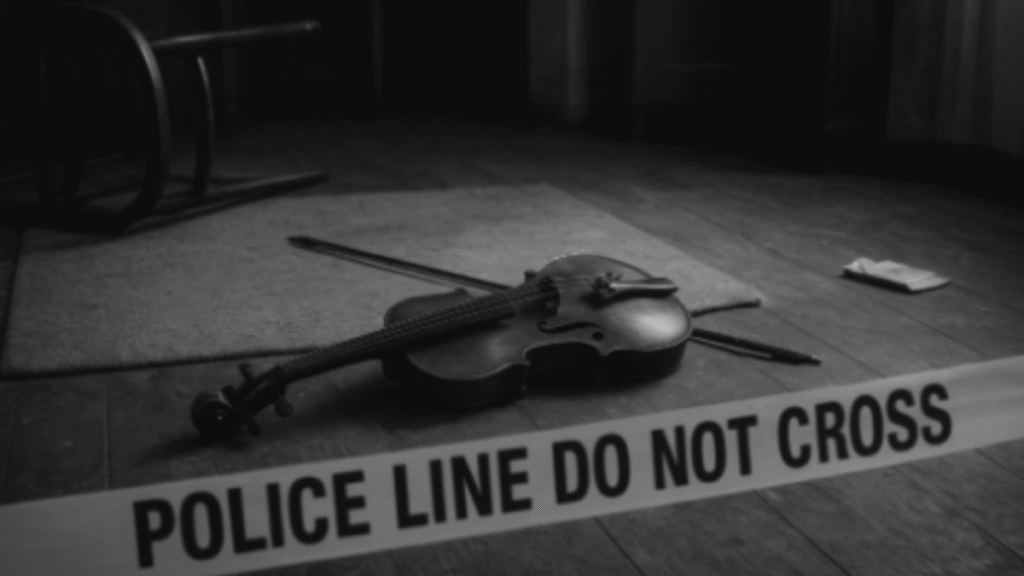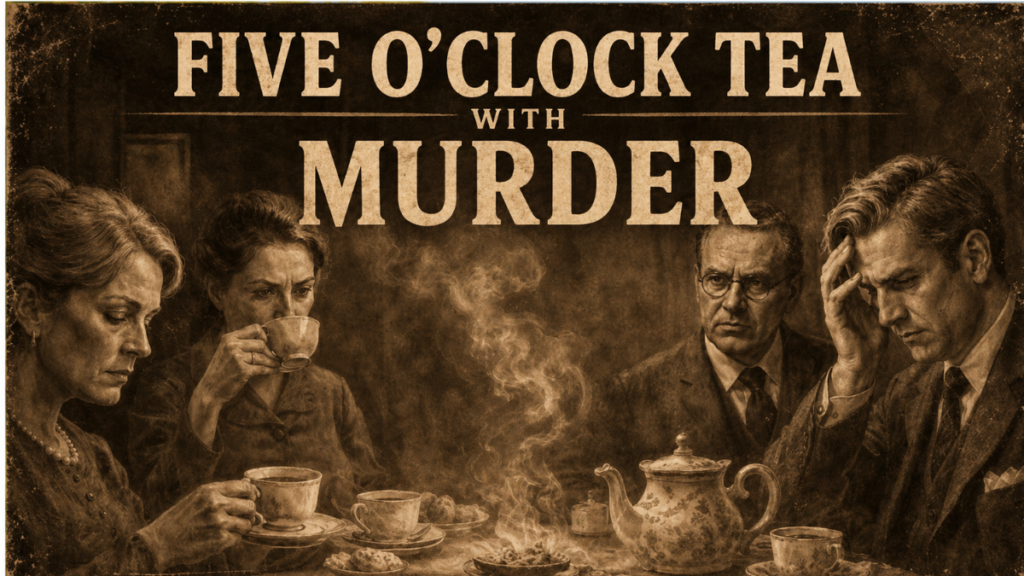
Discover the unsettling case of the five o’clock tea with murder, where a cursed cup unlocks buried secrets and uncovers a forgotten crime.
The Crime Gazette
Weekly Edition, Mysteries and Unexplained Events
The five o’clock tea with murder
In this town, where the blinds come down with the reverence of somebody crossing themselves and afternoon tea is still served on the good china when the occasion calls for it, nobody expected a social gathering this delicate to end up flicking open the truth of a crime like a folding knife pulled out of a lace pocket. There was tea, yes. There were scones, a lemon tart, a starched tablecloth, and polite voices. There was also a cup, just one, which from the first sip got called cursed by people who would later swear the air in the room had changed weight. Nobody died that afternoon. By the end of it, though, a murderer had been exposed, a friendship was over, a moral inheritance lay in pieces, and a house would never sound the same again.
This chronicle begins on Thursday, May 11, at the Valcárcel house on the San Jerónimo circle, where Doña Elvira Valcárcel, an impeccable widow and a hostess of measured hands, invited six guests to what the printed invitation described as “an intimate tea with music and conversation.” It was not the first time she had done it. Her blue drawing room, with its family portraits, a grand piano, and clocks that were too quiet, was known for gathering the kind of people a neighborhood knows by surname and judges by how they hold a cup. The gathering was not the extraordinary part. The extraordinary part was that somebody, in among the porcelain, served a tea that did not only wreck the composure of the table. It pulled a different secret out of every throat.
Suggestion? Mild poisoning? A cruel experiment? Maybe. The result was the same as if the truth had been boiled, strained, and poured into English china. Everybody present started saying what they should not have said. Not with the theatrics of delirium or the clumsiness of a drunk. They did it with an alarming calm, as if somebody had finally lifted off their chests the heavy lid under which years of lies, family pacts, and unwitnessed guilt had been simmering. By the time the afternoon ended, one guest had confessed to financial fraud, another had admitted to a false identity, a third had revealed where a ring really came from, and a fourth, in a voice so sweet it sounded like a request for more milk, gave the name of the man she had killed.
The house, the table, and the hostess
The Valcárcel house was one of those homes where even the silence seems to have been picked out of a catalog. High ceilings, discreet moldings, a Persian rug that muffled footsteps, and unbleached curtains that knew how to let light in without permitting it any impertinence. In the main drawing room, a low table waited for the five o’clock ceremony with almost liturgical precision. Limoges cups, silver spoons, milk jugs, a round lidded sugar bowl, and a porcelain teapot with gilded edges that had belonged, the hostess said, to her mother.
Doña Elvira, widowed for thirteen years, lived alone apart from the silent, efficient help of Tomasa, a housekeeper with a spine of iron, and a gardener who tended camellias like somebody guarding a secret. Elvira was famous for her sharpened courtesy. She never raised her voice. She never needed to. She had a way of pronouncing somebody’s full name that made anybody straighten their back. Organizing the May tea was not a social whim, it was a practical motive dressed up as elegance. She had decided to announce, between the pastries and the good manners, an important change to her will.
That decision, which at first glance might look as domestic as a set of keys, was really a grenade with a loose pin. The guests did not know it as they came in. Or maybe one of them suspected. In every old gathering there is one chair that trembles a second before the rest of the table does.
The six guests and their motives
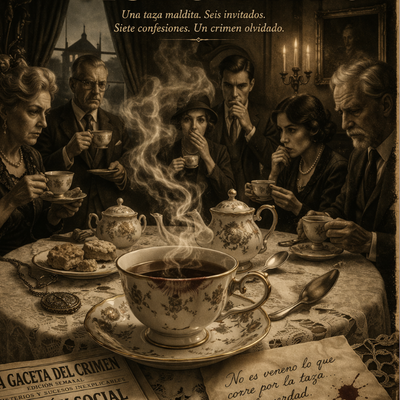
Attending the tea were Doctor Alonso Beltrán, a retired physician with an orderly mustache and the reputation of a quiet practice; his sister Adela, also a widow, a specialist in smiling without showing too much; Matilde Ros, an amateur pianist and distant niece of Elvira’s, known for a temper faster than her patience; Arturo Núñez, the family lawyer, whose voice always sounded like he was reading a clause aloud; Beatriz Llorente, the hostess’s young companion, precise in her manners and from somewhere nobody could quite place; and finally Don Julián Mena, the neighborhood apothecary and an old friend of the late Señor Valcárcel, a guest whose presence felt as natural as an inherited clock.
The list was not innocent. Every one of them had a relationship with Doña Elvira built out of years, favors, silences, and some debt or other. Doctor Alonso had cared for her after her husband died. Adela shared with her a friendship interrupted by stretches of coldness. Matilde was hoping, without saying so, for money to travel to Paris. Arturo had spent years managing papers, wills, and properties. Beatriz, according to the whispers, was more necessary in that house than her job description justified. And Don Julián, with his pharmacy and his air of a respectable man, represented the family’s past more solidly than any portrait in the hallway.
All of them, for one reason or another, had something to lose from a new will. All of them, for more private reasons, were dragging around a truth with no ventilation. This Gazette likes to remind its readers that crimes are rarely cooked up all at once. Before the blood comes the broth. Before the confession comes the habit of chewing lies over a low flame.
The cursed cup
Tomasa served the first round of tea without incident. It was a decent Darjeeling, light, with that dry good breeding favored by people who consider intensity vulgar. Conversation stayed on the safe ground of gardens, the concert season, and the lamentable decline of the good bookshops. A short piece was played on the piano. The tart was sampled. The drawing room clock struck 5:22 p.m. in low tones.
Elvira poured the second round herself. That detail, unusual, was the first thing anybody noticed. “Today I want to serve you,” she said, standing up with a minimal smile. She picked up the old teapot and filled the cups again. Not all of them. One got filled differently. Nobody caught it at the time. Later, all of them would swear the color was slightly darker, that the steam drew a slower shape, or that there was a different smell to it, something more floral or more bitter. The cup ended up in Matilde’s hands.
Matilde took one sip and stopped talking mid-sentence. She did not faint. She did not choke. She closed her eyes with a calm that had something of an involuntary ceremony about it. Then she let out a short laugh and said, in the voice of somebody who has finally stopped pretending in front of the mirror, “I cannot stand this house and I have never loved my aunt.” Nobody answered in the first second, because everybody assumed it was a badly judged joke. Then Matilde added, “I do not play the piano well either. I only play well enough to seem interesting.”
The cup stayed in her hand. Matilde did not look ill. She looked freed. In polite society, that is considerably more dangerous than a fainting spell. Elvira looked at her with a mix of fury and curiosity. Before she could say anything, Beatriz raised her own cup and said, calmly, “My name is not Beatriz.”
The first confession and the change in the air
When somebody confesses something serious at a tea table, the air takes on a different texture. It stops being air made of porcelain and lemon. It thickens, as though even the curtains were listening. Beatriz set her cup down on the saucer with a small click and repeated, “My name is not Beatriz Llorente. A lady in Zaragoza gave me that name so I could travel without questions.” At the back of the room, Tomasa made a small movement. Not of surprise, of confirmation. As if certain secrets stop being secrets to the staff long before they stop being secrets to the family.
Elvira demanded an explanation. The mechanism of that afternoon was already running, though. Doctor Alonso, who until then had held the tight expression of a man diagnosing without speaking, heard himself say, “I signed a death certificate without seeing the body.” He froze on hearing it. He tried to walk it back. He could not. The sentence dropped between the saucers like a lead spoon.
Adela put a hand to her throat, Arturo stopped fiddling with his napkin, Julián started sweating above his lip. Nobody seemed capable of holding back whatever reached their mouth. They were not shouting. They were not incriminating themselves violently. They simply spoke with a terrifying clarity, as if some slight substance had stripped the varnish off their manners and left the wood exposed.
The third confession came from Arturo, the lawyer. “The earlier will is not the original,” he said. He did not raise his voice. He did not look at anybody in particular. He said it the way he would read the simplest clause in a contract. Then he took a sip of water and added, “And the summer estate was never sold, it was hidden under the name of a shell company.” Elvira called him a liar. Arturo answered, “Until today, yes.”
By that point in the afternoon nobody was drinking for pleasure. They drank out of inertia, out of fear that putting the cup down would look like an admission of guilt. Maybe it would have been.
The pharmacy, the herbs, and the reasonable hypothesis
Once the news left the house and reached the street, the most comfortable explanation was chemistry. Adulterated tea. Herbs with a disinhibiting effect. A mistake in the kitchen. Police called in a health inspector and took samples of the leaves, the teapot, the water, even the sugar. They looked for alcohol, alkaloids, extracts, opiates, plants with long names and doubtful reputations. The result was disappointing for anybody fond of tidy solutions. The tea contained ordinary components, apart from a faint trace of a bitter plant that, at certain doses, neither kills nor causes delirium, but can produce a sensation of lightness and a temporary drop in verbal inhibition.
The lab identified the plant as a variety close to bitter lemon balm, used in old formulas to “ease the chest and loosen the tongue,” a phrase that would merit an investigation all on its own. They also found an almost imperceptible mix of verbena and another leaf that the municipal botanist described cautiously as “probably domestic.”
Everything pointed to a deliberate preparation. Not a poison, a tea designed to loosen tongues. What remained was working out who had prepared it and, above all, why. Because nobody organizes a tea party with homemade truth serum unless they are hoping for or dreading whatever might come out of it.
Police looked at the apothecary first. Julián Mena was the only guest with enough training to know discreet mixtures. He denied touching the teapot. Then it came out that the previous month he had sold Tomasa, the housekeeper, a small quantity of herbs “for the digestion.” Tomasa, questioned with the respect owed to somebody who has served a house for twenty years, did not deny it. She did not fully explain what they were for either. She only said, with admirable dryness, “In old houses, sometimes somebody needs to talk.”
The confessions in full
The afternoon carried on strangely, because despite the shock, nobody left. As if they all understood that walking out early would mean carrying half an open wound home. So they stayed. And they talked.
Matilde confessed that she not only despised the house, she had faked letters of recommendation to win scholarships she never deserved. She also admitted she had spent months searching Elvira’s study for a codicil to the will. “Not because I needed the money,” she said, “but because I did not want Beatriz inheriting anything.” Beatriz looked back at her with the serenity of stone. Then she said, “I was not going to inherit. I was going to leave.”
Beatriz, or whoever she was, explained that her real name was Inés de la Serna. The illegitimate daughter of the late Señor Valcárcel and a seamstress from the provinces. She had come into the house years earlier as a companion thanks to Tomasa, who had known the story since before the widowhood. Elvira went still. “I knew,” she finally said. That sentence was more violent than any shouting.
Doctor Alonso, by now unable to stop his own tongue, confessed that the death certificate he signed years earlier belonged to the manager of the summer estate, a man found drowned in the pond with no clear signs of an accident. “I did not see the body because it was described to me and I accepted the description. I wanted to avoid a scandal.” Scandal. That word came up three more times that afternoon and it always meant the same thing: somebody decided the truth was more inconvenient than the lie.
Adela, silent until then, closed her eyes and spoke the sentence that opened the door onto the real crime. “I was there the night of the pond,” she said. The whole room stopped breathing.
The night of the pond
The Valcárcel summer estate, hidden administratively and buried emotionally, had been the scene of a death nobody ever cleared up. The manager, Ramón Pereda, was found drowned one August morning five years earlier. The case was closed as an accident. He had been drinking, they said. He slipped, they added. The family avoided discussing it. The doctor signed. The lawyer put the papers in order. The widow did not attend the funeral. Too many pieces fell into place too quickly.
Adela explained that she went out to the estate that night because Ramón had asked her to come. He had documents. Papers proving the property had been moved into the name of a company set up by Arturo, with Julián’s knowledge and the doctor’s purchased silence. “I did not want to help them,” she said, “and I did not want Elvira finding out yet either.” Ramón threatened to tell everything unless he got money to leave. They argued beside the pond.
“I did not push him,” Adela said. “I grabbed his arm so he would stop coming closer. He was furious. He slipped.” It could have been an accident. It could. Arturo cut her off with a calm sentence that seemed to have been waiting years to be spoken. “I did push him.”
Arturo said it without drama, with no visible remorse, like a man finally taking off a tight shoe. “He slipped, yes. And when he tried to climb out, I stepped on his hand.” Elvira let her cup fall. The sound was minimal, and it split the afternoon into two exact halves. Before that sentence and after it.
The lawyer kept going because he could no longer stop. Ramón was demanding money, wanted to make Inés’s existence public, and intended to reveal that the estate was being concealed to dodge part of the division of assets. “It was not a fit of rage,” Arturo said. “It was a ten second decision. I thought the water would resolve what the paperwork kept tangling.” Nobody spoke for four long heartbeats.
What each of them did
The extraordinary thing about that tea was not only that a murderer surfaced, it was that the entire architecture of the silence got drawn out all at once. Arturo pushed Ramón and let him drown. Alonso signed a certificate without examining the body or the circumstances. Julián supplied, out of friendship and convenience, a sedative days earlier to “calm the manager down.” Adela kept quiet about the argument. Elvira suspected more than she was willing to admit and chose not to ask as long as the paperwork stayed in order. Tomasa hid letters and helped Inés into the house under another name, perhaps out of justice, perhaps out of revenge. Nobody was entirely innocent. Only Matilde seemed to fall outside the crime. Then she admitted stealing a key to the study months earlier to look for documents she could blackmail her aunt with.
Inés, the false Beatriz, listened to all of it without crying. At the end she said, “So I did not come looking for a surname. I came to sit at the table where fear and cowardice were already seated.” The sentence was not pretty. It was precise. And precision, as we know, cannot be argued with elegantly.
Tomasa, questioned afterward by police, admitted preparing the second round of tea following an old recipe of her mother’s. “It does not kill,” she repeated several times. “It only clears things up.” She had decided to do it that afternoon because she knew Elvira was going to announce changes to the will, and she was afraid the truth would be left outside again, like a beggar at the door of a rich house. “There has already been one death from too much silence,” she said. “I was not prepared to serve more pastries on top of a murder.”
It is not this Gazette’s job to judge whether Tomasa did right or wrong. Our job is to put it on record that justice sometimes gets prepared in the kitchen long before it walks in the front door.
The police and the arrest with no sirens
The arrest of Arturo Núñez had none of the noise fiction usually gives these things. No sirens, no chases across gardens, no handcuffs glinting at dusk. The inspector, tipped off by a neighbor who had heard more than she should have, arrived with two discreet officers. He found everybody still seated, as if the confession had frozen the arrangement of the tea. Arturo did not resist. He only asked to finish his cup.
“Do not worry,” the inspector told him, “we will give you water at the station.” Arturo smiled with an odd sadness. “I do not need to drink any more truth today,” he answered. That line, which police never enter into a report because reports distrust literature, deserves to be kept here. It was the line of a man who had spent years building an alibi out of solid furniture, good manners, and clean signatures, and who in the end was brought down by an infusion.
Doctor Alonso turned himself in at the same time, not for homicide but for document fraud and obstruction. Adela made her statement with a lawyer present, Julián handed over his sedative purchase records, and Elvira, alone at last in the blue drawing room, did the one thing nobody expected. She smashed the inherited teapot on the floor. Not out of rage, she said afterward, but “so the family cannot turn it into a relic.”
The precise cup and the missing detail
One last mystery remained inside the mystery. Why Matilde got the different cup. Tomasa explained it later with a logic so domestic it is frightening. “Because she is always the first to speak badly of everybody. And I knew that if she started, the rest would fall in behind her.” It was not a moral choice, then, it was a strategic one. The cursed cup went to whoever had the tongue closest to the exit. The rest was an avalanche with good manners.
Later analysis showed that only two cups carried clear traces of the disinhibiting mixture, Matilde’s and Arturo’s. Everybody confessed anyway. What that means is a matter for psychologists, judges, and priests. Perhaps it was enough for the first one to speak for the rest to feel the truth rising up their throats like a vapor of their own. There are houses where one broken glass is enough to make the cracks of decades audible.
Police closed the circle five weeks later. Arturo was charged with homicide and related offenses. Alonso lost his reputation before he lost his practice. Julián went on filling prescriptions with fewer customers and more silences. Adela went off for a while to stay with a sister in Santander. Matilde got her scholarship, not through blackmail but through an honest audition, the first of her life. Inés decided to stay in the house only one more month. “I do not want to live where the truth had to come in through a teapot,” she said.
Epilogue in porcelain
The Valcárcel house is still standing. The blue drawing room no longer serves tea. The piano stays closed. They say Elvira now takes her tea alone in the kitchen, in a plain cup, with no guests and no second rounds. Tomasa is still in her service, though perhaps the word service no longer describes their relationship well. Between the two of them there is now the kind of pact that only forms when somebody saves you and humiliates you at the same time.
Julián’s pharmacy now sells a digestive infusion called Serenidad de la Tarde, Afternoon Serenity. People buy it with half a smile and half a suspicion. Nobody has confessed anything on drinking it, as far as anyone knows. The inspector, for his part, keeps a Limoges saucer with a fine crack in it on his desk. He uses it as a paperweight. It reminds him, he says, that not every crime gets solved by hunting for footprints in the garden. Some of them simply require waiting for the table to get tired of holding secrets.
This Gazette, which has watched clocks announce endings and mirrors hand back lives nobody lived, does not intend to elevate a teacup to the status of a spell. It will not deny, either, that something stronger than good breeding crossed that tablecloth. If it was chemistry, it was strangely precise chemistry. If it was justice, it tasted slightly bitter and finished clean. And if it was, as Tomasa maintains, an old remedy for keeping the tongue out of prison, then perhaps we should accept that in some houses the truth does not arrive with a judge, it arrives with a teapot.
The real crime was not only the push beside the pond. It was the long architecture of the cover-up. The years of after-dinner conversation where everybody knew something and nobody wanted to be the first to break the china of the silence. The cursed cup did nothing more than speed up a fall that had been leaning for far too long. It killed nobody. It only forced each of them to sit down in front of their own guilt and say it out loud, unsweetened.
Was that cup a mild poison, a piece of kitchen justice, or a moral trap prepared over years of resentment? Leave us your theory in the comments. At The Crime Gazette, every reader is an investigator.
Do not miss everything else in The Crime Gazette!