Discover the Campanillas Town series by Inés de la Rosa, a literary saga set in a fictional town in Andalusia. Love, family, emotional inheritance, and characters that stay with you long after you turn the last page.
Andrés arrives in Campanillas, an ER doctor who left Seville behind, moving into a rental house that smells like whitewash and lavender, carrying a personal diagnosis he’s left untreated for ten years. Lucía is back too, Valeria’s daughter, with a secret book about her mother she doesn’t dare show her. Río, who’s been living in town for years, has something to say as well.
A novel about decisions you make without realizing it, diagnoses signed three weeks too late, cortados served without asking, and the quiet machinery of a town that knows what everyone is up to even when the people living in it don’t always see it.
First book in the Campanillas Town series.
This post contains affiliate links. See my full disclosure
A town that exists even though it’s not on any map
From the very first scene, a woman coming back to her hometown with a suitcase and a secret 422-page manuscript, you know you’re somewhere familiar even if you’ve never been there. A small town in southern Spain where everybody knows everything about everyone, where the local bar is the center of the universe, where love stories build slowly over cortados and conversations that seem to be about something else entirely.
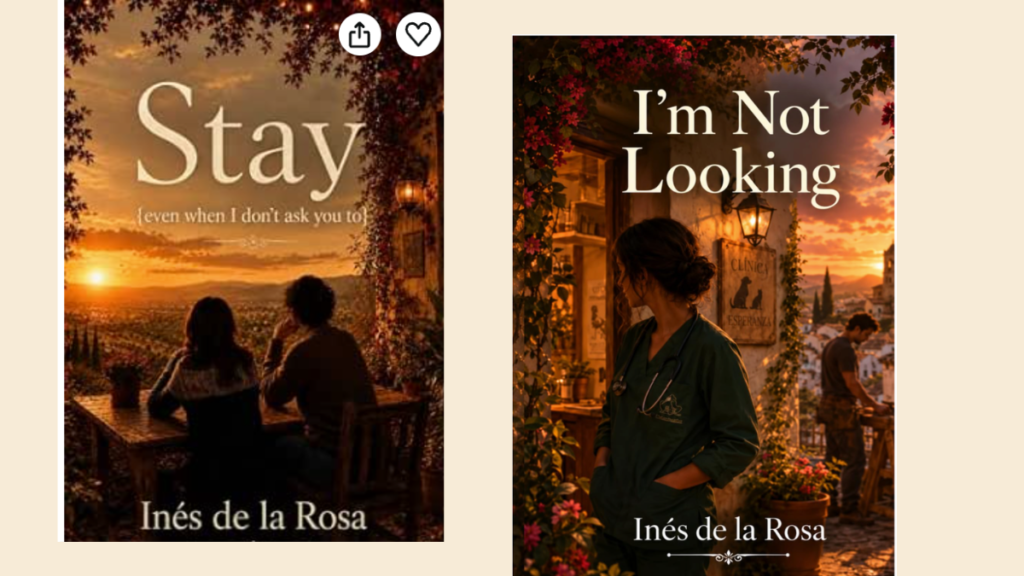
The Campanillas Town series has two novels out so far, Stay and I’m Not Looking. They’re technically contemporary romance, but that label sells them short.
These books use the language of romance to explore emotional inheritance, the difficulty of accepting love, the weight of things left unsaid, and the idea that a small town might be exactly the right size for figuring yourself out.
Two books, one town, seven narrative voices, and the feeling that when you close the last page, Campanillas is still there. Still running. Like it doesn’t need you around to keep going.
The town as a character
Campanillas is a fictional town in Andalusia. Small, compact, with the kind of social density you get in places where everyone knows each other and secrets last about as long as it takes Señora Carmen to walk into Pepe’s bar. Life centers around a handful of places that carry real emotional weight.
Aromas de Papel is Valeria’s restaurant-bookshop, half kitchen, half color-coded bookshelves. It’s the heart of the town. The kind of place people go to eat, sure, but also just to be. To sit down, let time pass, without anyone asking you anything you don’t want to answer.
The bookshelves are organized by color because Lucía, Valeria’s daughter, decided it that way when she was little, too young to read the titles but determined to be part of her mom’s business. Valeria has kept the system exactly as Lucía arranged it, decades later.
Pepe’s bar is the other center of gravity. Smaller, more of a counter-and-stool kind of place, where it’s all black coffee and blue pens. Pepe records the life of the town on napkins folded in quarters. Date, event, details. Two asterisks if it was a really good day. He’s the chronicler nobody appointed but everybody needs.
Sara’s veterinary clinic, the library where Lucía launches her novel, the streets where Marcos walks around with a pencil behind his ear looking for shutters to fix. Every place is more than a setting. Every spot accumulates layers of meaning as the books go on, until walking through Campanillas with these characters feels like walking through a place you’ve known your whole life.
Time in Campanillas is measured in routines. Andrés’s cortado at ten-fifteen. Sara’s shutter banging at seven in the morning. Señora Carmen stopping by the bar at the same time every day. Each repeated gesture adds another layer of meaning on top of the last.
The characters, or ways of not saying how you feel
The boldest narrative choice in the series is its structure. Each chapter is told in first person by a different character. Valeria, Lucía, Andrés, Río, Sara, Marcos, Pepe. Each one has their own voice, their own vocabulary, their own way of seeing the world.
One character reads a moment one way, another reads it completely differently. You piece the truth together from fragments, like hearing the same story from different people who were all in the same room but saw different things.
Valeria runs Aromas de Papel with quiet, unshakable competence. She raised a daughter on her own, built a business from nothing, and she’s the person who holds everything together without anyone ever asking how she’s doing. She copes by keeping busy. When something’s wrong, she rearranges the bookshelves, changes the daily special, and doesn’t tell a soul.
She’s never figured out whether she runs Aromas de Papel because she wants to or because she can’t picture her life without it. That blurry line between passion and habit, between love and obligation, is one of the central themes of the series.
Lucía, Valeria’s daughter, left to study in Salamanca and comes back to town with a 422-page manuscript about her mother. She started it as a novel, but as she writes she realizes it’s something else. A deep dive into her own family. A letter she doesn’t know how to send. An attempt to understand the woman who raised her.
The thing that throws her is realizing that the emotional trap she’s been dissecting in Valeria is hers too. The inability to accept love, the need to earn the right to belong. It runs in the family. Lucía thinks by digging. Her chapters are the densest, the most reflective, the ones that dare to go deeper. When she writes about her mother, she discovers she’s writing about her grandmother. When she writes about her grandmother, she discovers she’s writing about herself.
Andrés is the new town doctor. He falls for Valeria and translates his feelings into clinical diagnoses. He jots down everything he notices about her in the margins of a Portuguese novel. How she moves her hands when she’s plating food, how she adjusts her voice depending on who she’s talking to, how she keeps an eye on her daughter without anyone noticing.
He won’t admit it, but all those clinical observations add up to a love letter written in the language of a medical chart. He never says “I love you.” He writes down symptoms. His chapters are the most restrained in the series. Everything happens under the surface, beneath a layer of professionalism that cracks a little more with every page.
Río is an illustrator who doesn’t say much, draws constantly, and whose presence in a scene changes everything without a single line of dialogue. He’s one of those characters who seems to take up less space than he actually does, until you realize you’ve been holding your breath every time he walks into a scene. He draws Lucía without her knowing. When she finds out, he says nothing. In the context of these novels, that silence is bigger than any declaration.
Sara is the veterinarian, the lead of Book 2. She’s competent, decisive, fearless in her professional life. She’s up at five in the morning, rolls up her sleeves, and gets things done. In her personal life, she’s a quiet disaster. The kind of disaster that looks like doing nothing, letting time pass, waiting for things to sort themselves out while knowing full well they won’t.
Sara inherited the profession from her mother Concha, along with her work ethic and that way of loving without saying it out loud that works perfectly with animals and terribly with people. Her chapters are full of mental lists, compulsive organizing, “what I need to do today” as a way of not thinking about what she actually wants to do.
Her list of pending repairs always includes something she could fix on her own but doesn’t, because that gives her an excuse to call Marcos. That part never makes it onto the list. It lives in the space between the lines.
Marcos is the carpenter who always has a pencil behind his ear and fixes shutters as an excuse to be nearby. He’s been fixing things for Sara for two years. Sara’s been breaking them for two years. Neither one talks about what’s going on. The whole town sees it. Pepe writes it down on his napkins. Señora Carmen makes comments that aren’t really comments.
The only two people who don’t see it, or pretend not to, are the two of them. Marcos is the most patient character in the series. His way of loving is just showing up, over and over, without asking for anything, without pushing, without bringing up the obvious.
Pepe thinks by archiving. He doesn’t judge, he writes things down. His napkins are the documentary heart of Campanillas, the official record of what happens when nobody important is watching. “The big stories, other people tell those,” Pepe says. “Someone’s got to keep the small ones.”
He seems like a simple character until you realize he’s been doing the town’s most important emotional work for decades without anyone ever asking him to. His conversation with Evaristo about the napkins, about who tells the real story of a town, is one of the best moments in the series. Funny, deep, and true, all at once.
Señora Carmen doesn’t narrate any chapters, but she’s everywhere. Sixty-four years old, with a mental file on every neighbor since she turned four. She can organize a room just by sitting down in it. She knows things about everybody and uses them not to gossip (well, also to gossip) but to look out for people.
When Señora Carmen asks how you’re doing, she already knows the answer. The question is an invitation to say it out loud. She has this gift for wrapping truths inside sentences that sound harmless.
When she says “in this town, people know things before they happen,” she’s not exaggerating. When she tells Sara she has “the face of someone who fell asleep thinking about things that aren’t meant for sleeping,” she’s making an emotional diagnosis more accurate than any therapist’s. She says it in passing, while pouring herself another coffee, like it’s nothing.
Evaristo, Pepe’s friend, is the character who could have been filler but ends up being essential. An older man who sits in the bar, comments on town life, and seems to do nothing. But when he talks with Pepe about the napkins, about why it’s worth writing down the small stuff, you realize Evaristo understands something fundamental about memory and love that many of the younger characters are still trying to figure out.
Emotional inheritance, or what gets passed down without meaning to
If there’s one central theme in the Campanillas Town series beyond the romance, it’s emotional inheritance. The things that pass from mothers to daughters without anyone naming them, without anyone choosing them, without anyone knowing how to give them back.
In Book 1, Lucía comes back to town with a manuscript about her mother. As she writes, she realizes Valeria’s story doesn’t start with Valeria. It starts earlier. With Rosario, the grandmother. There’s a whole chapter where Lucía fictionalizes the moment Rosario didn’t go to the hospital the day her granddaughter was born.
She’s not trying to understand the act itself, but the layers of fear, pride, and social suffocation that made it possible. “Writing people who do damage without meaning to is infinitely harder than writing movie villains,” Lucía writes. That line could be the manifesto for the entire series.
The chain runs from Rosario to Valeria to Lucía. Each one inherited something from the one before without asking for it. The inability to accept love. The need to earn the right to belong. The habit of holding everything together without asking for help.
By writing her novel, Lucía is trying to see the whole chain, map the links, understand where this way of loving that holds as much distance as affection actually started. The thing that rocks her is finding out she’s not on the outside looking in. She’s inside it too. “The trap I’m writing about in her has caught me too. I inherited it.”
In Book 2, emotional inheritance takes a different shape with Sara. Sara inherited the profession from her mother Concha, the work ethic, and also a certain way of loving without saying it. It’s not pain that gets passed down in this case, but a way of being in the world. The courage to handle a tough delivery at five in the morning and the cowardice to say a single word to the man you like. Sara doesn’t have a 422-page manuscript to process what she feels. She has a vet clinic, a broken shutter, and two years of built-up silence. Her way of dealing with emotional inheritance is not dealing with it. Until she can’t take it anymore.
It’s one of the most powerful themes in the series. The idea that we don’t just inherit physical traits or material things. We inherit ways of loving, ways of staying silent. The Campanillas Town series puts a name to that inheritance, brings it into the light, and explores whether the chain can be broken.
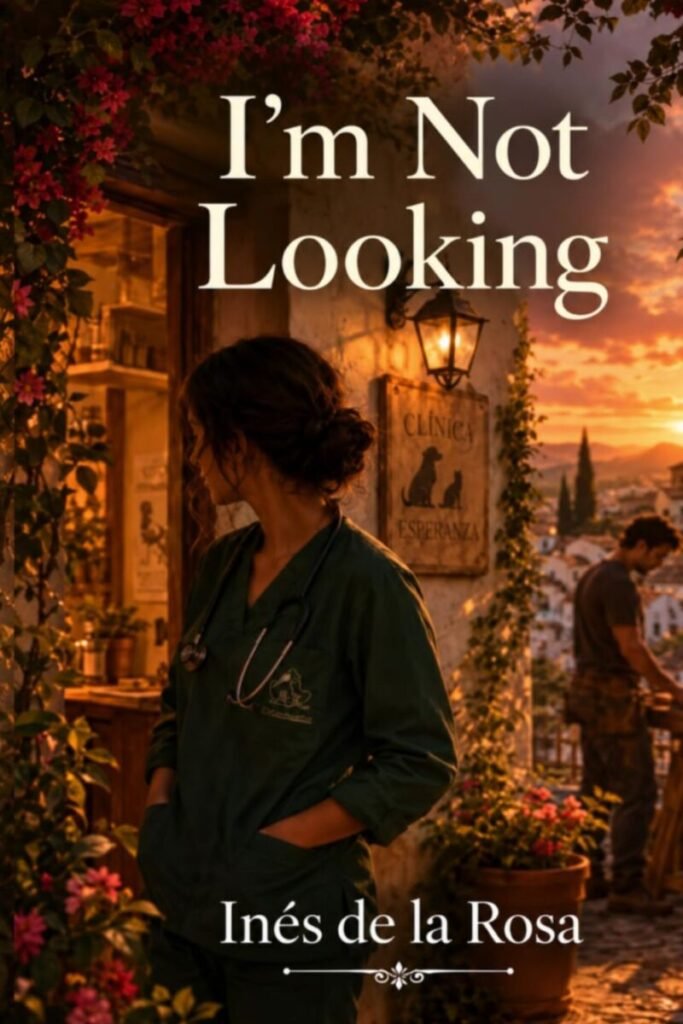
Book 2 cover
Objects that speak when the characters can’t
One of the smartest things about the Campanillas Town series is how it uses objects. They’re not decorations, they’re emotional machinery. In a town where nobody comes right out and says what they feel, the objects do the talking.
Andrés has a Portuguese novel where he scribbles observations about Valeria in the margins that are, whether he admits it or not, a coded love letter. Sara has a broken shutter she’s been banging on for two years to get it working. Marcos fixes it, taking away her excuse to see him. So she invents another problem.
Pepe has his napkins folded in quarters, where he archives town life with a blue pen and a system. Río has a sketchbook where he draws what he doesn’t dare say. Lucía has a manuscript that’s both a novel about her mother and a letter she doesn’t know how to send.
Aromas de Papel has its bookshelves organized by color, a system Lucía came up with as a kid that her mother has kept intact.
Sara’s shutter isn’t a shutter, it’s an excuse to see Marcos. Río’s sketchbook isn’t a sketchbook, it’s everything he’s not telling Lucía. Pepe’s napkins aren’t napkins, they’re the emotional memory of Campanillas, its sentimental archive, proof that someone was paying attention when it looked like nobody was watching.
There’s a scene in Book 2 that captures this better than any explanation. It’s Midsummer’s Eve. Sara and Marcos are standing by the bonfire. Each of them is holding a piece of paper with a single word written on it. The tradition is to burn whatever you want to leave behind.
Sara tells him what she wrote. Marcos reveals his paper has the same word. Neither one burns their paper. They keep it. In any other novel, this would be a romantic climax complete with a kiss. In Campanillas, it’s something bigger. Two pieces of paper that don’t get burned. Two people who choose to hold on to what they feel instead of letting it go. It’s one of the most beautiful scenes I’ve read in a long time.
Where other stories shout, Campanillas stays quiet
The defining narrative choice in this series is silence. The characters say less than they think, and what goes unsaid weighs more than what gets said.
Andrés never says “I love you,” he jots down symptoms. Río draws Lucía without her knowing, and when she finds out, he says nothing. Sara and Marcos spend almost three hundred pages communicating through broken shutters and invented repairs, without once saying what the entire town already knows.
Their love story is told through visits with a professional excuse. Sara needs something fixed at the clinic. Marcos fixes it. Sara finds something else broken. Marcos comes back. It’s such an elaborate choreography of avoidance that when something finally happens, it doesn’t need to be spectacular. One word is enough. Literally, a single word.
That commitment to the unsaid is what sets the Campanillas Town series apart from most contemporary romance novels. There are no grand confessions in the rain, no ten-page letters explaining feelings. There’s an annotated book, a broken shutter, and a napkin folded in quarters.
There are tiny gestures that accumulate enormous weight. When an object, a silence, or a routine tells you more about a character than three pages of dialogue, you know you’re reading someone who trusts the reader’s intelligence.
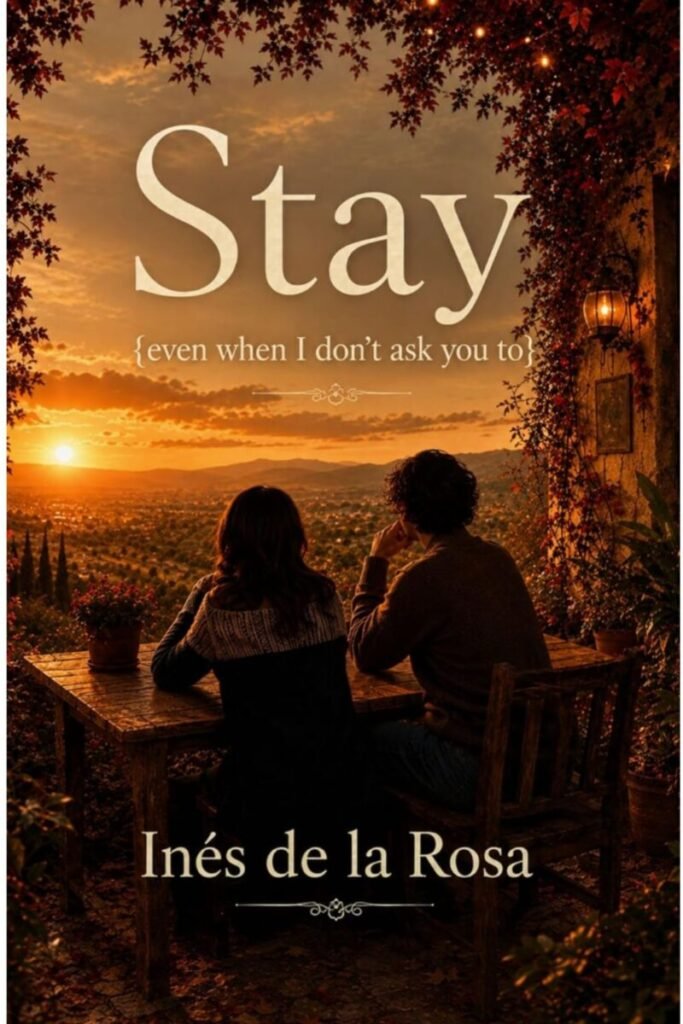
Book 1 cover (a nod to Lucía’s book)
The book launch (or when the town looks in the mirror)
There’s a moment that deserves special attention. Lucía launches her novel at the Campanillas library. The novel she’s been writing throughout all of Book 1, the one that started as a secret manuscript about her mother and turned into something much bigger. More than sixty people from town show up.
It’s an extraordinary scene for several reasons. First, because it’s the moment the novel-within-the-novel goes public. Lucía’s private project, her way of processing her relationship with her mother, her grandmother, the whole chain of emotional inheritance before her, becomes something collective. Lucía reads a passage. The town recognizes itself in a book that’s about them.
Second, because the scene works as a mirror for what the Campanillas Town series itself does with the reader. Just like the people of Campanillas recognize themselves in Lucía’s novel, the reader recognizes themselves in the town’s dynamics. In the mother who doesn’t know how to accept love. In the man who writes down what he feels because he doesn’t know how to say it. In the woman who invents broken things just to see the neighbor she likes. These are specific situations that work as universal mirrors.
Third, because all the main characters are there. Valeria, Andrés, Sara, Marcos, Pepe, Señora Carmen, Evaristo, Río. It’s one of the few moments in the series where all of Campanillas is gathered in one place, and the accumulated tension from every storyline converges in a scene that looks like a celebration but is also a turning point.
The epilogue, or how to end a saga without really ending it
The ending of Book 2 is probably one of the best narrative decisions in the series. A year after everything that’s happened, on a Saturday morning, Sara and Marcos walk through town. It’s a quiet, everyday, drama-free scene. They pass by the places the reader already knows. Aromas de Papel, Pepe’s bar, the clinic, the library. Everything is still there. Everything still works. The town keeps turning.
On the last page, a detail. Señora Carmen has already reserved Book 3. The final line of the novel is a statement of intent disguised as a slice-of-life observation. “In this town, when good things get going, they don’t stop.”
It’s an open ending that doesn’t leave anything hanging. You know everything is fine. You know there will be more. You know Campanillas is still there when you close the book. Pepe is still writing on napkins. Señora Carmen still knows everything. Valeria is still serving cortados without asking. Campanillas exists beyond the pages. It keeps going when you stop reading.
For Gilmore Girls fans (and everyone else)
When you read the Campanillas Town series, you can’t help thinking of Stars Hollow. The ensemble town, the restaurant as the center of gravity, the supporting characters who function as an extended family, the warm tone that makes you want to move there. The connection jumps out on its own, without anyone forcing it.
The Campanillas Town series reminds me of Stars Hollow from Gilmore Girls. It’s a series about a town where huge things happen wrapped in small ones. A woman writing a book about her mother without knowing she’s writing about herself. A vet who’s been banging on a shutter for two years because she can’t bring herself to knock on the door next door. A doctor who writes down symptoms because he can’t write “I love you.” An illustrator who draws what he doesn’t dare say.
The first time you open Stay, the echoes are immediate. Valeria, Lucía’s mother, runs Aromas de Papel with a quiet, unshakable competence that’s reminiscent of Lorelai Gilmore. But where Lorelai externalizes everything with humor and talking a mile a minute, Valeria turns it all inward. They share the same engine. Raising a daughter alone, building something from scratch, being the person who holds the world together without anyone asking how she’s doing. But they run at completely different speeds.
Lorelai fills the silence. Valeria thinks so she won’t have to talk. When Lorelai has a problem, she calls Rory, goes to Luke’s, and talks nonstop until she processes it. When Valeria has a problem, she rearranges the bookshelves, changes the daily special, and doesn’t tell anyone. Both strategies work as survival mechanisms. The difference is that Lorelai’s seems healthier because you can see it. Valeria’s worries you more because you don’t see it coming.
Lucía, the daughter who left to study in Salamanca and comes back to town with a manuscript about her mother, has something of Rory in her intellectual curiosity and that quality of someone who observes first and writes later. But Lucía is not Rory. Lucía watches with the intensity of someone trying to understand something that hurts. Rory writes articles. Lucía writes a manuscript that’s part novel, part family reckoning, part letter she doesn’t know how to send.
Stars Hollow exists so Lorelai and Rory have a place to be themselves. Campanillas exists so Valeria, Lucía, Sara, and the rest of the characters have a place where they don’t have to explain themselves. In both cases, the town isn’t a backdrop. It’s another character, with its own routines, its quirks, its traditions (the summer Velá in Campanillas, the Fall Festival in Stars Hollow) and its unsettling ability to know what’s going on with you before you do.
Amy Sherman-Palladino once described Stars Hollow as “a place where someone is always waiting for you with coffee.” Reading the Campanillas Town series, you get that same feeling, except here the coffee comes with a piece of toast, Valeria doesn’t ask what you want because she already knows, and Andrés’s ten-fifteen cortado is as sacred as Luke’s coffee is to Lorelai.
There’s something else that connects these two fictional towns in the reader’s mind. The feeling that time works differently within their borders. Stars Hollow has that timeless quality of well-built American comedies, where the seasons change but the town stays the same. Campanillas has something similar, but with a different feel. Here, time is measured in routines.

Campanillas Town series infographic
Frequently asked questions about Campanillas Town
What order should you read the Campanillas Town books in?
The recommended order is publication order. First Stay and then I’m Not Looking. Even though Book 2 switches to a different lead couple, there are plotlines and characters that develop throughout the whole saga.
Are these romance novels?
Yes, but with layers. There’s romance, there’s tension, there are couples that end up together. But there are also chapters dedicated to emotional inheritance between mothers and daughters, characters writing novels within the novel, and a bartender who archives the life of a town on napkins. The genre is contemporary romance, but the scope goes way beyond that.
Who are the main characters in each book?
Book 1 focuses on Valeria and Andrés (the owner of Aromas de Papel and the new town doctor) and on Lucía and Río (the writer daughter and the illustrator). Book 2 focuses on Sara and Marcos (the veterinarian and the carpenter). All the characters are present in both books.
What’s special about the narrative structure?
Each chapter is narrated in first person by a different character. That means the same scene can be seen from multiple perspectives throughout the saga. One character reads a moment one way, another reads it completely differently. It’s a technique that adds layers of meaning to every situation and builds the town as a mosaic of voices.
Will there be a third book?
According to Señora Carmen, yes. She’s already reserved her copy. That should be enough.
You can find the series on Amazon and at other digital bookstores.
If you’re more into romance than contemporary fiction, you might want to check out Julia and the Iceberg, another novel by the same author that’s a lot lighter but just as fun.