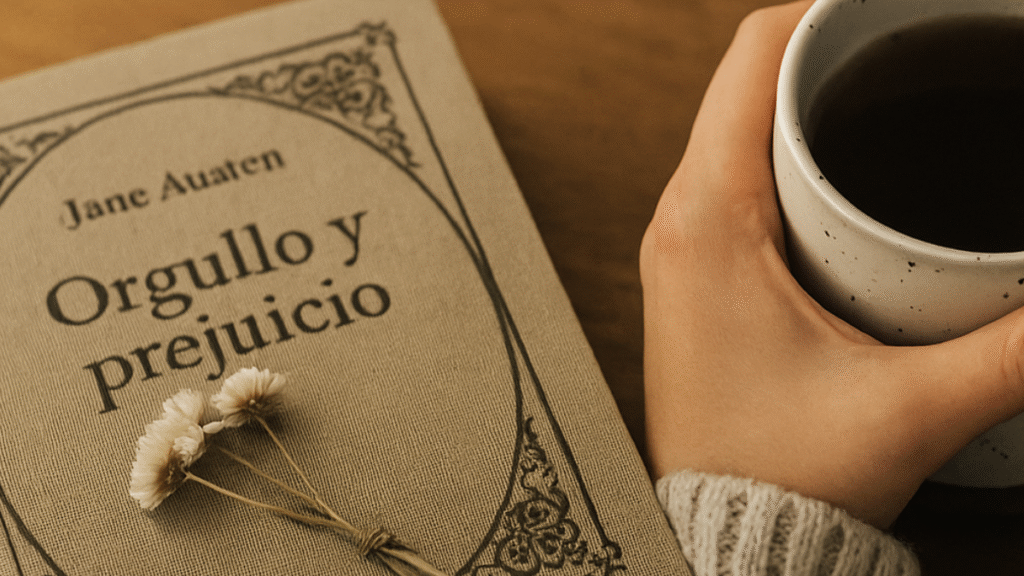
Pride and Prejudice, the timeless Jane Austen novel that changed literature and keeps winning hearts. An ironic, brilliant, deeply human portrait of love, appearances, and the search for freedom in an age full of rules.
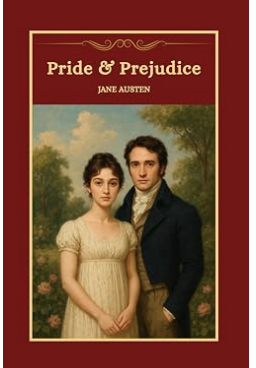
Pride and Prejudice is one of the most beloved novels ever written. Through the story of Elizabeth Bennet and Mr. Darcy, Jane Austen paints nineteenth century English society with irony and sensitivity, digging into love, class, prejudice, and the pursuit of happiness. It is a story about learning to look past appearances and finding out that real love grows out of respect and mutual understanding.
Has it ever happened to you that you read a book and feel like it is talking straight to you? That is what happened to me with Pride and Prejudice. I thought it would be an old fashioned love story with balls, long dresses, and flawless gentlemen. It was far more than that.
From the first pages I could tell I was holding something different, not simply a romance but a lucid, funny look at human nature, at pride, at appearances, and at what happens when we dare to see past all of it. A novel written more than two centuries ago that still feels remarkably current.
This post contains affiliate links. If you buy through them, you support my work at no extra cost to you.
Jane Austen, the woman who wrote freedom before it existed
Before we get into the story, there is something I want to tell you about Jane Austen, because understanding her is understanding why Pride and Prejudice has so much life in it.
Jane was born in 1775 in a small English village called Steventon. Her father was a clergyman and she grew up surrounded by books, conversation, and observation. From very early on she wrote about what she saw: how families behaved, the tensions inside marriages, the games people played with appearances. She did it with a delicious streak of irony.
She published Pride and Prejudice in 1813, though she had finished it many years earlier. In her day a woman could not put her name on a book, so it came out anonymously, credited only to the author of Sense and Sensibility. Her voice came through so strongly anyway that she became one of the most loved writers in English literature. The most fascinating part is that Austen never needed to travel or live through great adventures. From her corner of Hampshire, she captured the shades of the human soul like nobody else.
A society that lived on appearances
The world Jane Austen wrote this story in was nothing like ours. In early nineteenth century England, families lived and breathed status, inheritance, and marriages of convenience. Love was not a priority, it was a luxury.
In that setting, a woman without a fortune had few options. Marry well, or depend on somebody else. Austen knew what that meant and decided to write about women who thought for themselves, who asked questions, who refused to settle. That is where Elizabeth Bennet comes in, a young woman who never fit the mold and who, with her wit, her irony, and her independence, challenges the whole system without ever raising her voice. She stands for what so many women of her time, and of ours, dreamed about, which is the freedom to decide for themselves.
What Pride and Prejudice is about
The story opens with a line that is almost a joke and that sums up everything coming after it:
It is a truth universally acknowledged, that a single man in possession of a good fortune, must be in want of a wife.
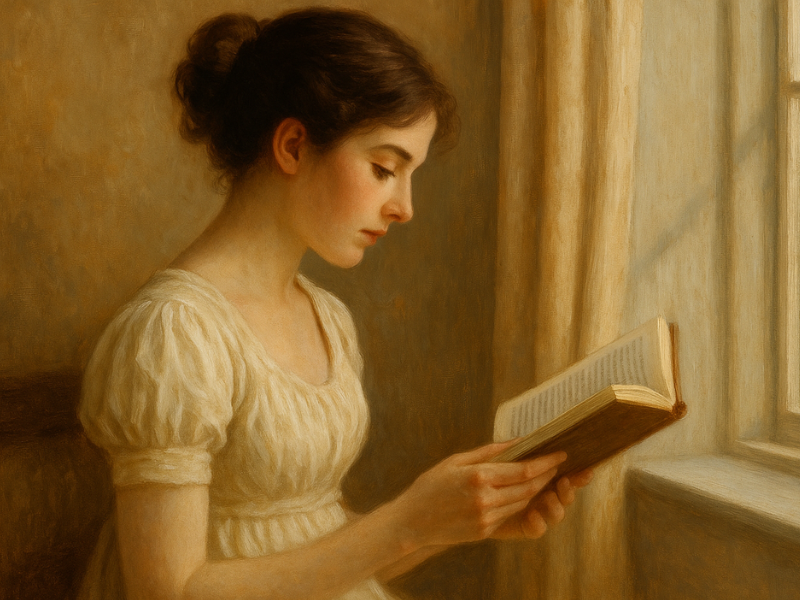
With that line, Austen throws open the doors of the Bennet house, a family with five marriageable daughters, a mother obsessed with finding them husbands, and a quiet father who watches it all with amusement. Our lead is Elizabeth, the second sister, and from the first moment you can tell she is not like the others. She is smart, ironic, honest, and, at times, a little proud.
Everything shifts when two newcomers arrive in the neighborhood, the charming Charles Bingley and his friend, the enigmatic Mr. Darcy. Bingley falls for Jane, the eldest sister, right away. Darcy seems like the opposite: reserved, haughty, carrying an air of superiority that irritates everybody, Elizabeth most of all.
From there the story turns into a kind of dance of misunderstandings, bad judgment, wounded pride, and second chances. It is a love story, yes, and it is also a lesson in how we learn to see with the heart.
Elizabeth Bennet, a woman ahead of her time
I am not exaggerating when I say Elizabeth Bennet is one of the most brilliant and most human characters in all of literature. She is not after a marriage of convenience and she will not pretend to be somebody she is not. What matters to her is honesty, laughter, intelligence, and freedom.
In an era when women were supposed to behave meekly, Elizabeth lets herself be herself. In 1813, that was nearly an act of rebellion. The loveliest thing about her, though, is that she gets things wrong too. She judges too fast, she lets pride carry her, and she learns through her mistakes. That is why we love her so much, because she is imperfect and completely genuine.
Mr. Darcy, from pride to real love
Then there is him, Fitzwilliam Darcy. The man who starts out as a wall of ice and ends up melting completely.
At first Darcy comes off as arrogant and distant. He stands for everything Elizabeth despises, the power of money, appearances, class snobbery. Bit by bit, he turns out to be far more complicated than that.
When he falls in love, he does not do it from arrogance, he does it through change. He learns humility, he learns to look with empathy, he comes to see that love has nothing to do with rank and everything to do with connection. What I like best is that his story is not only romantic, it is human. Darcy is not perfect, and that is what makes him real. He changes because love forces him to face himself.
Pride and Prejudice, love and growing up
Past the romance, Pride and Prejudice is a story about inner growth. It is about how all of us, at some point, let pride and prejudice run the show, and how we only learn once we dare to set both of them down.
Elizabeth and Darcy reflect what happens to us when we stop looking only at what we want to see. That is why, after more than two hundred years, the book still feels current. It is still talking about us.
Jane Austen’s irony, her most elegant form of rebellion
Jane Austen had a singular ability to criticize her society without ever sounding angry. She used irony like a smile with a hard truth hidden behind it.
Her conversations look light, and they are packed with subtlety. Her ordinary scenes carry more tension than a mystery novel. You laugh along with her characters while feeling the discomfort of something true underneath. That is the magic of Austen. She never needed to shout to change the world, a witty sentence and a well written exchange were enough. If you want to read more of her, I also recommend Emma.
The supporting cast has plenty to say too
Elizabeth and Darcy are the center of the story, and the supporting characters are essential. Each one represents a different way of loving, or of living.
Jane Bennet and Mr. Bingley embody sweetness and decency. Charlotte Lucas shows the most pragmatic side of it, marrying without love because she cannot afford anything else. Mr. Collins represents the absurdity of social convention. Lydia Bennet, the youngest sister, is pure chaos and recklessness.
All of them work as mirrors that help us understand Elizabeth. Her story shines because it stands apart from theirs.
Jane Austen’s style, the elegance of ordinary life
If anything defines Jane Austen, it is the way she tells a story. There are no battles and no impossible twists, and every word is deliberate. Conversations between her characters are as intense as duels, and her ballroom scenes are loaded with emotional tension. Austen turns the small into the momentous. In her hands, daily life becomes art.
Her prose, always balanced, combines intelligence, tenderness, and humor. Reading her is like hearing a soft melody that stays in your head.
Love in an age of rules
When Jane wrote Pride and Prejudice, marriage was not a romantic choice, it was a social obligation, and she dared to question that.
Her message is clear: love should be a free decision, not a strategy. Elizabeth does not want to marry in order to survive, she wants to share her life with somebody who respects her, and saying that in 1813 was a revolution all by itself.
Adaptations and legacy
Since it came out, Pride and Prejudice has lived a thousand lives. The 2005 film with Keira Knightley and Matthew Macfadyen is one of the best loved, for how beautiful it looks and how much it feels.
There are also series, modern retellings, and even comic versions like Pride and Prejudice and Zombies. Every generation comes back to it, because the message never ages.
What Pride and Prejudice left me with
When I finished the book I was left with that warm feeling of having learned something that matters. Not about perfect love, but about humility, empathy, and second chances. Elizabeth and Darcy reminded me that changing is not giving up, it is growing. Jane Austen taught me that you can be strong and delicate at the same time.
You can get it online here. That illustrated color edition is gorgeous.
Frequently asked questions about Pride and Prejudice
What is Pride and Prejudice really about?
How love and understanding can get past the barriers of pride, prejudice, and social rules.
Why does this novel matter so much?
Because it was a pioneer in giving women a voice with intelligence and dignity, and in showing that love does not have to mean submission.
What is its message?
That only once we stop judging other people, and ourselves, are we capable of really loving.
Is it hard to read?
No. The pace is unhurried, and the irony and humor keep it moving naturally.
Why is it still this popular?
Because it deals with feelings everybody has: pride, desire, freedom, love, and redemption.
More than a love story
In the end, Pride and Prejudice is more than a romance. It is a meditation on being human, on who we are once we let the masks drop.
Jane Austen wrote about her world and about ours at the same time, and every time somebody picks her up again, that voice comes back to life, fresh and ironic and sharper than ever.
What about you? Have you read Pride and Prejudice? Tell me what it made you feel. Every time I reread it, I fall a little more for Elizabeth, for Darcy, and for Jane Austen’s talent.