Needful Things by Stephen King is a chilling story about the power of desire, the corruption of decency, and how a small town turns into a mirror of the worst in us. A novel that does more than frighten you, it gets you rethinking what you want.
This post contains affiliate links
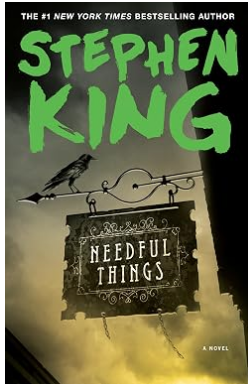
Needful Things is one of Stephen King’s most unsettling novels. A mysterious man named Leland Gaunt arrives in the small town of Castle Rock and opens a shop where every customer finds exactly what they want most. Nothing in that place is free, though. In exchange, buyers have to do small favors that end up setting off total chaos. It is a story about temptation, about what desire costs, and about how evil can slip into ordinary life wearing a friendly smile.
When wanting something has a price
Some books you do not just read, you live through them, and that is what happens with Needful Things. The first time I read it I was thinking about it for days, not so much because of the plot as because of everything it makes you feel.
Imagine somebody offers you the exact thing you want most in the world. That object, that opportunity, that small happiness you believe would change your life. All they ask in return is one thing, something small, a favor of no importance. Would you take it?
That is the deal this story puts in front of you, one impossible to turn down that turns into a trap. King is not simply writing horror here, he is writing about desire, about guilt, about the darkest part of every one of us. He does it with a precision that frightens, because the scariest thing in this book is not the monsters, it is how easily you recognize yourself in it.
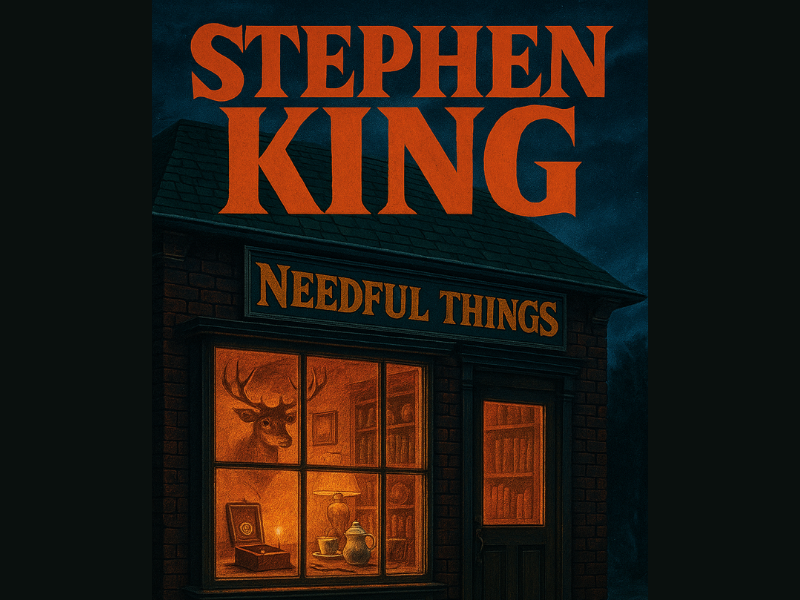
Stephen King at the top of his game
Before we get into the story, I have to tell you that Needful Things is one of those books where King is firing on every cylinder. It came out in 1991 and it sums up everything that makes him singular: a small town, ordinary people, and an evil that walks in quietly, dressed up as good manners.
King has always played with the idea that evil does not need fangs or shadows. Sometimes it shows up with a smile, a friendly voice, and an offer that looks harmless. This story is also part of his famous shared universe. Everything takes place in Castle Rock, a fictional town that had already appeared in books like Cujo, The Body, and The Dead Zone. In fact, Needful Things works as a kind of closing chapter for that cycle. King burns the set down, literally, in an ending that is as brutal as it is symbolic.
It is as if he were saying: everything ends here, and first, let us take a look at what the human soul is made of.
What Needful Things is about
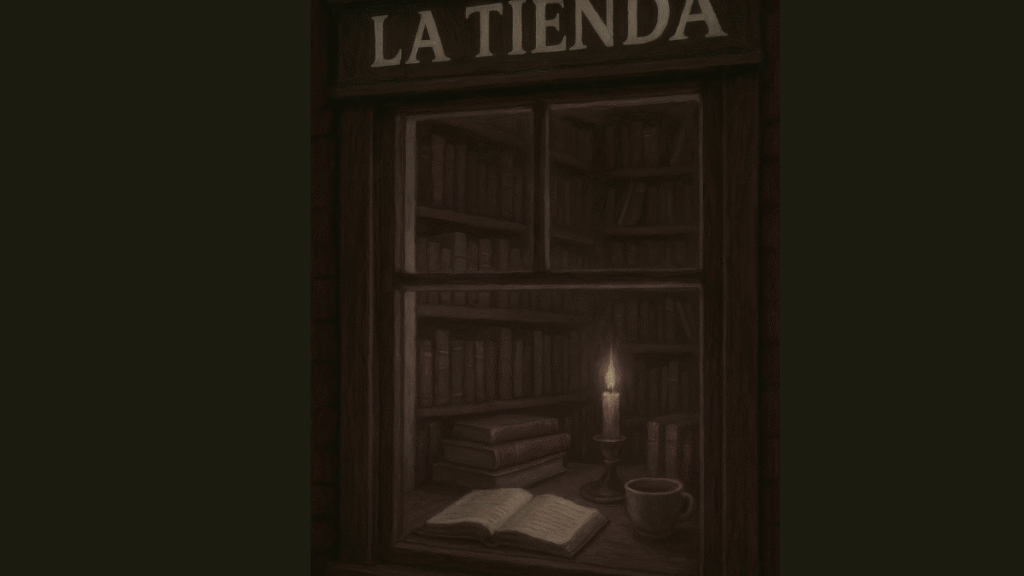
The story starts with the arrival of a mysterious man, Leland Gaunt, in the small town of Castle Rock. He opens a shop, hangs out a sign reading Needful Things, and from the sidewalk it looks like any other business. Nothing in that window is normal, though.
Every person who walks in finds exactly what they want. Sometimes it is a worthless trinket, sometimes an impossible rarity. The unsettling part is that these objects seem to have a deep connection with whoever picks them, as if Gaunt knew which piece was missing from each life. The strange part is that he does not always take money. He asks for something else, a small favor, a prank, something apparently meaningless. Those “small favors” start chaining together. Every prank triggers another one, and the whole town fills up with tension, misunderstandings, and hate.
What looked like a game turns into a nightmare. Leland Gaunt does not sell objects, he sells desires, he sells the illusion of filling a hole. The price is always your soul.
The characters: the broken soul of a town
What I like most about this novel is how King draws his people. There are no perfect good guys and no absolute villains. Everybody has shadows, hidden wants, a weak spot, and that is what makes them real.
Leland Gaunt
The shopkeeper is easily one of King’s most unsettling creations. He never has to raise his voice or use force. His power is temptation. He has that dangerous calm of somebody who looks you in the eye and convinces you that what he is doing is for your own good. He is the devil as a salesman, elegant and seductive, able to read your mind after watching you for one second.
Alan Pangborn
The town sheriff is Gaunt’s counterweight. He is a decent, steady man marked by past losses, trying to hold onto his sanity while everything around him comes apart. Alan stands for moral resistance, that voice all of us have inside that tries to slow us down when desire starts pulling.
Polly Chalmers
Polly, Alan’s partner, is a beautiful character in her fragility. She lives with physical and emotional pain, which makes her an easy target for Gaunt. Her story reflects how suffering can leave you open to any promise of relief.
Nettie, Wilma, and the rest of the town
Every neighbor has a history, a grudge, a small tragedy. King introduces them in such detail that you end up feeling like you know them. Nettie is a tormented woman, Wilma is full of rage and envy. All of them are pieces on Gaunt’s board.
The fascinating part is that Gaunt barely has to do anything. He watches, he smiles, and he lets them destroy each other.
What King shows us about ourselves
Past the horror, Needful Things is about something far more human, how easy it is to let desire take over. What frightens you is not Gaunt, it is watching ordinary people tear everything down over something as small as an object or a feeling of power.
As you read, you ask yourself what you would do. What would your weak spot be? What would Gaunt offer to tempt you?
That is where King wins, because he gives you no answers. He just stands you in front of a mirror.
A hypnotic pace that carries you off before you notice
Reading Needful Things is like watching a storm form. First there are only clouds, then a bit of wind, and by the time you look up the sky has gone black and the storm is already on you.
King has that talent for building horror bit by bit. He starts with everyday details, conversations between neighbors, routines, minor irritations. It all looks normal, and every page adds one more drop of tension.
By the time the chaos breaks, you are already inside it, caught, and even though you know nothing good is coming, you cannot stop reading. The storytelling flows easily. There is humor, there is irony, and above all there is a deep understanding of how the human mind works. King does not write about monsters, he writes about us once we stop pretending to be good.
Castle Rock: a small town with big demons
Castle Rock is far more than the setting, it is practically a character. A place that seems quiet, where everybody knows everybody, and where everybody is also sitting on something they would rather nobody found out.
Gaunt arrives and simply lights the fuse. The violence, the envy, the mistrust were all there already. He only brings them to the surface.
In that sense the novel is also a critique of the modern world, of the consumerism that has us believing everything has a price tag, happiness included. King is telling you: watch out, because sometimes the price is your soul, and you do not notice at first.
The objects as symbols
Every object in the shop means something. They work like extensions of whatever is missing from each character’s life. King plays with the idea that things can fill emotional holes, and he does it brilliantly, because all of us have felt that at some point, that illusion that something material could make us feel better.
In this story, though, the illusion becomes a sentence. The objects are traps, and once you fall into one there is no way back.
The destruction of Castle Rock
As the small pranks turn into confrontations and the rumors turn into hate, the whole town starts collapsing. The pace picks up, the tension spikes, and you reach a point where you know nothing can be saved.
The impressive part is that King makes all that chaos make sense. Every action, every word, every lie fits, and the ending is as brutal as it is logical. The fire that eats Castle Rock is not only literal, it is a perfect metaphor for what happens when you let desire eat you from the inside.
The message underneath the fear
What hits me hardest about Needful Things is that in the end it is not a book about the devil, it is a book about us. Gaunt never forces anybody to do anything, he only offers. Everyone else is the one saying yes.
Evil, according to King, does not force its way in. We invite it, we justify it, we feed it. That, honestly, is a lot more terrifying than any monster.
What Needful Things left me with
When I finished the book I had to sit in silence for a while. Not out of fear, but because of everything it leaves you thinking about. It makes you see how easy it is to fall, how close all of us are to the edge. It got me thinking about the times I have wanted something so badly that the consequences stopped mattering, and about how the things we think we need are often just mirages.
This book tests you, and that discomfort is exactly what makes it so powerful.
You can find it here.
Frequently asked questions about Needful Things
What exactly is Needful Things about?
A mysterious shopkeeper arrives in a town and, by offering each person what they want most, gets the entire place to destroy itself.
Is it scary?
Not in the traditional way. There are no jump scares here, only tension and unease. It is the kind of fear that seeps in slowly, like an idea you cannot get out of your head.
Do I need to have read other Stephen King books first?
No, you can read it on its own. If you know the other Castle Rock novels, though, you will catch the nods and connections.
What genre is it?
Psychological horror, with touches of social criticism and the feel of a moral fable. It is the kind of horror without monsters you also get in Firestarter.
Is it worth reading if you do not like horror?
Absolutely. It is not out to scare you, it is out to make you think about human nature.
When the real horror is you
Needful Things is a lot more than a scary novel. It is a story about the desires that run us, about how easy it is to lose control, and about how expensive giving in turns out to be.
Stephen King does not hand you an external monster, he hands you a mirror, and what you see in there can be far more frightening. So if you ever walk past a new shop with a window full of things that look like they were made just for you, maybe the smart move is to stay on the sidewalk and keep looking from there.
What about you, what do you think you would find in that shop? Tell me in the comments, I would love to hear it.