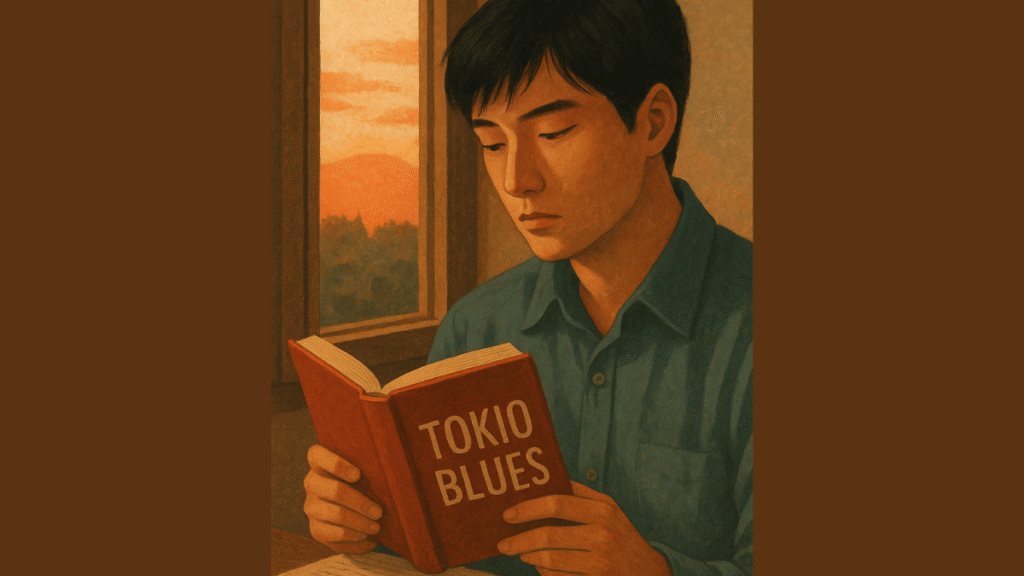
Today I am bringing you Norwegian Wood by Haruki Murakami, a novel that reaches past love and loss into an intimate journey through memory, loneliness, and desire, one that leaves you shaken and thinking for days.
At first I thought it would be one more love story, and it is, though it is also a story about loss, loneliness, memory, and that moment when you realize growing up hurts more than you expected. Murakami has this strange power to write about ordinary things and make them feel enormous. He talks about daily life in a way that gets you thinking about yourself, about what you have been through, about what you keep quiet. In Norwegian Wood he pulls off something very hard, making you hurt and comforting you at the same time.
This post contains affiiate links
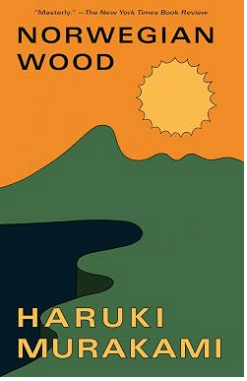
Norwegian Wood is an intimate, melancholy story about love, loss, and loneliness. Through the memories of Toru Watanabe, a college student marked by his best friend’s death, Murakami builds a novel about the passage into adulthood and the fragility of human feeling. In prose that is simple and deeply poetic, he takes us on an inward journey where sadness and beauty blur together on every page.
Who Haruki Murakami is and why he writes the way he does
Before I get to the book, I have to tell you something about him. Murakami is a much loved and very enigmatic Japanese author. He was born in Kyoto in 1949, and before he wrote full time he ran a jazz bar with his wife. I suspect that is why his books sound like a song. They have rhythm, rests, and silences.
He published Norwegian Wood in 1987. He had written before that, and this was the novel that changed his life. It was such an enormous hit that he felt overwhelmed by the fame and left Japan for a while.
Interestingly, this book has none of the magical or surreal elements Murakami is known for. Everything here is real. It is a completely human story with no fantasy in it, and maybe that is why it makes us feel so much.
What Norwegian Wood is about
The story is told by Toru Watanabe, a Japanese man who hears the Beatles song “Norwegian Wood” and finds his whole past coming back to him. Through his memories we get his youth in 1960s Tokyo, a time of change and freedom and also of open wounds.
Toru was seventeen when his best friend, Kizuki, took his own life. That marks him permanently. Years later, in college, he runs into Naoko, Kizuki’s girlfriend, and something deep, quiet, almost painful grows between them. At the same time, Midori shows up, a completely different girl: alive, funny, a little chaotic. She is Naoko’s opposite in every way, the present, life, movement.
So Toru gets stuck between two worlds, Naoko’s, which belongs to the past and to silence, and Midori’s, which hums in the now. The novel lives inside that conflict, between the love that drags you back toward memory and the one that pushes you forward. I could not help being reminded a little of Tengo ganas de ti.
The characters, the faces of a soul
Toru Watanabe
Our narrator, a calm, sensitive kid who is a little lost. He has the way of looking at the world that comes from meeting suffering far too early. He says little and notices everything. I like him because he is not the standard flawless lead, which makes him feel real.
Naoko
Naoko is an open wound. She lives between nostalgia and sadness, trying to work out why everything around her keeps breaking. She cannot find her place in the world, and every time she tries she seems to sink further. She stays with you because she embodies the most fragile part of love.
Midori
Midori is chaos, laughter, contradiction. She says what she thinks, does what she wants, and never apologizes. She is also hiding pain of her own. She is life in its purest form, and against Naoko she stands for whatever keeps going even when everything hurts.
Reiko
Reiko is an older woman living at the same retreat as Naoko. She is the voice of experience, the one who has suffered and still plays the piano. She is the kind of character who reconciles you with the world, because she proves that even when everything falls apart, you can keep breathing.

Memory as an invisible thread
One of the strongest themes in the book is memory. Everything Toru tells us is a recollection: what happened, what he believes happened, what may only exist in his head. That is what makes the story beautiful and sad at once.
Murakami gets you feeling that remembering is not looking back, it is reliving, that every time you think about someone who is gone you are living with them again for a second. Toru does not remember in order to stay in the past. He remembers because it is the only way to understand who he is now.
It got me thinking about how all of us carry our own Norwegian Wood around, those moments that got burned in and come back when we hear a song or walk past a place that is not there anymore.
The loneliness we share
If I had to define this book with one word, it would be loneliness. Not the empty kind, though. The kind you feel even in a room full of people. Murakami gives us characters who are together and never quite reach each other, who talk and never quite listen. He does it so delicately that it almost makes you dizzy, because you recognize a piece of yourself in every silence.
There is a scene where Toru walks alone through Tokyo at night. Nothing special happens, he just walks. You feel like everything is right there, the sadness, the calm, the search for meaning. That way of writing loneliness is what makes Norwegian Wood such a universal story.
The music running through everything
Music is not just a reference in this book, it accompanies every page and every feeling. Murakami has a special relationship with music and it shows. The songs he names are never random. “Norwegian Wood” by the Beatles does not only give the book its title, it holds its whole essence: the nostalgia, the melancholy, what was lost.
While you read you can almost hear the notes, feel that sound carrying you into another time. If you know the song, you know it has something hypnotic about it, exactly like the novel.
Tokyo as another character
The Tokyo in this story is not the one from the commercials or the skyline shots. It is an intimate Tokyo, full of boarding houses, coffee shops, and quiet streets. It is a city that resembles its characters: solitary, beautiful, contradictory.
Murakami makes you feel the city as another presence that breathes and keeps you company. When Toru walks its streets, you walk with him. When he sits down on a bench or steps into a bookstore, you feel like you are right there beside him.
What Murakami teaches us about loving
In Norwegian Wood, loving is not easy or pretty all the time. There are no happy endings and no eternal promises. Loving means accepting pain, acknowledging absences, learning to live with what cannot be changed.
Murakami does not idealize love, he shows it exactly as it is, fragile and contradictory and human. Sometimes loving does not mean staying. Sometimes loving means letting go, even when it hurts. That may be the most valuable lesson in the book, that life keeps going even after love stays behind.
Murakami’s style
Murakami writes slowly. Not in the sense that the story crawls, but in the sense that every word has its own rhythm, its own breath. There are no big twists and no constant action, and something holds you there without your knowing why. His style is clean, almost transparent, and inside that simplicity sits enormous depth. Reading him is like hearing a quiet song on a long night. It stays with you, it wraps around you, and when it ends the silence has weight.
You can find the book on Amazon.
What Norwegian Wood left me with
When I closed the book I sat still. I did not want to start another one or talk to anybody. I felt like I had read something that knew me better than I knew myself.
Norwegian Wood taught me that all of us carry our wounds around, and that there is no correct way to heal them. It reminded me that growing up means losing things, people, versions of yourself, and that there is beauty inside that loss too.
It is a book that gives you no answers and leaves you thinking for days. In the end, that is what I love most about it.
Frequently asked questions about Norwegian Wood
What is Norwegian Wood really about?
Loss, the passage of time, and how love can heal you and destroy you in equal measure.
Is it a sad story?
Yes, though not in a depressing way. It is sad in a beautiful way, the kind that makes you feel alive.
Is it an easy read?
Yes. The prose is simple, the emotions are not.
How old are the characters?
They are around twenty. That is the age when life starts hurting and dazzling in equal parts.
Why is it called Norwegian Wood?
The title comes from the Beatles song that opens the book and sets Toru’s memories going. The song carries the same thing the novel does, a quiet nostalgia for something that cannot be recovered.
Norwegian Wood is not only a story about love or death. It is a portrait of who we are once we run out of answers. It is about silence, about memory, about the people we leave behind and the ones we cannot forget.
If you let it, this book will pull you all the way in. Not because you have lived the same things, but because the sadness and the tenderness it carries belong to everybody.
If you have ever loved somebody you could not save, or felt the past weighing more than it should, Norwegian Wood will speak straight to you. Have you read it? Tell me what it made you feel. It left me with that mix of pain and calm that only good books manage.